
The Ultimate Guide to WhatsApp AI Agents in 2026: Revolutionizing Customer Automation
WhatsApp AI Agents are no longer a “nice-to-have” experiment. In 2026, they are a revenue-critical infrastructure layer for sales, support, and operations across B2B and B2C organizations. If your business still treats WhatsApp as a human-only inbox or worse, a basic rule-based chatbot, you are leaving scalability, data, and money on the table.
This guide is written for founders, CTOs, product leaders, and growth teams who want to deploy LLM-powered WhatsApp AI Agents that actually work in production. Not demos. Not brittle flows. Real agents that understand intent, retrieve knowledge, execute actions via API endpoints, and convert conversations into measurable ROI.
At a Glance: WhatsApp AI Agents (2026)
- Definition: Autonomous, LLM-powered conversational agents operating on WhatsApp via the WhatsApp Business Cloud API.
- Core Tech: Large Language Models, Retrieval-Augmented Generation (RAG), Vector Databases, Webhooks, Secure API Orchestration.
- Primary Use Cases: Sales qualification, customer support, onboarding, order management, internal ops.
- Business Impact: 24/7 automation, global scale, lower CAC, higher LTV.
- Best Practice: Professionally architected agents outperform DIY bots by a wide margin.
Direct Answer: What are WhatsApp AI Agents?
Statement: WhatsApp AI Agents are intelligent, autonomous systems that conduct human-like conversations on WhatsApp using Large Language Models.
Fact: Unlike legacy chatbots, they reason over context, retrieve knowledge from vector databases, and trigger backend actions via APIs.
Citation: Enterprise deployments using LLM-based agents show higher task completion and customer satisfaction compared to rule-based bots.
Introduction: Why WhatsApp AI Agents Matter Now
WhatsApp is the most dominant messaging platform on the planet. Over two billion active users. Near-100% open rates. Real-time intent. From an AI strategy perspective, this makes WhatsApp a high-signal, high-conversion conversational surface.
Yet most businesses still misuse it. They assign human agents to repetitive conversations. They deploy static chatbots that collapse the moment a user goes off-script. Or they avoid automation entirely due to compliance and technical complexity.
WhatsApp AI Agents solve this by combining:
- Neural-network-based language understanding for intent detection and reasoning.
- Persistent conversational memory across sessions.
- Secure integration with CRMs, ERPs, payment systems, and internal tools.
In short, WhatsApp AI Agents turn conversations into infrastructure.
The What & Why: LLM-Powered Agents vs Legacy Chatbots
What Is a WhatsApp AI Agent?
A WhatsApp AI Agent is not a chatbot flow with buttons and canned replies. It is an autonomous conversational system built on top of a Large Language Model, deployed via the WhatsApp Business API or Cloud API, and connected to external knowledge and execution layers.
Core components include:
- LLM Core: Responsible for natural language understanding, reasoning, and response generation.
- RAG Layer: Retrieval-Augmented Generation using vector databases to ground responses in factual business data.
- Tool Calling: API endpoints that allow the agent to perform actions (create tickets, check inventory, book meetings).
- Memory Management: Session-based and long-term memory for personalization and continuity.
Why Legacy Bots Fail
Rule-based bots were designed for a simpler internet. They rely on decision trees and keyword matching. This creates three structural problems:
- Brittleness: Any deviation from expected phrasing causes failure.
- No Reasoning: They cannot infer intent or handle multi-step tasks.
- No Learning: Improvements require manual reprogramming.
LLM-powered WhatsApp AI Agents eliminate these constraints. They generalize across language, handle ambiguity, and operate in probabilistic rather than deterministic space.
Direct Answer: Why replace legacy WhatsApp bots?
Statement: Legacy bots cannot scale with real human language.
Fact: LLM-based agents dynamically interpret intent and context instead of relying on predefined flows.
Citation: Modern conversational AI systems demonstrate significantly higher resolution rates.
Technical Architecture of WhatsApp AI Agents
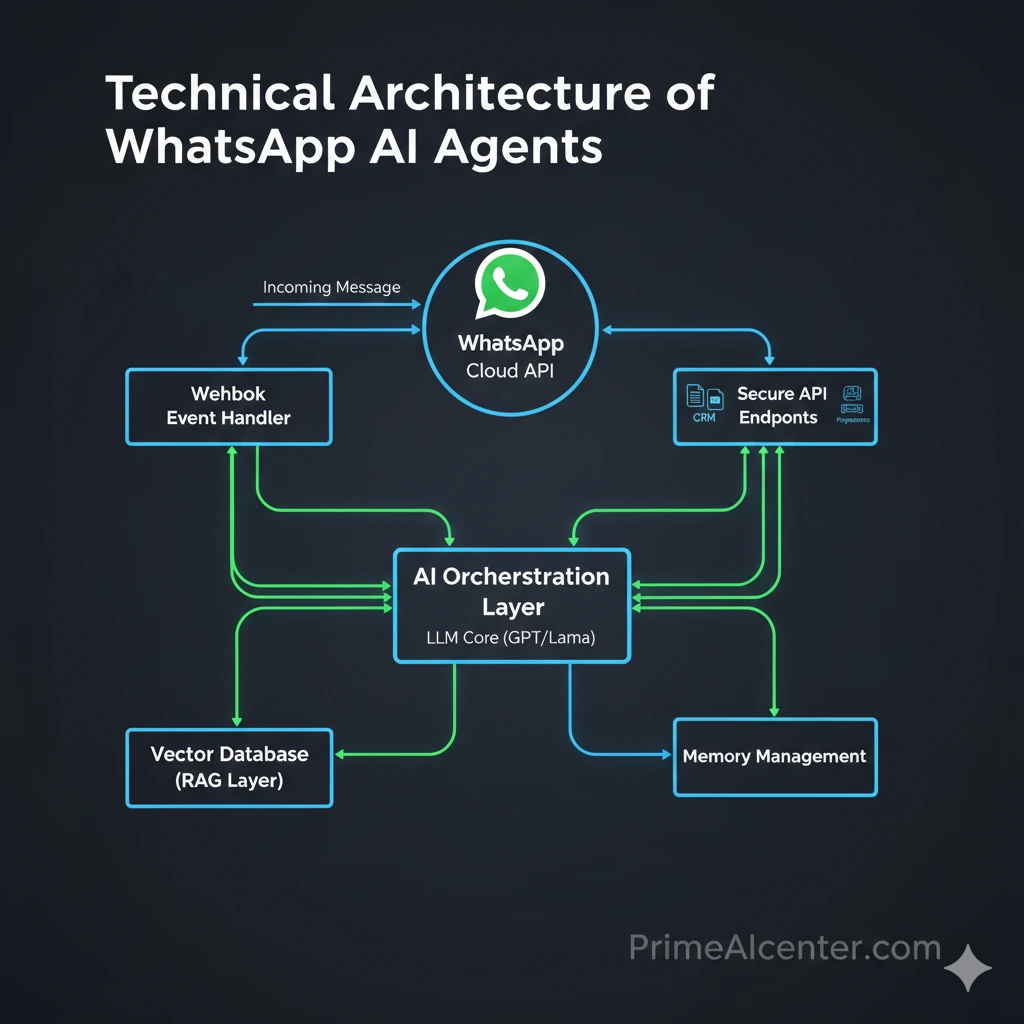
This is where most guides get vague. We will not.
1. WhatsApp Business API vs Cloud API
All serious WhatsApp AI Agents operate through official APIs. There are two primary options:
- WhatsApp Business API (On-Prem or BSP): Greater control, higher complexity.
- WhatsApp Cloud API (Meta-hosted): Faster deployment, elastic scaling.
In 2026, the Cloud API is the default choice for most businesses due to lower operational overhead and native webhook support.
2. Webhooks and Event-Driven Architecture
Incoming messages from WhatsApp trigger webhook events. These events are the entry point into your AI pipeline.
Typical flow:
- User sends message on WhatsApp.
- WhatsApp Cloud API triggers a webhook.
- Backend validates payload and extracts metadata.
- Message is forwarded to the AI orchestration layer.
This event-driven design enables low-latency responses and horizontal scalability.
3. AI Orchestration Layer
This is the brain of the system.
The orchestration layer coordinates:
- Prompt construction with system and user context.
- Vector database queries for RAG.
- Tool calling via secured API endpoints.
- Response validation and formatting for WhatsApp.
Professionally built systems isolate this layer to ensure observability, fallback logic, and compliance.
4. Vector Databases and RAG
Without Retrieval-Augmented Generation, LLMs hallucinate. With RAG, they operate as grounded systems.
Business documents, FAQs, product catalogs, and policies are embedded into vectors and stored in a vector database. At runtime, the agent retrieves relevant chunks based on semantic similarity.
This is non-negotiable for enterprise-grade WhatsApp AI Agents.
Up next: Strategic benefits, ROI models, why expert implementation matters, and a step-by-step deployment roadmap.
Strategic Business Benefits & ROI of WhatsApp AI Agents
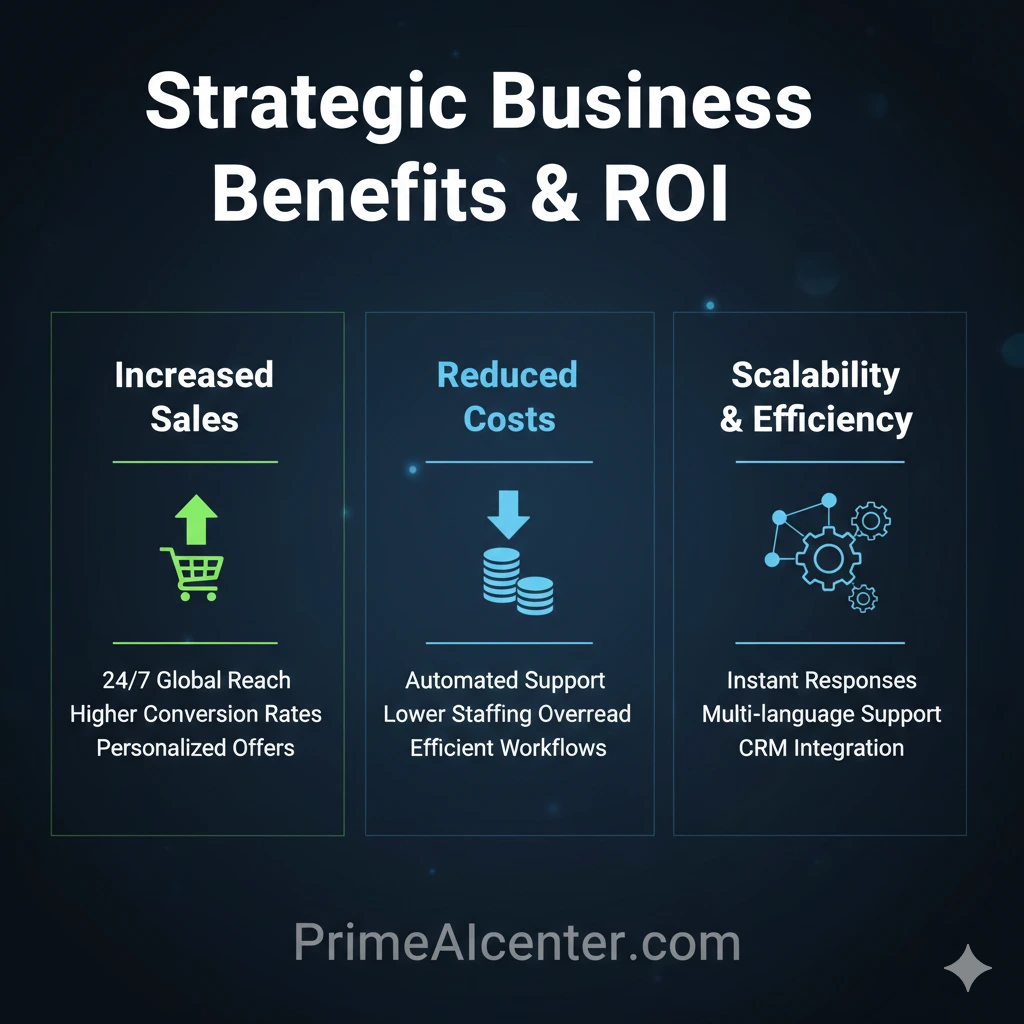
Let’s skip the inspirational fluff and talk outcomes. Businesses do not deploy WhatsApp AI Agents because they are “cool AI toys.” They deploy them because they compress costs, expand revenue capacity, and remove human bottlenecks from high-intent conversations.
Cost Reduction Through Intelligent Automation
Human agents are expensive, slow to scale, and limited by geography and time zones. A properly architected WhatsApp AI Agent replaces a significant percentage of Tier-1 and Tier-2 conversational workload.
- Support Cost Reduction: AI Agents resolve repetitive queries instantly without human escalation.
- Lower Staffing Overhead: One AI Agent can handle thousands of concurrent conversations.
- Operational Efficiency: Automated ticket creation, CRM updates, and order lookups via API endpoints.
From an ROI lens, this is not marginal optimization. It is structural cost compression.
Statement: WhatsApp AI Agents significantly reduce operational costs.
Fact: Automating first-response and routine interactions eliminates the need for large support teams.
Citation: Enterprise conversational AI deployments consistently report lower cost-per-interaction.
Conversion Rate Optimization Inside Conversations
WhatsApp is not email. It is not a landing page. It is a real-time, high-trust channel. AI Agents leverage this by responding instantly, qualifying leads, and personalizing offers at scale.
- Instant Lead Qualification: Neural intent classification determines buyer readiness in seconds.
- Context-Aware Upselling: The agent reasons over user history and product data.
- Abandoned Funnel Recovery: Automated follow-ups triggered by inactivity.
The result is simple: higher conversion without increasing ad spend. Marketing teams love that part.
24/7 Global Sales Without Burnout
Time zones are a tax on human teams. AI Agents do not care.
A WhatsApp AI Agent operates continuously, handling inbound sales inquiries from any geography, in multiple languages, with consistent quality.
- No Downtime: Always-on availability.
- Language Generalization: LLMs natively handle multilingual conversations.
- Consistent Brand Voice: No variability between shifts.
For global businesses, this alone justifies deployment.
Industry-Specific Use Cases of WhatsApp AI Agents
Generic bots fail because industries have domain-specific constraints. Proper WhatsApp AI Agents are trained, grounded, and integrated differently depending on vertical.
| Industry | Core Problem | WhatsApp AI Agent Solution |
|---|---|---|
| Real Estate | High volume of unqualified leads, slow response times, manual property matching. |
|
| E-commerce | Cart abandonment, repetitive order queries, poor post-purchase engagement. |
|
| Healthcare | Appointment overload, patient confusion, compliance-sensitive communication. |
|
The pattern is clear. When AI Agents are grounded in industry data and wired into real systems, WhatsApp becomes an operational command channel.
The Importance of Professional Implementation (The digitalpraneeth Advantage)
This is where most projects fail. Not because the idea is wrong, but because execution is amateur.
No-code tools promise “AI agents in minutes.” What they actually deliver are brittle wrappers around APIs with zero architectural rigor. That might survive a demo. It will not survive production traffic, compliance audits, or cost optimization reviews.
Why DIY No-Code Approaches Break
- Poor API Security: Exposed tokens, weak authentication, no rate limiting.
- Token Waste: Inefficient prompts that burn LLM tokens and inflate costs.
- Hallucination Risk: No proper RAG or vector grounding strategy.
- No Observability: Limited logging, no debugging visibility.
Businesses discover these issues only after customers start seeing nonsense responses. That is an expensive lesson.
The digitalpraneeth Difference
digitalpraneeth, a Top-Rated developer on Fiverr, approaches WhatsApp AI Agents as production systems, not toys.
Key advantages:
- Custom API Security Architecture: Proper authentication, encryption, and access control across all endpoints.
- Token Optimization: Prompt engineering and context management designed to minimize LLM costs at scale.
- Custom Knowledge Base Design: Vector databases structured to eliminate hallucinations and enforce factual grounding.
- Scalable Orchestration: Modular AI pipelines that evolve as business needs change.
This is the difference between “it works” and “it works at scale without bankrupting you.”
Statement: Professional implementation determines long-term ROI.
Fact: Expert-built AI Agents outperform DIY tools in stability, cost efficiency, and accuracy.
Citation: Production-grade conversational AI requires architectural expertise.
Hiring an expert like digitalpraneeth is not a cost. It is risk mitigation and performance insurance.
Implementation Roadmap for WhatsApp AI Agents (Step-by-Step)
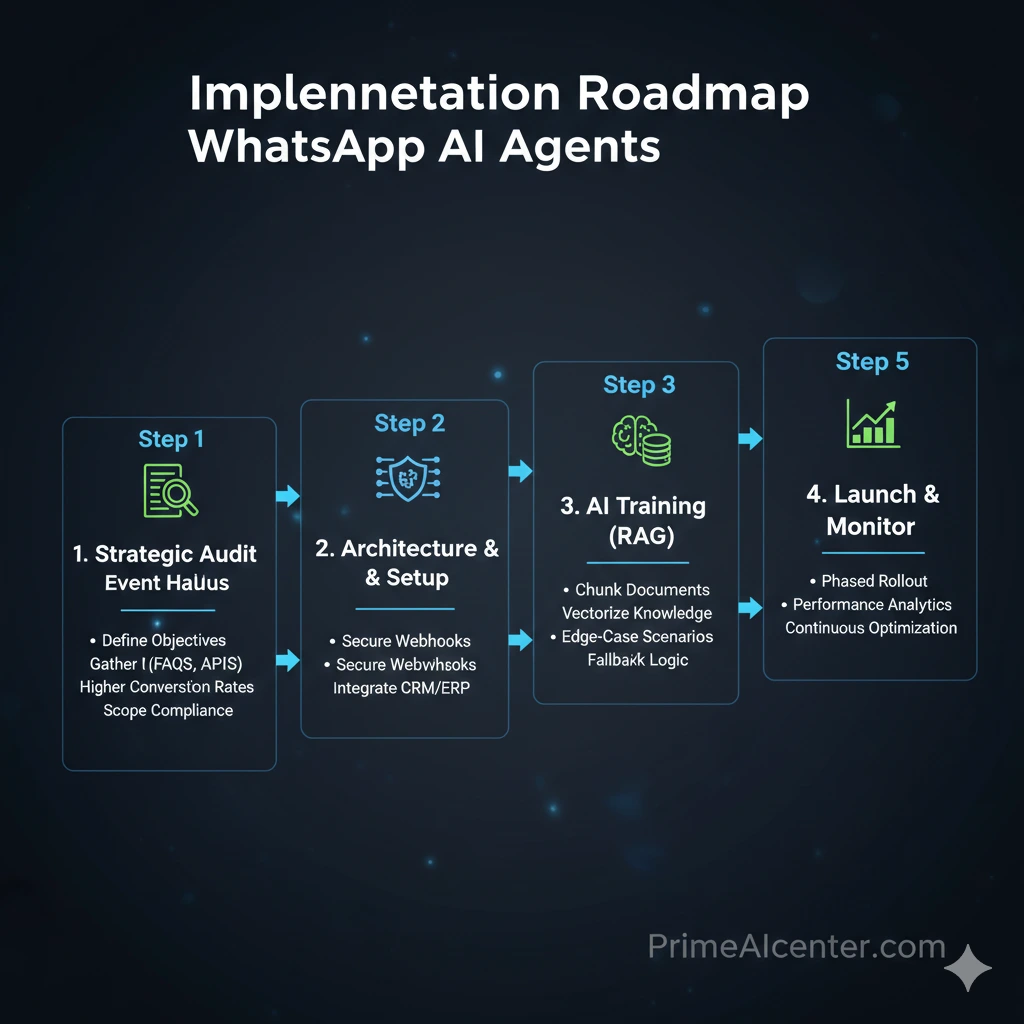
Successful WhatsApp AI Agent deployments are engineered, not improvised. Below is a proven, enterprise-grade implementation roadmap that minimizes risk while maximizing ROI.
Step 1: Strategic Audit & Data Gathering
Every effective AI Agent starts with clarity. This phase defines what the agent should do and what it must never do.
- Conversation Audit: Analyze historical WhatsApp chats to identify high-frequency intents.
- Business Objectives: Sales conversion, support deflection, lead qualification, or all three.
- Data Inventory: FAQs, SOPs, PDFs, CRMs, databases, APIs.
This step determines scope boundaries, compliance requirements, and expected ROI. Skipping it guarantees rework later.
Step 2: Architecture Design & API Setup
This is the backbone of the system.
- WhatsApp Cloud API Configuration: Webhook registration, message templates, business verification.
- Backend Infrastructure: Event-driven services for message intake and response delivery.
- Secure API Endpoints: CRM, ERP, payment gateways, scheduling tools.
Professionally designed architectures isolate the AI layer from messaging logic, ensuring maintainability and scalability.
Step 3: RAG & Knowledge Base Training
This is where intelligence becomes reliable.
- Document Chunking: Breaking content into semantically meaningful units.
- Vector Embeddings: Encoding knowledge into high-dimensional vector space.
- Similarity Search: Real-time retrieval during conversations.
A Custom Knowledge Base ensures answers are grounded in approved business data, dramatically reducing hallucination risk.
Step 4: UAT & Edge-Case Testing
Before launch, the agent must be stress-tested against reality.
- User Acceptance Testing (UAT): Realistic conversations across personas.
- Edge Cases: Ambiguous inputs, mixed languages, incomplete data.
- Fallback Logic: Safe handoff to human agents when confidence drops.
This phase separates production systems from experimental prototypes.
Step 5: Production Launch & Monitoring
Deployment is not the end. It is the beginning.
- Gradual Rollout: Controlled traffic exposure.
- Monitoring & Logging: Conversation quality, latency, token usage.
- Continuous Optimization: Prompt tuning, cost reduction, accuracy improvements.
Well-monitored WhatsApp AI Agents improve over time instead of degrading.
Future Trends in WhatsApp AI Agents (2026–2030)
WhatsApp AI Agents are evolving rapidly. The next phase will redefine conversational commerce and operations.
Voice AI Agents on WhatsApp
Voice messaging is already native to WhatsApp. The next leap is Voice AI Agents capable of understanding, reasoning, and responding via speech.
- Real-time speech-to-text and text-to-speech pipelines.
- Hands-free customer support and sales conversations.
- Accessibility-driven adoption.
Multimodal AI (Images & Video)
Future WhatsApp AI Agents will process images and videos, not just text.
- Image-based product support.
- Document verification via photo uploads.
- Video-based onboarding and tutorials.
Multimodal reasoning turns WhatsApp into a full-service interface.
In-Chat Payments & Commerce Automation
WhatsApp Payments will unlock end-to-end transactional flows.
- AI-guided checkout inside chat.
- Automated invoices and receipts.
- Subscription management and renewals.
This collapses the funnel from discovery to payment into a single conversation.
Conclusion & Call to Action
WhatsApp AI Agents are no longer experimental. They are a competitive necessity.
Businesses that deploy them correctly gain:
- Lower operational costs.
- Higher conversion rates.
- 24/7 global reach.
- Scalable conversational infrastructure.
The real differentiator is not the technology. It is execution.
For organizations serious about building production-grade WhatsApp AI Agents, partnering with a proven expert matters. digitalpraneeth, a Top-Rated developer on Fiverr, delivers custom, secure, and cost-optimized implementations that outperform no-code alternatives.
Next Step: If you want a WhatsApp AI Agent that actually drives revenue and scales safely, schedule a professional consultation with digitalpraneeth on Fiverr and build it right the first time.
Frequently Asked Questions (FAQs)
Will Meta ban my WhatsApp Business account for using AI Agents in 2026?
No, as long as your AI Agent is “Task-Oriented.” According to Meta’s 2026 policy update, AI is fully permitted for specific business functions like customer support, lead qualification, and order tracking. However, “General Purpose” or “Open-ended” AI assistants that just chat without a business purpose are restricted. Using an official WhatsApp Business API provider ensures you stay 100% compliant.
How do WhatsApp AI Agents handle sensitive customer data and GDPR?
Professional WhatsApp AI Agents prioritize data privacy by using “Data Minimization” techniques. They only process the information needed to complete a task. Enterprise-grade setups (like those by digitalpraneeth) use end-to-end encryption and secure API vaults to ensure that conversation data is not used to train public AI models, keeping your business fully GDPR and SOC2 compliant.
Can a WhatsApp AI Agent actually ‘take actions’ like booking or payments?
Yes. Unlike old-school chatbots that only talk, modern AI Agents are “Action-Oriented.” Through Webhooks and API integrations, they can check real-time database inventory, book appointments directly into your calendar (Google/Outlook), and generate WhatsApp In-Chat Payment links to close sales without the customer ever leaving the app.
What is the difference between a Chatbot and an AI Agent?
The core difference is “Reasoning.” A Chatbot follows a fixed decision tree (if the user says X, do Y). An AI Agent uses Large Language Models (LLMs) to understand context and intent. If a customer asks a complex, multi-part question, the AI Agent reasons through the data to provide a human-like response, whereas a chatbot would simply fail or restart the flow.
Is it expensive to maintain an AI Agent on WhatsApp?
It is actually a cost-saving investment. While there are initial setup costs and minor per-message API fees from Meta, a professional implementation focuses on “Token Optimization.” By engineering efficient prompts, an expert can reduce the computational cost of each conversation by up to 40%, making the AI Agent significantly cheaper than hiring a full-time 24/7 support team.