

You’ve heard the word “agent” thrown around so much lately it’s almost lost all meaning. Every chatbot is an agent now. Every automation tool calls itself agentic. And honestly? Most of them don’t deserve the label.
Here’s what’s actually happening. We’ve moved — fast — from passive AI chatbots that answered questions to systems that can do things. Book meetings. Write and run code. Scrape data. Coordinate with other AI systems. Manage workflows across a dozen tools simultaneously. These are AI Agents. And they’re already in production at over half of Fortune 500 companies right now.
The numbers back this up. The global AI agents market hit $10.91 billion in 2026, up from $7.63 billion just a year earlier. Gartner predicts 40% of enterprise applications will embed task-specific AI agents by end of 2026 — up from less than 5% in 2025. That’s not gradual adoption. That’s a warp-speed shift. And 51% of enterprises already have AI agents running in production, with another 23% actively scaling.
Whether you’re a developer evaluating agentic workflow implementations, an architect deciding between frameworks, or a business leader trying to figure out what “multi-agent systems” actually means for your team — this guide gives you the real picture. Architecture, frameworks, protocols, use cases, limitations, and the honest truth about what works and what doesn’t in 2026.
The DNA of an AI Agent: Core Architectural Components

Before we talk frameworks and use cases, let’s get the architecture straight. An AI Agent isn’t just an LLM with a fancier prompt. It’s a system with four distinct layers working together. Most “agents” people build actually only implement two or three of these properly — and that’s usually why they underperform.
Perception: What the Agent Sees
Perception is the agent’s interface with the world. This is where inputs come in, get parsed, and get turned into something the reasoning layer can work with. Modern agents handle a wide range: natural language (queries, emails, documents, conversation history), structured data (API responses, database records, JSON payloads, CSV files), multi-modal inputs (images, audio, video, sensor data), and environmental state signals like system metrics, logs, and monitoring feeds.
The perception layer does more than pass data through. It handles preprocessing, entity extraction, and intent classification. Garbage in, garbage out — this is still the most common cause of poor agent performance. If your agent is hallucinating or doing the wrong thing, the perception layer is usually where to look first, not the LLM itself.
The Reasoning Engine: Where the Thinking Happens
This is the cognitive core — the LLM doing the actual reasoning. But there’s a big difference between calling an LLM API and building a proper reasoning engine. Good agents use structured reasoning patterns:
Chain-of-Thought Prompting
Chain-of-Thought Prompting forces the model to “think step by step” rather than jumping straight to an answer. This technique dramatically improves performance on multi-step reasoning — arithmetic, planning, logical inference. The side benefit: the reasoning becomes auditable. You can see exactly how the agent got to its conclusion, which matters enormously for production deployments where accountability is real.
The ReAct Framework
The ReAct Framework (Reasoning + Acting) is probably the most important conceptual contribution to practical agent design. Instead of treating reasoning and action as separate phases, ReAct interleaves them: think → act → observe → think again. The agent reasons about what it knows, takes an action (uses a tool, calls an API), observes the result, then reasons about the next step. This loop continues until the task is complete or the agent hits a dead end.
In practice, ReAct outperforms pure reasoning approaches on almost every benchmark involving tool use and knowledge retrieval. The key insight: actions generate new information that should update the reasoning, not just execute a predetermined plan. Real tasks rarely play out exactly as planned.
Action: Tool Use, Function Calling, and MCP
This is what separates agents from chatbots. Actions turn reasoning into real-world outcomes. Modern agents operate through function calling — the LLM generates a structured API call, the system executes it, and the result comes back into context. Agents can execute code, query databases, call external APIs, read and write files, trigger workflows, send messages, and provision infrastructure.
In 2026, the standard protocol for tool connectivity is MCP (Model Context Protocol). Originally created by Anthropic in November 2024 and now governed by the Linux Foundation’s Agentic AI Foundation, MCP has become the de facto standard for how AI agents connect to external tools and data sources. By February 2026, it crossed 97 million monthly SDK downloads and was adopted by every major AI provider — Anthropic, OpenAI, Google, Microsoft, Amazon. Over 10,000 active public MCP servers exist today. Think of MCP as the USB-C of AI: one standard interface that works everywhere. Want a deeper breakdown? We have a full piece on MCP vs A2A Protocol worth reading before you design your next agentic system.
What kind of actions are we talking about concretely? API calls to CRM systems, payment gateways, or data providers; SQL queries and database writes; file reading and manipulation; CI/CD pipeline triggers; notification delivery; code execution and calculation. A customer support agent that can only provide information is useful. One that can process refunds, update account records, and escalate with full context? That’s where the real ROI lives.
Memory: Short-Term, Long-Term, and Episodic
Memory is what transforms a stateless API call into something that feels intelligent and consistent over time. AI Agents implement multiple memory types:
Short-term memory (working memory) maintains context within a single session — recent conversation history, intermediate reasoning steps, partial tool results, current task state. Typically implemented through the context window, though advanced agents use attention mechanisms to prioritize relevant information when approaching token limits.
Long-term memory (vector databases) enables retention across sessions. Systems like Pinecone, Weaviate, Qdrant, and pgvector store embeddings of previous interactions, domain knowledge, and user preferences. Through semantic search, agents retrieve relevant past experiences to inform current decisions. A coding agent that remembers your preferred patterns, your project’s conventions, your previous debugging decisions — that’s long-term memory working correctly.
Episodic memory captures specific past task executions and their outcomes. This is what lets an agent learn that a particular approach failed last time and try something different. Most production implementations underinvest in this layer, which is why many deployed agents make the same mistakes repeatedly.
How AI Agents Work: The Observe-Think-Act-Refine Loop

The operational cycle of an AI Agent follows a continuous loop. This is where the “agentic” part actually happens — the iterative, self-correcting behavior that distinguishes agents from one-shot LLM calls.
Step 1: Observe
The agent begins by perceiving its environment. Input reception (capturing the trigger — user query, system event, or scheduled activation), context assembly (pulling relevant information from memory), and state assessment (understanding available tools, current constraints, existing task state). Observation isn’t passive. The agent actively filters and prioritizes information based on relevance to its current goal. This selective attention is what prevents context overload from killing performance.
Step 2: Think
This is where task planning happens. Goal analysis (what actually needs to be accomplished, not just what was asked), task decomposition (breaking complex objectives into manageable subtasks with dependencies), strategy selection (which reasoning patterns and tools are appropriate), and hypothesis generation (formulating candidate approaches). Advanced agents don’t just react — they create structured plans with contingencies and success criteria. The quality of planning directly determines task success rate. Most agent failures can be traced to the Think phase, not tool execution.
Step 3: Act
Execution phase. Tool selection (choosing the right tool for each subtask), parameter preparation (formatting inputs correctly), actual execution (API calls, code runs, workflow triggers), and result capture (recording outcomes for the next reasoning cycle). This is where the distinction between a “wrapper” and a true agent becomes clear. Agents make autonomous decisions about tool sequencing, handle partial failures gracefully, and deviate from initial plans when intermediate results demand it.
Step 4: Refine
The loop closes here. Outcome assessment (did the action achieve what was intended?), error analysis (what went wrong and why?), plan adjustment (update remaining steps based on new information), and learning integration (store useful insights in memory for future tasks). This is what makes agents adaptive. Unlike deterministic software, a well-designed agent can recover from unexpected outcomes, find alternative paths, and improve over repeated executions. The 88% of agentic deployments that fail to reach production typically skip meaningful implementation of this phase.
The Evolution: From Simple Reflex to Autonomous Task-Solvers
AI Agents didn’t appear fully formed. Understanding the evolutionary path gives you a clearer sense of where current systems actually sit and what “autonomous” genuinely means in practice.
Simple Reflex Agents
The earliest architectures: specific inputs mapped to predetermined outputs. No memory, no reasoning, no adaptation. Rule-based chatbots and basic automation scripts are the canonical examples. Fast and predictable in well-defined environments — still used extensively in production for exactly those properties.
Model-Based Reflex Agents
Added internal state representation, letting agents track aspects of the world not immediately visible in current inputs. This enabled handling of partially observable environments and decisions based on context rather than just the immediate trigger.
Goal-Based and Utility-Based Agents
Goal-based agents introduced explicit objective representation — evaluating action sequences based on their likelihood of achieving specified goals. Utility-based agents extended this by comparing outcomes on a continuous scale, enabling optimization across trade-offs. These were necessary precursors to modern agents. Without the ability to reason toward goals and weigh trade-offs, you just have faster rule-following, not genuine agency.
Learning Agents
Feedback-driven improvement through experience. Reinforcement learning, few-shot adaptation, and in-context learning are all expressions of this archetype. Modern LLM-based agents combine all previous types with learned representations from massive training corpora, enabling generalization across novel domains.
The Rise of Autonomous Task-Solvers
The current generation: systems capable of extended, multi-step task execution with minimal human intervention. AutoGPT demonstrated in 2023 that LLMs could function as the cognitive core for genuinely autonomous systems. BabyAGI introduced dynamic task generation — agents that create new objectives based on completed work.
Both projects had real limitations. Loops, wasted tool calls, hallucinated progress. But they proved the concept. What came after — LangGraph, CrewAI, Microsoft Agent Framework 1.0, and the MCP/A2A protocol stack — is what happens when that concept gets engineering discipline applied to it. The tools that are in production today are not AutoGPT. They’re structurally different in ways that matter.
Agentic Frameworks in 2026: LangGraph, CrewAI, and Microsoft Agent Framework 1.0

The framework war is over. By late 2025 the chaos settled into clarity: three frameworks won, the rest consolidated or died. Here’s the honest state of play.
LangGraph (The Production Standard for Complexity)
Important context first: LangChain — the framework that dominated 2023 with 80K+ GitHub stars — publicly shifted its own focus. The team’s message is unambiguous: “Use LangGraph for agents, not LangChain.” LangChain remains excellent for RAG and document Q&A pipelines. For agent orchestration, LangGraph is the recommended successor. The reason is architectural: LangChain’s chain-based model struggles with the cycles, conditionals, and state persistence that complex agent workflows require. LangGraph handles all of that natively.
LangGraph introduces a graph-based architecture where agents are nodes and transitions between them are explicit edges. This gives you cyclic execution (agents revisiting previous steps based on new information), conditional branching (different paths based on intermediate results), state persistence (durable execution that survives interruptions), and built-in human-in-the-loop patterns for high-stakes approval flows.
The latest LangGraph 1.1.x series introduced content-block-centric streaming (version v3), which replaces event dicts with typed per-channel streams — cleaner to consume, easier to debug. The Deep Agents harness (built on LangGraph) ships planning, filesystem access, and sub-agent spawning out of the box. LangGraph is running in production at LinkedIn, Uber, and hundreds of other companies. It integrates with LangSmith for full reasoning-chain observability — which matters because you cannot improve what you cannot see. The learning curve is steep. The ceiling is high. For complex, production workflows requiring auditability, LangGraph is currently the correct default.
CrewAI (The Fastest Path to Role-Based Multi-Agent Systems)
CrewAI is the fastest growing framework in the space and earned that position. The numbers as of 2026: 47.8K GitHub stars, 27 million PyPI downloads (5 million in the last month alone), 2 billion agent executions in the past 12 months, and used by 60% of the U.S. Fortune 500. The platform has been ranked #4 on the 2026 Enterprise Tech 30 Early Stage list by venture capital leaders.
CrewAI’s innovation is the role-based agent model. You define agents with specific roles (Researcher, Writer, Analyst, QA Engineer), assign them to crews, and specify tasks with clear delegation patterns. The framework handles agent collaboration, task sequencing, dependency management, and execution tracking. The 2026 State of Agentic AI survey by CrewAI (500 C-level executives, $100M+ revenue organizations across 7 global regions) found that 100% of surveyed enterprises plan to expand agentic AI use — and 65% are already using it in production. Among those, IT (52%), Operations (44%), Customer Support (39%), and Sales & Marketing (39%) lead in adoption.
One honest caveat: CrewAI’s opinionated structure has a ceiling. Teams building beyond sequential or hierarchical task execution frequently hit constraints 6-12 months in that require rewrites to LangGraph. If your requirements will stay predictable and role-based, CrewAI gets you to production faster than anything else. If you expect complex orchestration needs to emerge, build on LangGraph from the start and avoid the painful migration.
Microsoft Agent Framework 1.0 (The Enterprise Standard for .NET/Azure)
In October 2025, Microsoft merged AutoGen and Semantic Kernel into a unified platform. Microsoft Agent Framework 1.0 reached GA on April 7, 2026 — production-ready with stable, long-term-support APIs. This isn’t just a version bump. The API surface changed. The multi-agent programming model shifted from AutoGen’s conversation-centric design to a graph-based model where agents are nodes with explicit transitions. If you have AutoGen code in production, migration requires real work. The Semantic Kernel migration is gentler — most existing plugins port directly.
What Microsoft Agent Framework 1.0 ships with: sequential, concurrent, handoff, group chat, and Magentic-One orchestration patterns (all supporting streaming, checkpointing, and human-in-the-loop), declarative agent/workflow definition via YAML, MCP support for tool discovery, A2A 1.0 for cross-framework agent collaboration, multi-language support across .NET and Python, native Azure AI Foundry integration, and a browser-based DevUI debugger for visualizing agent execution in real time. For organizations running .NET shops or locked into Azure, this is the clear choice. Native compliance guarantees (SOC 2, HIPAA), formal support contracts, and production SLAs justify the Microsoft ecosystem lock-in for mission-critical deployments. For everyone else, LangGraph or CrewAI depending on complexity level. For a deeper head-to-head on the protocol side, see our guide on MCP vs A2A.
Quick Framework Decision Guide
| Situation | Recommended Framework |
|---|---|
| Complex production workflows, need auditability, long-term scaling | LangGraph |
| Need to ship role-based multi-agent system in <2 weeks, predictable requirements | CrewAI |
| .NET/Azure ecosystem, enterprise compliance requirements | Microsoft Agent Framework 1.0 |
| RAG, document Q&A, retrieval pipelines | LangChain (classic) |
| Research prototyping, experimental multi-agent patterns | AutoGen v0.7.x |
Technical Comparison: Standard LLMs vs. RAG Systems vs. AI Agents
These three paradigms get conflated constantly. Getting the distinction right is essential for making correct architectural decisions.
| Dimension | Standard LLMs | RAG Systems | AI Agents |
|---|---|---|---|
| Core Function | Text generation from training data | Retrieval-augmented generation | Autonomous multi-step task execution |
| Knowledge Source | Static training corpus (cutoff date) | External knowledge bases + training data | Dynamic tool access + memory + live data |
| Reasoning | Single-turn inference | Retrieval + single-turn inference | Multi-step iterative reasoning |
| Action Capability | None (text output only) | Limited (search/retrieve only) | Extensive (APIs, code, workflows, MCP tools) |
| Memory | Context window only | Vector DB for retrieval | Short-term + long-term + episodic |
| Autonomy Level | None (passive response) | Low (follows retrieval pipeline) | High (self-directed goal pursuit) |
| Protocol Support | Not applicable | Limited integration | MCP for tools, A2A for agent coordination |
| Error Handling | None (single attempt) | Limited (fallback retrieval) | Retry, replan, escalate to human |
| Best For | Creative writing, general Q&A, summarization | Document Q&A, knowledge bases, compliance research | Workflow automation, complex problem-solving, business process execution |
| Cost Profile | Predictable (per-token) | Moderate (retrieval + generation) | Variable (iteration and tool call dependent) |
| Observability | Simple (input/output logging) | Moderate (retrieval tracing) | Complex (full reasoning chain — requires LangSmith or equivalent) |
When to Choose Each Approach
Choose standard LLMs when you need straightforward text generation, the domain is well-covered by training data, and no external interaction is required. Content drafting, code explanation, general Q&A — these belong here. Don’t over-engineer with agents when a well-prompted LLM handles the job.
Choose RAG systems when your application requires grounding in specific knowledge bases, answers must be sourced and verifiable, and the knowledge extends beyond training data. Enterprise search, technical documentation Q&A, legal and compliance research — RAG is purpose-built for these.
Choose AI agents when tasks require multi-step execution, interaction with external systems, adaptation based on intermediate results, and autonomous decision-making across multiple tools. Software development workflows, financial analysis pipelines, complex business process automation — agents earn their overhead here.
Real-World Applications of AI Agents in 2026

Theory is useful. What actually ships and generates ROI is more useful. Here’s where agents are delivering measurable results in production today.
Software Engineering
This is where agentic AI has the clearest production track record. Coding agents in 2026 handle requirements analysis (parse natural language specs, generate structured user stories with acceptance criteria), architecture proposals (evaluate trade-offs, generate technical docs), code generation across multiple languages with style-guide adherence, comprehensive test suite generation, CI/CD pipeline creation, and autonomous GitHub issue resolution. The productivity data is now solid: McKinsey reports 6.4 hours saved per knowledge worker per week in production deployments. Forrester’s TEI studies show code review agents completing routine PRs for $0.72 versus $48 of senior engineer time — a 66x cost reduction. Payback period for engineering agent deployments averages 9.3 months. For a detailed look at the best tools in this category, see our breakdown of the best AI coding assistants.
Research and Analysis
Research agents compound human analytical capacity. Literature review automation (searching academic databases, extracting key findings, synthesizing across hundreds of papers), market analysis (continuous monitoring of news, filings, and social signals), competitive intelligence (automated tracking of competitor moves and product launches), and hypothesis generation from pattern detection in data. Research institutions and consulting firms deploy agent teams where specialized agents handle collection, statistical analysis, visualization, and writing in parallel. The throughput gains are substantial — what took a team of analysts weeks can be reduced to hours of compute plus focused human review and verification.
Finance and Trading
Financial applications align well with agentic architectures because they demand exactly what agents provide: precision, speed, multi-source data integration, and deterministic action execution under uncertainty. Deployed use cases include real-time algorithmic trading with autonomous risk management, multi-agent fraud detection systems (pattern recognition + behavioral analysis + alert triage running in parallel), portfolio management (autonomous rebalancing, tax-loss harvesting), regulatory compliance monitoring, and personalized financial planning based on comprehensive client data. Financial institutions report agentic systems processing and analyzing information at 100x the speed of human analysts. AI agents resolve approximately 30% of customer service cases in financial services without any human involvement. Median payback period for customer service agents in this sector is 4.1 months.
Enterprise Automation
This is the biggest deployment surface. Enterprise agents are automating complex business processes that span multiple systems and departments. Customer support (end-to-end ticket resolution including information retrieval, troubleshooting, account updates, and human escalation with full context), HR operations (resume screening, interview scheduling, onboarding coordination), supply chain management (demand forecasting, inventory optimization, supplier coordination), IT operations (incident response, patch management, capacity planning), and sales operations (lead qualification, proposal generation, CRM updates). The 2026 State of Agentic AI survey found 75% of enterprises report high or very high time savings, 69% report significant operational cost reductions, and 62% are seeing revenue generation impact. Enterprises automating at this level report operational cost reductions of 40-60% with simultaneous quality improvements. These aren’t estimates from pitch decks. They’re coming from organizations with agents already in production. The enterprise AI agent deployment guide has more on how to structure these rollouts correctly.
Content Creation and Marketing
Marketing operations agents in 2026 are generating measurable ROI: payback period averages 6.7 months, productivity gains of 3.1x versus manual work. Multi-agent content pipelines handle research, drafting, SEO optimization, internal linking, image briefing, and publishing workflow coordination as a coordinated system — not sequential one-person handoffs. Human-AI collaborative teams demonstrate 60% greater productivity than human-only teams, spending 23% more time on creative work and 60% less on editing. If you’re building content operations on agentic workflows, the GEO optimization principles apply here too — AI-generated content ranking well requires the same trust signals as human-written content. See also our piece on GEO ranking techniques for how to structure this content for AI-driven search.
Challenges, Failure Modes, and What Actually Goes Wrong
88% of agentic AI projects never reach production. That’s the sobering Gartner figure. And even among the 12% that do, only organizations with mature governance generate the 171% average ROI that makes the headlines. Here’s what goes wrong, specifically.
Hallucinations in Agentic Contexts
Hallucinations — confident generation of incorrect information — are more dangerous in agents than in chat applications. In a chatbot, a hallucination gives a user a wrong answer. In an agent, a hallucination can trigger incorrect tool selection, which propagates false assumptions through a multi-step execution chain, which triggers real-world actions with real-world consequences. A hallucinated API response format causes a tool call to fail. A hallucinated data interpretation causes downstream decisions to be wrong. A hallucinated assessment of task completion causes the agent to stop before finishing.
Mitigation strategies: multi-step evaluation architectures (verification agents reviewing outputs before they trigger downstream actions), confidence thresholding with escalation to human review, RAG integration for factual grounding on domain-specific knowledge, and comprehensive testing against historical scenarios before production deployment. Don’t deploy agents on tasks where hallucination consequences are severe without human approval gates on high-stakes decisions.
Prompt Injection and Security Attacks
Prompt injection is the agent-specific security threat that most teams underestimate until they get burned. Attack vectors: direct injection (malicious instructions embedded in user input that override intended agent behavior), indirect injection (malicious content retrieved from external sources — websites, documents, emails — that hijacks agent actions), and tool exploitation (manipulating agents to misuse available tools for unauthorized access or data exfiltration).
By 2028, 25% of enterprise breaches are projected to involve AI agent abuse per Gartner. Only 23% of organizations deploying agents today have agent-specific security frameworks. This is a governance gap that is going to cause serious incidents. Production requirements: input sanitization and validation, output filtering before action execution, principle-of-least-privilege tool access (agents should only have access to exactly the tools they need), human-in-the-loop requirements for sensitive operations, and comprehensive audit logging of all agent actions.
The Production Gap: Why 88% Fail
The organizations reaching production share four characteristics: pre-deployment governance infrastructure, documentation before deployment (not after), baseline metrics captured before pilots start, and dedicated business ownership with accountability for post-deployment performance. The organizations that fail typically did one or more of: prioritized speed over governance, built without a measurable success definition, deployed without observability infrastructure, or failed to do integration testing with their actual enterprise systems.
Integration is the most common technical failure point — 46% of organizations cite integration with existing systems as their primary deployment challenge. MCP helps, but it doesn’t solve the problem of 20-year-old enterprise systems with no API surface. That requires real engineering work that can’t be shortcut.
Human-in-the-Loop: Not Optional for High-Stakes Decisions
Full autonomy is the wrong target for most enterprise applications. The right architecture is calibrated autonomy — agents operating independently within clearly defined boundaries, with human review triggered by specific conditions. Practical HITL patterns: approval gates for high-stakes or irreversible actions, confidence threshold escalation (agent pauses and asks when certainty falls below defined levels), anomaly detection escalation (automatic human notification when agent behavior deviates from expected patterns), and feedback integration (agent learns from human corrections over time).
The balance isn’t fixed — it should evolve as trust in a specific agent’s performance in a specific domain builds over time. Start conservative. Expand autonomy based on observed accuracy, not on theoretical capability.
Ethical and Governance Considerations
Beyond the technical challenges, agents operating autonomously raise questions that require organizational answers before deployment, not during an incident. Accountability: who is responsible when an autonomous agent makes a decision that causes harm? Transparency: how do you ensure agent decision-making is explainable when regulators or customers ask? Employment impact: what is the responsible approach when agents automate roles currently held by people? Data usage: what data should agents have access to, and what logging of their actions is required for compliance?
Only 21% of organizations have a mature governance model for autonomous AI agents today. The companies that build governance infrastructure first and scale agent autonomy second are dramatically outperforming those that did it the other way. This is the most consistent finding across every credible 2026 enterprise AI study.
The Infrastructure Layer: MCP, A2A, and the Agentic Protocol Stack
Here’s something most articles on AI agents still aren’t covering properly: the protocol layer that makes multi-agent systems actually work at scale.
Two protocols have emerged as the foundation of the 2026 agentic stack. They’re complementary, not competing, and you need to understand both if you’re building anything serious.
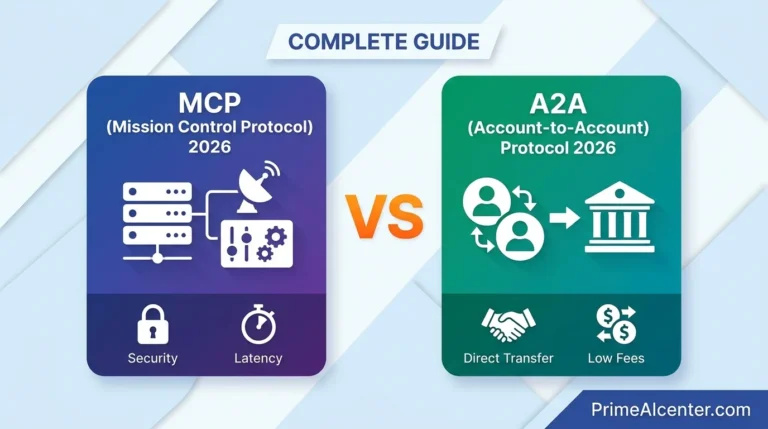
MCP (Model Context Protocol) is vertical: agent to tools. It standardizes how an AI agent connects to external tools, data sources, and services. Created by Anthropic, open-sourced in late 2024, now governed by the Linux Foundation’s Agentic AI Foundation (AAIF) with co-founding members including OpenAI, Google, Microsoft, AWS, and Block. As of early 2026, over 10,000 public MCP servers exist. Every major AI provider has adopted it. Think of it as the standard plugin interface for AI — build an MCP server once, and any MCP-compatible agent can use it.
A2A (Agent-to-Agent Protocol) is horizontal: agent to agent. Where MCP connects one agent to its capabilities, A2A connects multiple agents to each other — including agents from different vendors, running on different frameworks, with different models inside. A2A v1.0 reached formal release in April 2026. IBM’s Agent Communication Protocol (ACP) merged into A2A in August 2025. Both protocols are now under AAIF governance. This matters because it means competing companies have aligned on common infrastructure — which almost never happens and signals genuine long-term staying power.
The practical architecture: MCP for tool access at the individual agent level, A2A for coordination when you have multiple agents that need to work together, and Streamable HTTP as the transport backbone. A production system that routes customer support queries to a front-line agent, which escalates technical cases to a specialized technical agent via A2A, with both agents accessing CRM and knowledge base data via MCP — that’s the 2026 reference architecture. Full breakdown in our MCP vs A2A protocol guide. And if you want to understand how this connects to general web infrastructure for agents, our WebMCP explainer is worth reading.
The Future: Multi-Agent Systems, Agentic Workflows, and What Comes Next

The trajectory is clearer now than it’s been at any point in this technology’s history. Here’s what the next phase looks like based on where production systems are today.
Agent-Native Interfaces Replace Traditional Apps
Traditional applications present fixed interfaces — menus, forms, buttons, workflows designed by developers. Agent-native systems accept goals in natural language, dynamically assemble capabilities based on task requirements, and adapt to individual preferences. The analogy that holds: this is like the transition from command-line interfaces to graphical interfaces. The fundamental interaction model changes, not just the aesthetics. Organizations that have already moved to agent-native workflows for specific processes are seeing the competitive advantage this creates.
Multi-Agent Systems at Enterprise Scale
Single-agent systems held 59% of market share in 2025, favored for simplicity and lower cost. But multi-agent system platforms are projected to reach $391.94 billion by 2035. The shift is being driven by the limits of what a single agent can maintain in context and the efficiency gains from specialization. A multi-agent system where a coordinator routes to specialized agents (one for customer history, one for technical troubleshooting, one for billing) consistently outperforms a single generalist agent trying to do all three. The WhatsApp-native deployment model for business-facing agents is one pattern gaining traction — see our piece on WhatsApp AI agents for that specific use case.
Enterprise Transformation: What the Data Projects
By end of 2026: 40% of enterprise applications embed task-specific AI agents (Gartner). By 2028: 15% of daily work decisions made by AI agents (Gartner). By 2029: 50% of knowledge workers developing new skills specifically for working with, governing, or creating agents (various sources). The global AI agents market reaches $50.31 billion by 2030, growing at 45.8% CAGR from 2025 (Grand View Research). The enterprises automating 31% of their workflows today expect to add another 33% in 2026 alone. That’s not incremental. That’s structural transformation happening on a 24-month timeline.
For the agents powering these deployments, model quality matters — and the frontier is moving fast. The Claude Opus vs GPT vs Gemini comparison and our review of best AI tools for 2026 are good reference points for current model and platform selection decisions.
Who Should Actually Be Building with AI Agents Right Now
Honest answer: not everyone, and not everything. AI agents are not a universal hammer. The organizations generating real ROI from agents share a specific profile.
You should invest in building agentic systems if you have repeatable workflows involving multiple steps and multiple tools, where errors are recoverable and you can implement human review checkpoints. If your team can handle the engineering complexity of production observability (agent systems require significantly more monitoring than standard APIs), if you have clear success metrics defined before deployment, and if you have dedicated ownership — a person accountable for the agent’s performance post-launch.
You should hold off or start smaller if your workflows are genuinely well-served by a well-prompted LLM with no tool use, if you have no observability infrastructure, if governance processes for autonomous AI don’t exist in your organization yet, or if the consequences of errors are severe and the deployment would require near-100% accuracy that current systems can’t reliably deliver.
The 88% failure rate isn’t because the technology doesn’t work. It’s because teams deploy before they’re ready. The 12% in production generating 171% ROI built the infrastructure before scaling the autonomy. That’s the actual lesson from 2025-2026 deployment data.
Conclusion: Agents Are Infrastructure Now
AI Agents have crossed the line from promising technology to production infrastructure. $10.91 billion market in 2026. 51% of enterprises in production. Frameworks with GA status and long-term support commitments. Industry-wide protocol standards under neutral governance. The research phase ended. The deployment phase is well underway.
The architecture is understood: perception, reasoning, action, memory working as a coordinated system through an iterative observe-think-act-refine loop. The frameworks are production-ready: LangGraph for complex orchestration, CrewAI for rapid role-based deployment, Microsoft Agent Framework 1.0 for .NET/Azure enterprise environments. The protocols are standardized: MCP for tool connectivity, A2A for agent coordination. The failure modes are documented: governance gaps, security vulnerabilities, hallucination propagation, integration failures.
What remains is execution discipline. Organizations that build governance before scaling autonomy, that instrument their agents with proper observability, that define success metrics before deployment, and that start with workflows where failure consequences are manageable — these organizations are the ones generating the 171% average ROI. The others are contributing to the 88% failure rate.
The question in 2026 isn’t whether AI agents will transform your industry. That’s settled. The question is whether your organization will be among those leading the deployment curve — or among those still trying to figure out governance after the first production incident.
The tools exist. The frameworks are mature. The protocols are standardized. The ROI data is real. Start with a clear use case, pick the right framework, build observability from day one, and keep humans in the loop for decisions where the cost of error is high. That’s the playbook that works in 2026.
Frequently Asked Questions
What is an AI Agent in simple terms?
An AI agent is a software system that perceives its environment, makes decisions, takes actions using tools (like APIs, databases, or code execution), and remembers context — all in pursuit of a specific goal, with minimal human intervention per step. Unlike a chatbot that responds to prompts, an agent plans, executes, evaluates results, and adjusts its approach iteratively until a task is complete.
What is the difference between an AI Agent and a chatbot?
A chatbot answers questions. An AI agent takes actions. A chatbot responds to what you type and stops there. An AI agent can receive a goal, break it into subtasks, call external APIs, run code, update databases, coordinate with other agents, and complete multi-step workflows — all without you guiding each individual step. The core difference is autonomy and action capability.
What is the best AI agent framework in 2026?
It depends on your requirements. LangGraph is the recommended default for production-grade complex workflows that need auditability and long-term scalability — it’s running in production at hundreds of companies including LinkedIn and Uber. CrewAI is the fastest path to multi-agent deployment for role-based systems with predictable requirements. Microsoft Agent Framework 1.0 (GA April 2026) is the enterprise standard for .NET and Azure environments. There is no universally “best” framework — the right choice depends on your team’s stack, timeline, and workflow complexity.
What is Model Context Protocol (MCP) and why does it matter for AI agents?
MCP is an open standard that defines how AI agents connect to external tools, data sources, and services. Created by Anthropic in November 2024 and now governed by the Linux Foundation’s Agentic AI Foundation, MCP has been adopted by every major AI provider. It eliminates the need to build custom connectors for every tool integration — build one MCP server, and any MCP-compatible agent can use it. As of early 2026, over 10,000 public MCP servers exist with 97 million monthly SDK downloads.
What is the ROI of AI agents for enterprise?
For successfully deployed agents, ROI averages 171% — roughly 3x what traditional automation delivers. McKinsey reports 5.8x ROI within 14 months of production deployment. 74% of executives report positive ROI within the first year. Payback periods range from 4.1 months (customer service) to 9.3 months (engineering). However, only 41% of agent deployments reach positive ROI within 12 months, and 19% never reach payback — which is why governance, clear success metrics, and human oversight architecture matter as much as the technology itself.
Why do most AI agent projects fail to reach production?
88% of agentic AI projects never reach production per Gartner. The primary causes: insufficient governance infrastructure before deployment, unclear ROI metrics, integration failures with existing enterprise systems, lack of observability tooling, and inadequate security frameworks (only 23% of deploying organizations have agent-specific security policies). The organizations that succeed build governance and monitoring before scaling autonomy, not after.
What is the difference between MCP and A2A protocol?
MCP (Model Context Protocol) is vertical — it governs how a single agent connects to external tools and data sources. A2A (Agent-to-Agent Protocol) is horizontal — it governs how multiple agents communicate with each other, including agents from different vendors running on different frameworks. They are complementary, not competing. A production multi-agent system typically uses both: MCP for individual agent tool access and A2A for coordination between agents.
What are the main types of memory in AI agents?
Three types: short-term (working) memory maintains context within a single session — conversation history, intermediate reasoning, partial results; long-term memory uses vector databases (Pinecone, Weaviate, pgvector) to persist information across sessions — past interactions, user preferences, domain knowledge retrieved via semantic search; episodic memory captures specific past task executions and their outcomes, enabling agents to avoid repeating previous mistakes. Most deployed agents underinvest in episodic memory, which limits their ability to improve over time.
What is the ReAct framework in AI agents?
ReAct (Reasoning + Acting) is a design pattern that interleaves reasoning and action in a continuous loop: think about current state → take an action → observe the result → think about what to do next. This is fundamentally different from reasoning first and acting second. ReAct outperforms sequential approaches because actions generate new information that updates the reasoning, rather than executing a predetermined plan that can’t adapt to unexpected results.
How do AI agents handle prompt injection attacks?
Prompt injection involves malicious instructions embedded in inputs or retrieved content that attempt to hijack agent behavior. Defense requires multiple layers: input validation and sanitization before instructions reach the reasoning layer, output filtering before actions are executed, principle-of-least-privilege tool access (agents should only access what they need), separation between trusted system instructions and untrusted external content, human review requirements for sensitive operations, and comprehensive audit logging of all agent actions. This is an active area of security research — no single defense is sufficient on its own.
What industries are seeing the fastest AI agent adoption in 2026?
IT/technology leads with 52% of enterprises reporting meaningful impact from agent deployments, followed by Operations (44%), Customer Support (39%), Sales and Marketing (39%), and R&D (38%). Healthcare is the highest-adoption industry by sector at 68% usage, driven by administrative automation. Customer service and e-commerce show the fastest ROI realization — highest adoption rates with clearest measurable outcomes. Regulated industries like financial services and healthcare move more cautiously on autonomous decision-making but are deploying heavily in support, research, and compliance functions.
What is Human-in-the-Loop (HITL) in AI agent systems?
Human-in-the-Loop (HITL) is the design pattern of keeping humans involved in agent decision-making at specific trigger points rather than allowing fully autonomous operation. Common implementations: approval gates before high-stakes or irreversible actions, escalation when agent confidence falls below defined thresholds, anomaly detection that flags unusual behavior for human review, and structured feedback mechanisms that let humans correct agent decisions and improve future performance. Effective HITL isn’t about limiting agents — it’s about deploying them safely while building the track record that justifies gradually expanding their autonomous authority.
How is Microsoft AutoGen different from Microsoft Agent Framework 1.0?
AutoGen is now in maintenance mode — receiving bug fixes and security patches but no new features. Microsoft Agent Framework 1.0 (GA April 7, 2026) is the successor: a unified SDK that merges AutoGen’s multi-agent orchestration with Semantic Kernel’s enterprise capabilities into a single platform. The multi-agent model shifted from conversation-centric (agents talking in chat threads) to graph-based (agents as nodes with explicit transitions). AutoGen code in production requires migration — there is an official migration guide. For new projects in the Microsoft ecosystem, Agent Framework 1.0 is the correct starting point.