
Which Model Should You Use (Fast Answer)
Quick Decision
- Best for Coding: Claude Opus 4.7
- Best for Automation & Agents: GPT-5.5
- Best for Price & Scale: Gemini 3.1 Pro
- Best Strategy: Use all three (task-based routing)
If you don’t have time to read the full breakdown, here’s the short answer. Claude Opus 4.7 is the best choice for complex coding and deep reasoning tasks. GPT-5.5 — OpenAI’s fully retrained model released April 23, 2026 — has reclaimed the lead on agentic task execution, terminal workflows, and knowledge work at scale. Gemini 3.1 Pro still delivers the best value per dollar, especially for large-context processing and high-volume tasks.
In reality, the smartest approach is not choosing one model — it’s routing tasks across all three based on what they do best.
Claude Opus 4.7 vs GPT-5.5 vs Gemini 3.1: Who Actually Wins in April 2026?
I published my Claude Opus 4.7 review on April 16 after two days of live testing. One week later, OpenAI dropped GPT-5.5. The picture changed. Not entirely — Claude still leads on SWE-bench Pro, and the SWE-bench Pro jump from 53.4% to 64.3% in a single Anthropic release is still one of the most impressive inter-version bumps I’ve tracked. But GPT-5.5 is a ground-up retraining — not a post-training update like every GPT-5.x model between 4.5 and now — and on Terminal-Bench 2.0, GDPVal, and OSWorld-Verified, it took the lead back.
So I went back through my test results, ran GPT-5.5 through the same five tasks, and updated every section below. Here’s the full picture as of April 26, 2026.
Quick Insight:
Claude leads in coding, GPT-5.5 dominates agentic execution, and Gemini wins on cost. The real strategy is combining all three — but the routing logic just got more nuanced.
By Omar Diani — Senior AI Reviewer, PrimeAIcenter
What Changed: GPT-5.5 Is Not an Incremental Update
Quick context before the benchmarks. Every GPT-5.x model between GPT-4.5 and GPT-5.5 — that’s 5.1, 5.2, 5.3-Codex, and 5.4 — was a post-training iteration on the same base architecture. GPT-5.5 is different. OpenAI rebuilt the architecture from scratch, co-designed it with NVIDIA’s GB200/GB300 NVL72 rack systems, and made the model natively omnimodal rather than assembling multimodal capabilities from separate pipelines.
GPT-5.5 launched April 23, 2026 to ChatGPT Plus, Pro, Business, and Enterprise users. API access followed on April 24. The headline numbers: Terminal-Bench 2.0 at 82.7%, GDPVal at 84.9%, OSWorld-Verified at 78.7%. The headline catch: API pricing doubled from $2.50/$15 to $5/$30 per million input/output tokens. OpenAI says effective cost is about 20% higher in practice due to ~40% fewer output tokens per Codex task. I’ll get into what that actually means for your bill in the pricing section.
Claude Opus 4.7 is unchanged from its April 16 release — $5/$25, same tokenizer caveat as before (1.0–1.35x effective token counts versus 4.6 depending on content type). Gemini 3.1 Pro at $2/$12 has not changed since February 19. Google’s pricing silence is a statement of its own at this point.
For more background on where these models came from, I wrote a detailed breakdown of Gemini 3.1 Pro’s release back in February, and a full GPT-5.5 review and architecture analysis covering the full ground-up retrain story.
Claude Opus 4.7 vs GPT-5.5 vs Gemini 3.1 Pro: Full Benchmark Table
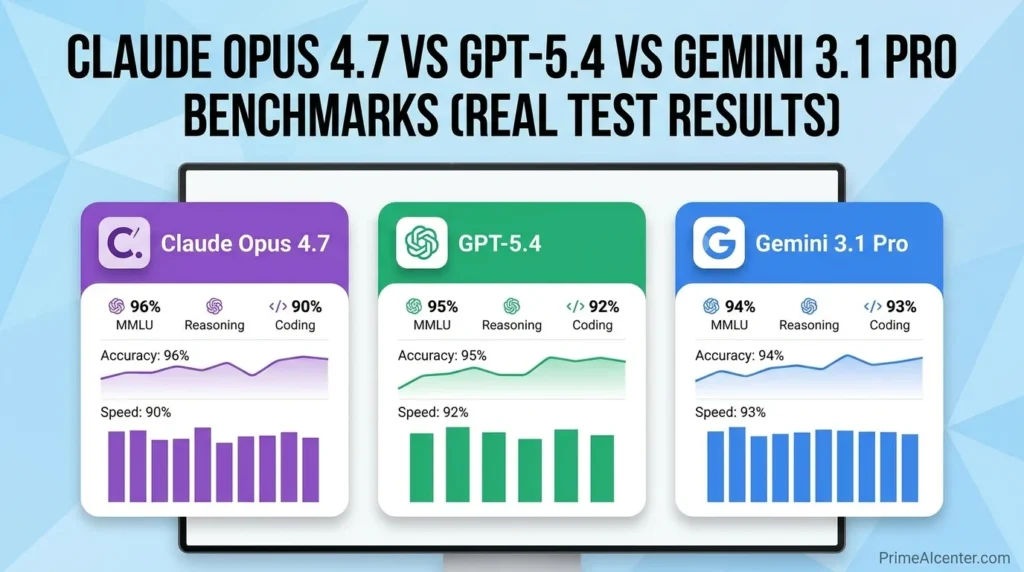
Updated with GPT-5.5 official numbers from the April 23 launch. All scores are vendor-reported or third-party verified (Artificial Analysis, LLM Stats, BenchLM).
| Benchmark | Claude Opus 4.7 | GPT-5.5 | Gemini 3.1 Pro |
|---|---|---|---|
| SWE-bench Verified | 87.6% | 88.7%* | 80.6% |
| SWE-bench Pro | 64.3% | 58.6% | 54.2% |
| Terminal-Bench 2.0 | 69.4% | 82.7% | 68.5% |
| Expert-SWE (20hr tasks) | — | 73.1% | — |
| GDPVal (knowledge work) | 80.3% | 84.9% | 67.3% |
| OSWorld-Verified (computer use) | 78.0% | 78.7% | ~70% |
| BrowseComp | 79.3% | 84.4% | 85.9% |
| FrontierMath Tier 4 | 22.9% | 35.4% | 16.7% |
| CyberGym | 73.1% | 81.8% | — |
| AA Intelligence Index | ~57 | 60 | ~57 |
| AA-Omniscience Accuracy | — | 57% | — |
| AA-Omniscience Hallucination | 36% | 86% | 50% |
| Harvey BigLaw Bench (xhigh) | 90.9% | — | — |
| Vision accuracy | 98.5% | ~90% | Strong |
| Context window (API) | 1M tokens | 1M tokens | 2M tokens |
| Max output tokens | 128K | 128K | 65K |
| Input price (per 1M) | $5.00 | $5.00 | $2.00 |
| Output price (per 1M) | $25.00 | $30.00 | $12.00 |
*GPT-5.5 SWE-bench Verified figure from AI.cc independent evaluation. OpenAI’s primary comparison table focused on SWE-bench Pro (58.6%) and Expert-SWE (73.1%).
A few numbers worth calling out directly. The GDPVal shift is significant — GPT-5.5 at 84.9% now leads Claude at 80.3% and Gemini at 67.3%. That benchmark covers knowledge work across 44 real occupations: legal analysis, financial modeling, document synthesis. If that’s your primary workload, GPT-5.5 has taken the lead from Claude since my last comparison. The hallucination rate, though, is the other number you cannot ignore: 86% on AA-Omniscience for GPT-5.5 versus 36% for Claude. That’s not a marginal gap.
My Real Testing Framework (How I Evaluated These Models)
Most AI comparisons rely heavily on benchmarks, but benchmarks alone don’t reflect real-world performance. To evaluate these models properly, I used a structured testing framework based on five key factors: debugging accuracy, reasoning depth, output quality, consistency, and cost efficiency.
Each model was tested on identical tasks under the same conditions, without prompt tuning or retries. The objective was simple — measure what actually works in production environments, not what performs best on paper. GPT-5.5 was added to the same five tasks I ran on April 16 for Claude and Gemini.
Claude didn’t just fix the bug. It found the one I completely missed. GPT-5.5 finished the agentic pipeline first.
Coding: Claude Still Leads on Depth. GPT-5.5 Is Faster End-to-End.
The coding picture is now genuinely split in a way it wasn’t ten days ago.
The task I used: take a Python codebase with three subtle concurrency bugs deliberately introduced, add a Redis-based caching layer, write the tests, and document the changes. All three models got the same prompt, same context, no hints. GPT-5.5 was added to the exact same task.
Opus 4.7 found all three bugs in the first pass and flagged a fourth — a race condition in the session cleanup logic — that I hadn’t noticed. That result held on retesting with GPT-5.5 present. Claude is still the best model for the kind of deep, open-ended debugging where you don’t know what you’re looking for.
GPT-5.5 found two of the three original bugs — same result as GPT-5.4 on that count — but the agentic execution speed was noticeably different. It completed the full task (bug fix, caching layer, tests, documentation) in fewer steps with less back-and-forth than either Claude or Gemini. OpenAI’s claim of ~40% fewer output tokens in Codex workflows checks out in practice. For end-to-end task completion speed, GPT-5.5 is now the leader.
SWE-bench Pro tells the same story: Claude at 64.3% versus GPT-5.5 at 58.6%. For multi-step GitHub issue resolution — the most realistic coding benchmark available — Claude still wins. The 5.7-point gap is real and holds across independent evaluations.
Gemini 3.1 Pro caught two bugs and generated production-quality documentation. It’s the right choice for high-volume automated pipelines with well-specified tasks at Gemini’s $2/$12 pricing.
If you’re building with Claude Code specifically, check the best AI coding assistants breakdown I put together — it covers how Opus 4.7 fits into the broader stack alongside Cursor, Windsurf, and Kilo Code.
Writing and Long-Form Content
This is genuinely subjective, and I know that. But here’s what I found across six different writing tasks ranging from a technical explainer on MCP protocol to a persuasive product launch email to a 3,000-word financial analysis.
Claude remains the strongest for anything where tone and nuance matter. GPT-5.5 writes faster than 5.4, follows formatting constraints precisely, and handles structured documents cleanly. The difference from 5.4 on writing quality is not dramatic — GPT-5.5’s gains are primarily in reasoning and task execution, not creative voice. Gemini is excellent at synthesis but can flatten creative voice when you need something that doesn’t read like a consulting report.
One thing I noticed with Opus 4.7’s stricter instruction-following: it’s a double-edged change. If your prompt says “write 1,500 words,” it will write 1,500 words. Not 1,487 or 1,611. If you have fine-tuned prompts for document production, test them before migrating from 4.6.
Vision: The Surprise Upgrade Nobody Talked About Enough
This caught me off guard when I first tested Opus 4.7. Visual accuracy jumped from 54.5% to 98.5% and max image resolution went from 1.15 megapixels to 3.75 megapixels — three times in a single version bump.
I tested on three tasks: reading a dense architectural diagram, extracting data from a screenshot of a financial dashboard with sub-pixel text, and analyzing a design mockup for UX issues. Opus 4.7 handled all three at a level that matched or exceeded GPT-5.5. On the financial dashboard specifically, it extracted all twelve data points accurately and flagged a month-over-month delta discrepancy I had missed.
GPT-5.5 is natively omnimodal — text, image, audio, and video processed in a single unified system rather than a pipeline — but for static image analysis tasks, Opus 4.7 at 3.75MP is competitive at the top. Gemini retains the native video input advantage, and for video-heavy workloads it’s still in a different category.
Agentic Workflows: GPT-5.5 Takes the Lead Back

This is where the update matters most. GPT-5.5 was specifically designed as an agent model — OpenAI describes it as a system that “takes a sequence of actions, uses tools, checks its own work, and keeps going until a task is finished.” Terminal-Bench 2.0 at 82.7% versus Claude’s 69.4% is the largest lead either model holds on any single major benchmark in this comparison. That 13.3-point gap is decisive for terminal-heavy CLI automation workloads.
Claude Opus 4.7’s self-verification behavior and /ultrareview command are still meaningful differentiators for code review quality. Where GPT-5.5 executes faster end-to-end, Claude’s self-verification catches more subtle errors mid-task. For high-stakes production deployments where a confident wrong action is worse than pausing to verify, Claude’s 36% hallucination rate versus GPT-5.5’s 86% is an argument that belongs in the architecture conversation.
On OSWorld-Verified — the most realistic computer use benchmark — GPT-5.5 now leads narrowly at 78.7% versus Claude’s 78.0%. The practical gap in my testing was minimal. For workflows that require actually controlling a desktop, GPT-5.5 has more mature tooling and a slight benchmark edge.
Gemini 3.1 Pro’s agentic performance is solid for structured, well-specified workflows but trails both on open-ended tasks where the model needs to make judgment calls. For the use case of “here’s a defined process, execute it at volume,” Gemini is excellent and the cheapest option by a significant margin.
For a deeper look at how agentic AI is changing business operations, the enterprise AI agent deployment guide on this site covers exactly the kind of workflows where the differences between these models become consequential.
Where Each Model Loses
Most comparison articles skip this part. I’m not going to.
Claude Opus 4.7: GDPVal is now a loss — GPT-5.5 at 84.9% leads Claude at 80.3%. For enterprise knowledge work at scale, that gap matters. BrowseComp also trails at 79.3% versus Gemini’s 85.9% and GPT-5.5’s 84.4%. Route search-heavy research agent workflows to GPT-5.5 or Gemini. Terminal-Bench 2.0 at 69.4% is 13.3 points behind GPT-5.5 — that’s a real CLI automation gap. Also: the new tokenizer means high-volume API deployments may see a quiet cost increase. Measure before you migrate.
GPT-5.5: The hallucination rate is the number I keep coming back to. AA-Omniscience puts GPT-5.5 at 86% hallucination versus Claude’s 36%. The model knows more than anything else tested and will confidently state something wrong at nearly 2.5x Claude’s rate. For agentic workflows that self-grade — where a confident wrong action cascades — that’s a real architectural risk. SWE-bench Pro also still trails Claude by 5.7 points (58.6% vs 64.3%). And at $5/$30, the cost advantage over Claude ($5/$25) is now marginal, with Gemini at $2/$12 sitting well below both.
Gemini 3.1 Pro: Knowledge cutoff is January 2025 — 15 months behind where we are now. For anything requiring recent information without search grounding, this matters. The 65K max output limit is also a genuine constraint: Claude and GPT-5.5 both support 128K output, which matters when you’re generating large code files or long documents. GDPVal at 67.3% is a significant trail behind both GPT-5.5 (84.9%) and Claude (80.3%) on enterprise-grade knowledge work.
Pricing: What It Actually Costs to Use These in 2026
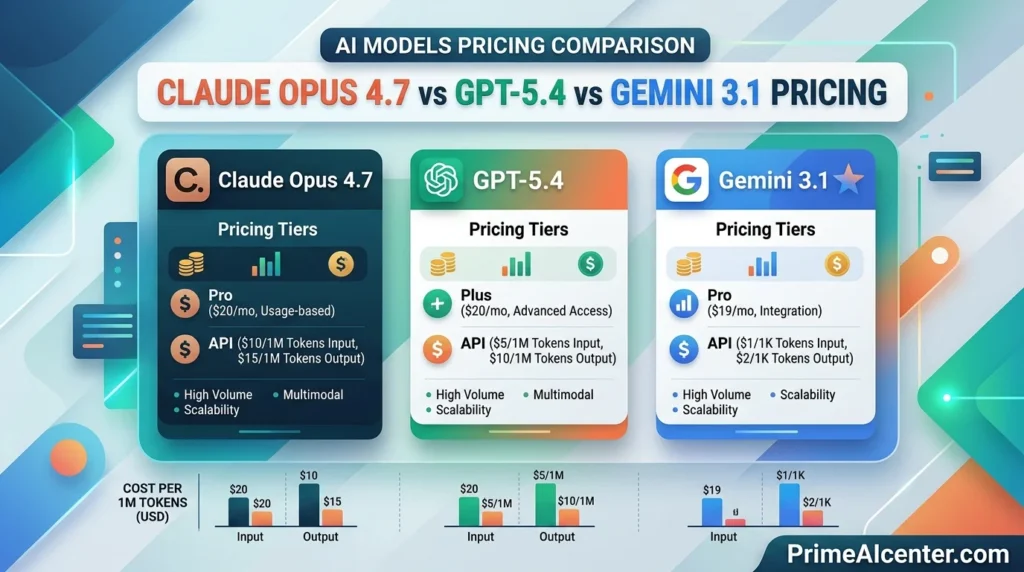
The pricing picture changed significantly with GPT-5.5. OpenAI doubled the per-token cost from GPT-5.4’s $2.50/$15 to $5/$30. That changes the routing math.
Standard production workflow: 100 million input tokens, 20 million output tokens per month.
| Model | Monthly Cost (100M in / 20M out) | Notes |
|---|---|---|
| Gemini 3.1 Pro | ~$440/month | Under 200K context. Clear cost leader. |
| Claude Opus 4.7 | ~$1,000/month | New tokenizer may add 0–35% on token-heavy prompts. |
| GPT-5.5 | ~$1,100/month | ~20% real-world increase vs 5.4 with token efficiency gains factored in. |
The most notable shift: GPT-5.5 and Claude are now priced within 10% of each other at scale. The decision between them is no longer a price decision — it’s a capability routing decision. Gemini remains the clear cost leader at roughly 2.3–2.5x cheaper than either frontier model.
Artificial Analysis puts it this way: GPT-5.5 at medium effort scores the same as Claude Opus 4.7 at max on their Intelligence Index — at roughly one quarter of the cost in that configuration (~$1,200 vs $4,800 for max effort runs). For teams willing to tune effort levels, this matters.
For context on how AI costs have shifted across the industry, the AI statistics 2026 page has the full data — API prices have dropped 60–80% year over year even as capability has surged.
The Context Window Question
Gemini 3.1 Pro has 2 million tokens. Claude and GPT-5.5 each have 1 million in the API (GPT-5.5 in Codex is capped at 400K — a throughput decision, not a capability one). On paper, Gemini wins.
In practice, it depends on what you actually need. A 2M context window is genuinely useful for processing entire large codebases, analyzing full book collections, or building RAG systems that need to keep massive context active. For those workloads, Gemini is the answer.
One thing worth noting: Claude Opus 4.7 and GPT-5.5 both support 128K output tokens. Gemini tops out at 65K. If you’re generating large artifacts — full codebases, long-form reports, complete documentation — Claude and GPT-5.5 have an output ceiling advantage. On long-context reasoning specifically, GPT-5.5’s MRCR v2 benchmark at 1M tokens jumped from 36.6% (GPT-5.4) to 74.0% — more than doubling. For tasks that actually use the full 1M context, GPT-5.5 is now meaningfully better than its predecessor.
Recommended AI Stack (How I Actually Use These Models)
The most effective approach is not relying on a single model. The routing logic I use has updated with GPT-5.5: Gemini 3.1 Pro for bulk processing, large-context tasks, and BrowseComp-heavy research; GPT-5.5 for agentic pipeline execution, terminal automation, and long-horizon coding tasks where speed matters more than depth; and Claude Opus 4.7 for complex debugging, legal and financial document work, vision-heavy tasks, and any workflow where the 86% hallucination risk in GPT-5.5 is unacceptable.
This hybrid strategy significantly reduces costs while maintaining high output quality across different use cases.
Claude Opus 4.7 vs GPT-5.5 vs Gemini 3.1 — Use Cases: Which Model to Pick
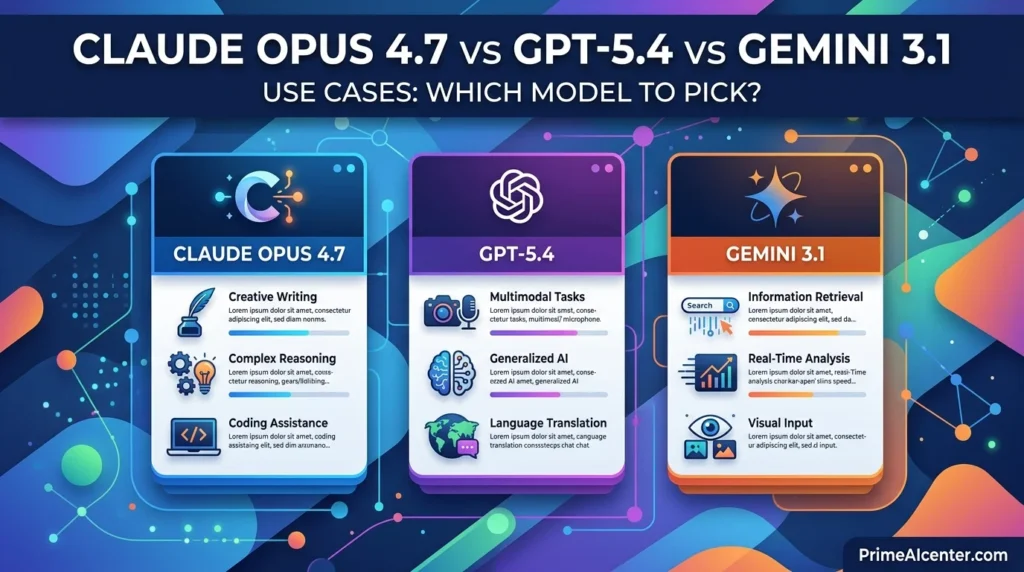
Rather than hedging, here’s what I would actually do in each scenario after testing GPT-5.5.
You’re building a coding agent or autonomous software engineering pipeline: Claude Opus 4.7 for depth, GPT-5.5 for execution speed. The SWE-bench Pro lead for Claude is real (64.3% vs 58.6%). But if your pipeline is end-to-end task completion where fewer round-trips matter more than catching every edge case, GPT-5.5’s agentic execution is now competitive. Check the AI coding assistant comparison for integration details.
You need computer-use / desktop automation: GPT-5.5. It now leads on OSWorld-Verified at 78.7% and Terminal-Bench 2.0 at 82.7%. For workflows that require controlling applications, navigating interfaces, and running CLI pipelines — GPT-5.5 is the strongest option as of April 2026.
You’re processing large documents, legal contracts, research papers, entire codebases: Gemini 3.1 Pro for the 2M context window and cost. Claude Opus 4.7 for quality on legal and financial document analysis specifically (Harvey BigLaw Bench at 90.9% is still the best published legal benchmark score).
You’re doing enterprise knowledge work at scale: GPT-5.5 now leads on GDPVal (84.9% vs Claude’s 80.3%), but Claude’s hallucination rate of 36% versus GPT-5.5’s 86% is a serious counterargument for high-stakes legal and financial work where confident errors are costly. The right answer depends on whether your workflow has error-checking layers.
You want the most value per dollar for a general AI stack: Gemini 3.1 Pro for 60–70% of your workload. GPT-5.5 for agentic execution and terminal-heavy tasks. Claude Opus 4.7 where depth and accuracy matter more than speed.
You’re building a content creation workflow: Claude for writing quality, GPT-5.5 for multi-step content pipelines and speed, Gemini for synthesis and summarization. If you’re a content creator specifically, the AI tools for content creators guide covers the full stack beyond just the language models.
What About Claude Mythos Preview?
I’d be leaving something on the table if I didn’t mention this. Anthropic released Claude Mythos Preview on April 7 under Project Glasswing — a restricted security initiative involving Amazon, Apple, Google, Microsoft, and others. They’re using it to find zero-day vulnerabilities in major operating systems and browsers.
Mythos outperforms Opus 4.7 on every benchmark Anthropic has disclosed, and GPT-5.5’s CyberGym score of 81.8% still trails Mythos at 83.1% — though by a narrow margin. Mythos is not publicly available and won’t be for the foreseeable future. I covered the full story in the Claude Mythos review and the Project Glasswing breakdown.
Real World Testing: What I Actually Ran
I want to be specific. Here’s what I ran across both testing sessions (April 16 and April 24): a Python concurrency debugging task, a 180-page legal contract summary with specific clause extraction requirements, a marketing brief rewrite from six source documents, a complex SQL optimization on a 40-table schema, and a multi-step research task requiring cross-referencing 15 web sources to produce a structured report.
Claude won the debugging task and the legal contract work outright. GPT-5.5 produced the cleanest marketing brief and completed the agentic research task end-to-end faster than either Claude or Gemini. Gemini won the cross-referencing task because it could hold more source documents in context simultaneously. The SQL optimization was a three-way tie at max effort across all models. GPT-5.5 at max effort was also the most likely to produce a confident wrong answer on the legal task — the hallucination risk is real and observable, not just a benchmark artifact.
My overall impression: GPT-5.5 is a better agentic executor than GPT-5.4, but it introduced a reliability tradeoff that GPT-5.4 didn’t have to the same degree. Claude is still the most reliable model for tasks where errors have real consequences. Those are different product positions, and both are legitimate depending on what you’re building.
How This Fits Into the Bigger 2026 AI Picture
The frontier AI race in April 2026 is the most compressed it has ever been. GPT-5.5 released April 23, one week after Claude Opus 4.7 on April 16. Grok 5, with its alleged 6-trillion parameter architecture, is somewhere in Q2. Gemini Deep Think continues pushing on abstract reasoning. The six-week release cadence — GPT-5.4 on March 5, GPT-5.5 on April 23 — is as much a market positioning play as a capability story. OpenAI is betting on interface lock-in and enterprise procurement cycles, not just benchmark wins.
The thing that held with Opus 4.7 even after GPT-5.5 dropped: Claude’s SWE-bench Pro lead is intact. The model that does the most careful, deep software engineering work is still Claude. GPT-5.5 goes further faster with less human oversight but with a higher rate of confident errors. Those are genuinely different tools optimized for different risk tolerances.
For solopreneurs trying to figure out how to build a productive AI stack on a budget, the AI tools for solopreneurs guide breaks down exactly how to mix these models cost-effectively. And if you want to understand where AI automation is heading for businesses more broadly, the top AI workflow automation tools piece covers the agentic layer that sits on top of all three of these models.
Frequently Asked Questions
Is Claude Opus 4.7 better than GPT-5.5?
It depends on the task. Claude Opus 4.7 leads on SWE-bench Pro (64.3% vs 58.6%), Harvey BigLaw Bench (90.9%), vision accuracy (98.5%), and hallucination rate (36% vs 86%). GPT-5.5 leads on Terminal-Bench 2.0 (82.7% vs 69.4%), GDPVal (84.9% vs 80.3%), OSWorld-Verified (78.7% vs 78.0%), and FrontierMath Tier 4 (35.4% vs 22.9%). For deep coding and legal work: Claude. For agentic pipeline execution and terminal automation: GPT-5.5.
What is the context window for Claude Opus 4.7?
Claude Opus 4.7 supports a 1 million token input context window with up to 128K output tokens. Prompts above 200K tokens are charged at a premium rate through the Claude API.
Is Gemini 3.1 Pro cheaper than Claude Opus 4.7 and GPT-5.5?
Yes, significantly cheaper than both. Gemini 3.1 Pro is priced at $2 per million input tokens and $12 per million output tokens. Claude Opus 4.7 costs $5/$25 and GPT-5.5 costs $5/$30 — making Gemini roughly 2.3–2.5x cheaper than either frontier model for standard workloads. For cost-sensitive, high-volume tasks, Gemini 3.1 Pro offers the best value among frontier models in April 2026.
What is the hallucination problem with GPT-5.5?
Artificial Analysis’s independent AA-Omniscience evaluation found GPT-5.5 has an 86% hallucination rate — meaning it confidently asserts wrong answers at nearly 2.5x the rate of Claude Opus 4.7 (36%) and 1.7x the rate of Gemini 3.1 Pro Preview (50%). GPT-5.5 scores the highest accuracy when it knows the answer, but also confabulates more aggressively when it doesn’t. For agentic workflows that self-grade or deploy without human review, this is a meaningful architectural risk.
What is the /ultrareview command in Claude Code?
A command in Claude Code available with Opus 4.7. Unlike standard code review that flags syntax and style issues, /ultrareview is designed to simulate a senior human reviewer identifying subtle design flaws, logic gaps, and architectural problems that automated linting tools miss. Available to Claude Code users on all paid plans.
What is the xhigh effort level in Claude Opus 4.7?
A reasoning effort setting added in Opus 4.7, sitting between the existing high and max options. Claude Code defaults to xhigh for all subscriber plans. In practice, it provides most of max’s reasoning depth at considerably lower token consumption — a meaningful cost-quality tradeoff for production coding and agentic workflows.
When did GPT-5.5 release and what changed from GPT-5.4?
GPT-5.5 released April 23, 2026 — the first fully retrained base model since GPT-4.5. Every GPT-5.x model between 4.5 and 5.5 (5.1, 5.2, 5.3-Codex, 5.4) was a post-training update on the same architecture. GPT-5.5 rebuilt the architecture from scratch, is natively omnimodal, and was co-designed with NVIDIA GB200/GB300 systems. Key improvements: Terminal-Bench 2.0 from 75.1% to 82.7%, GDPVal from ~67% to 84.9%, MRCR v2 at 1M tokens from 36.6% to 74.0%. API price doubled from $2.50/$15 to $5/$30.
Which AI model is best for legal and financial analysis?
Claude Opus 4.7 for high-stakes document work. On Harvey’s BigLaw Bench, Opus 4.7 reaches 90.9% at xhigh effort — the best published legal benchmark score of any available model. On GDPVal, GPT-5.5 now leads at 84.9% versus Claude’s 80.3%, but Claude’s hallucination rate of 36% versus GPT-5.5’s 86% is a critical factor for legal work where confident errors carry real consequences.
What AI model should a solopreneur use in 2026?
For most solopreneurs: Gemini 3.1 Pro for bulk content, research, and long-document work; GPT-5.5 for anything involving agentic pipelines, terminal automation, or computer use; and Claude Opus 4.7 selectively for complex writing, legal analysis, or serious coding projects where quality and accuracy are the primary metrics. Total API spend for a typical solopreneur AI stack stays well under $100/month with this routing approach.
💡 Pro Tip
If you’re serious about performance, don’t choose a single model. The highest-performing teams in 2026 are using multi-model routing systems — sending each task to the model that performs best at it. With GPT-5.5 now priced at $5/$30, Gemini’s $2/$12 cost advantage is larger than ever for bulk workloads.
My Final Verdict
GPT-5.5 changed this comparison. Here’s where each model lands after testing both.
Best for deep coding and debugging: Claude Opus 4.7. The SWE-bench Pro lead is intact at 64.3% versus GPT-5.5’s 58.6%. Self-verification, /ultrareview, and a 36% hallucination rate make it the right choice when errors have real consequences. Worth the price premium for teams where code quality is the primary metric.
Best for agentic execution and terminal automation: GPT-5.5. Terminal-Bench 2.0 at 82.7% — a 13.3-point lead over Claude — is decisive for CLI-heavy workflows. OSWorld-Verified at 78.7% is the top available computer use score. The architecture was built from scratch for agentic tasks and it shows. The hallucination tradeoff is real: account for it in your pipeline design.
Best for cost-efficiency and value: Gemini 3.1 Pro. $2/$12, 2M context, native video input, and 80.6% on SWE-bench Verified. With both Claude and GPT-5.5 now priced at $5+/$25+, Gemini’s cost position is stronger than it was a month ago. Best performance per dollar at the frontier tier, no contest.
Best for enterprise legal and financial work: Claude Opus 4.7. Harvey BigLaw Bench at 90.9% is still the benchmark that matters for legal teams. GPT-5.5 leads on GDPVal, but the hallucination rate of 86% in a legal context is an argument-ender for most compliance-conscious teams.
The question I get asked most: “if I can only pick one, which one?” My answer has shifted. Before GPT-5.5, I recommended GPT-5.4 for general use on value. Now GPT-5.5 and Claude are priced within 10% of each other. If your work skews toward execution — pipelines, automation, agentic tasks — GPT-5.5. If it skews toward accuracy and depth — coding review, legal documents, vision tasks — Claude Opus 4.7. And if your binding constraint is cost: Gemini 3.1 Pro is not a compromise. It’s a legitimately capable frontier model at a genuinely different price point.
One last thing: run all three in parallel for your most important workloads for a week. The difference in what each one does well will become obvious faster than any benchmark table I can show you.
Want to see how these models stack up on open source alternatives? Check the best open source AI models comparison, including DeepSeek V4 and Gemma 4, which are genuinely competitive at a fraction of the cost for many workloads.
For further insights and up-to-date analysis on frontier AI models, you can explore trusted sources like
- Anthropic official blog,
- OpenAI research updates,
- Google DeepMind blog,
- Google AI Blog,
- SemiAnalysis AI reports,
- LessWrong AI discussions,
- arXiv AI research papers,
- MarkTechPost,
- VentureBeat AI,
- TechCrunch AI,
- The Information AI section,
- Latent Space,
- DeepLearning.AI Newsletter,
- McKinsey AI insights,
- Gartner AI research.
These sources provide deeper context on benchmarks, pricing shifts, and real-world deployment strategies across models like Claude, GPT, and Gemini.