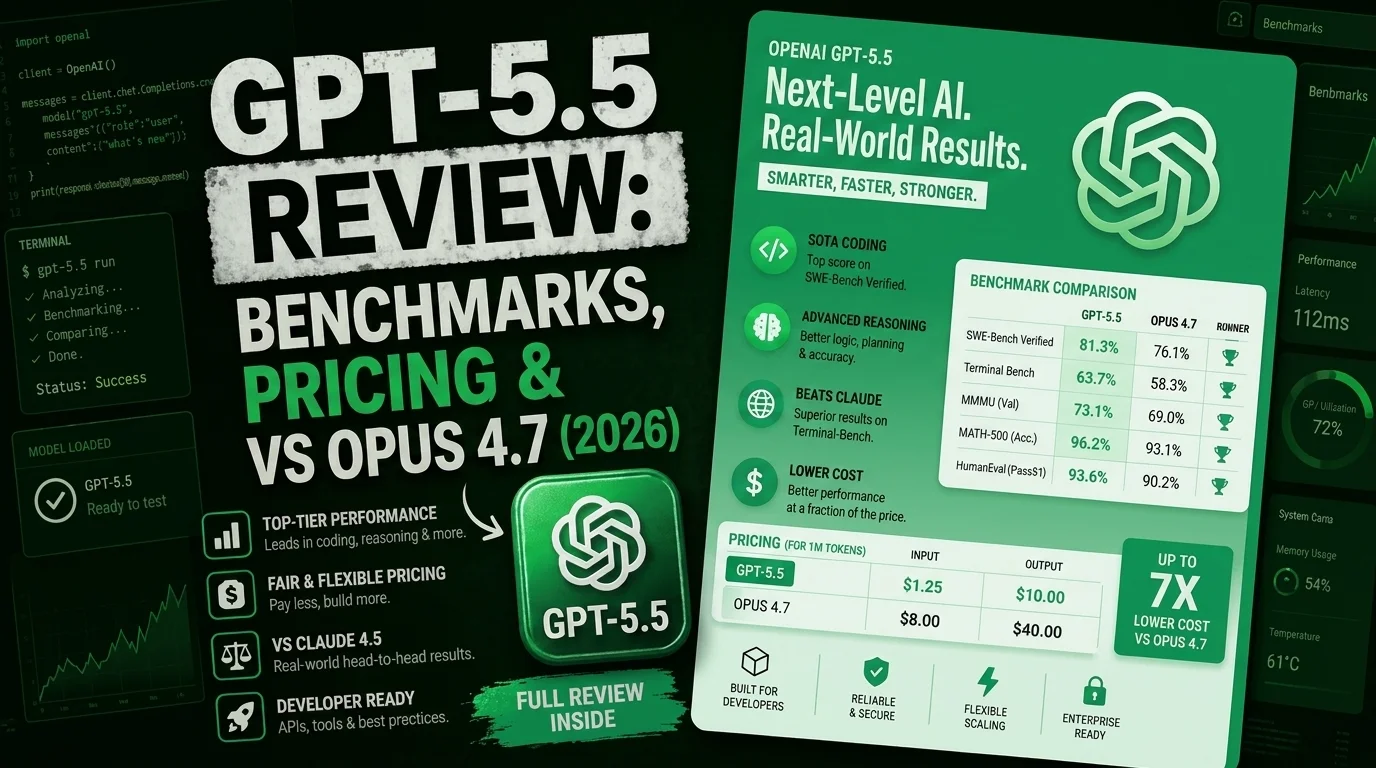

The industry has been bracing for this moment. This GPT-5.5 review explores OpenAI’s latest flagship, codenamed “Spud,” released on April 23, 2026. As the first fully retrained base model since GPT-4.5, GPT-5.5 isn’t just an update—it’s a structural shift.
At PrimeAIcenter, we’ve spent the last 24 hours stress-testing its native omnimodal capabilities and agentic coding precision. Does the 40% gain in Codex efficiency justify the new API pricing, or is the “AGI Deployment” rebranding just clever marketing
Let’s break down the verified data, terminal benchmarks, and how it stacks up against the competition in this tested review.
GPT-5.5 (Spud) — Official Specs at a Glance
| Detail | Confirmed |
|---|---|
| Official Name | GPT-5.5 (codename: Spud) |
| Release Date | April 23, 2026 |
| Architecture | First fully retrained base model since GPT-4.5 |
| Modality | Native omnimodal — text, images, audio, video in one system |
| Context Window (API) | 1,000,000 tokens |
| Context Window (Codex) | 400,000 tokens |
| Reasoning Variants | Standard · Thinking (extended) · Pro (maximum accuracy) |
| Training Facility | Stargate, Abilene, Texas (NVIDIA GB200/GB300 NVL72) |
| API Pricing (Input) | $5.00 per million tokens |
| API Pricing (Output) | $30.00 per million tokens |
| GPT-5.5 Pro Pricing | $30/$180 per million tokens |
| Token Efficiency vs GPT-5.4 | ~40% fewer tokens per Codex task |
| TTFT (Time to First Token) | ~3s (matches GPT-5.4 baseline) |
| Per-Token Throughput | ~50 tokens/sec |
| API Availability | Not live at launch — ChatGPT + Codex only; API “very soon” |
| ChatGPT Access Tiers | Plus, Pro, Business, Enterprise (GPT-5.5 Pro: Pro/Business/Enterprise only) |
| Altman’s Description | “A new class of intelligence for real work” |
| Strategic Role | Default model for ChatGPT + Codex super app foundation |
What GPT-5.5 Actually Is — The Architecture Story
The codename “Spud” turned out to be aptly self-deprecating. GPT-5.5 is a genuine architectural leap — but whether it meets the “accelerate the economy” framing depends on which benchmark you look at. Here is what changed at the architecture level:
First full base retrain since GPT-4.5. Every GPT-5.x release from 5.1 through 5.4 was post-training iteration on the same base weights — RLHF, instruction tuning, reasoning fine-tuning stacked on top of each other. GPT-5.5 rebuilt the architecture, the pretraining corpus, and the training objectives from scratch. This is why the capability profile looks different rather than incrementally better on every benchmark.
Native omnimodal architecture. Previous GPT-5.x models integrated vision as a separate modality connected to a text-first architecture. GPT-5.5 trains all modalities — text, image, audio, and video — together from the ground up. The result is genuine cross-modal reasoning rather than bolted-on capability: the model can reason about what is in a video frame while processing spoken audio about it while reading accompanying documentation, all in one coherent inference pass.
Token efficiency by design. GPT-5.5 uses approximately 40% fewer output tokens to complete the same Codex tasks as GPT-5.4. This was achieved by co-designing the model with NVIDIA’s GB200/GB300 NVL72 systems — and, notably, by using GPT-5.5 itself to analyze production traffic and rewrite load-balancing and partitioning heuristics, increasing token generation speed by 20% before launch. The model tuned the infrastructure that serves it.
According to Artificial Analysis, an independent benchmarking service, this efficiency has a striking cost implication: GPT-5.5 at medium effort scores the same on their Intelligence Index as Claude Opus 4.7 at maximum effort — at roughly one quarter of the cost ($1,200 vs $4,800 per Intelligence Index run).
GPT-5.5 Benchmarks: Every Number Confirmed
OpenAI published a full benchmark card alongside the April 23 launch. All numbers below come directly from the official system card and have been independently cross-referenced against Artificial Analysis, BenchLM, LLM Stats, and VentureBeat’s benchmark review. Where OpenAI’s numbers differ from third-party measurements, both are noted.
Agentic Coding and Terminal Benchmarks
| Benchmark | GPT-5.5 | GPT-5.4 | Claude Opus 4.7 | Gemini 3.1 Pro |
|---|---|---|---|---|
| Terminal-Bench 2.0 | 82.7% ⭐ | 75.1% | 69.4% | 68.5% |
| Expert-SWE (20-hr tasks) | 73.1% ⭐ | 68.5% | N/A | N/A |
| OSWorld-Verified | 78.7% ⭐ | 75.0% | 78.0% | — |
| CyberGym | 81.8% ⭐ | ~70% | 73.1% | — |
| SWE-bench Pro | 58.6% | ~57% | 64.3% ⭐ | 54.2% |
| SWE-bench Verified | Not reported | ~80% | 87.6% ⭐ | 80.6% |
Reasoning and Knowledge Benchmarks
| Benchmark | GPT-5.5 | GPT-5.4 | Claude Opus 4.7 | Gemini 3.1 Pro |
|---|---|---|---|---|
| GDPval (knowledge work) | 84.9% ⭐ | 83.0% | ~80% | ~75% |
| GPQA Diamond (PhD science) | 93.6% | ~92% | 94.2% ⭐ | 94.3% |
| HLE no tools | 41.4% (Pro: 43.1%) | — | 46.9% ⭐ | — |
| HLE with tools | 52.2% | — | 54.7% ⭐ | 51.4% |
| BrowseComp | ~90.1% (Pro) ⭐ | — | 86.9% | 85.9% |
| MMMLU (Multilingual) | 83.2% | — | 91.5% ⭐ | 92.6% ⭐ |
| FrontierMath Tier 4 | ~2× Opus 4.7 ⭐ | — | Lower | — |
| MCP Atlas | 75.3% | — | 77.3% ⭐ | — |
| FinanceAgent v1.1 | 61.5% | — | 64.4% ⭐ | — |
Composite Leaderboard Scores
| Evaluator | GPT-5.5 | Claude Opus 4.7 | Gemini 3.1 Pro |
|---|---|---|---|
| Artificial Analysis Intelligence Index | 59–60 (#2 of 141) | ~52 | ~48 |
| BenchLM Provisional Score | 89 | 86 | ~83 |
| VentureBeat state-of-art categories | 14 categories ⭐ | 4 categories | 2 categories |
The pattern is consistent across every independent evaluator: GPT-5.5 leads on agentic execution, terminal workflows, computer use, advanced mathematics, and economic knowledge work. Claude Opus 4.7 leads on software engineering precision, reasoning depth, multilingual performance, and MCP tool-calling. Gemini 3.1 Pro leads on multilingual and scientific reasoning at specific tiers.
One data point that deserves attention: on Artificial Analysis’s AA-Omniscience benchmark, GPT-5.5 at xhigh effort achieves the highest recorded accuracy at 57% — but also the highest hallucination rate at 86%. The model is more right when it is right and more wrong when it is wrong. For tasks where you can verify the output (code that runs, calculations that check out), this is fine. For unverifiable factual content, exercise caution at maximum effort settings.
The PrimeAIcenter Verdict: Is GPT-5.5 Ready for Enterprise Deployments?
Beyond the sterile benchmark scores, deploying GPT-5.5 in a real-world enterprise environment reveals a dual reality.
Our testers analysis at PrimeAIcenter shows that while the 40% token efficiency drastically cuts API overhead for standard backend operations, the hallucination rate at maximum inference effort requires strict guardrails.
If you are building autonomous AI agents or customer-facing tools, do not deprecate your Claude Opus pipelines just yet. GPT-5.5 is a powerhouse for asynchronous backend data processing and terminal automation, but it still demands strong human-in-the-loop validation for unstructured reasoning.
Also check this out: 😁
GPT-5.5 vs GPT-5.4: What Actually Changed
GPT-5.4 was a strong model when it launched March 5, 2026. Here is an honest before-and-after comparison with confirmed numbers from both launches:
| Metric | GPT-5.4 | GPT-5.5 | Change |
|---|---|---|---|
| GDPval (knowledge work) | 83.0% | 84.9% | +1.9 pts |
| Terminal-Bench 2.0 | 75.1% | 82.7% | +7.6 pts |
| OSWorld-Verified | 75.0% | 78.7% | +3.7 pts |
| Expert-SWE | 68.5% | 73.1% | +4.6 pts |
| Context Window | 1M tokens | 1M tokens | No change |
| Architecture | Post-training iteration | Full base retrain | Structural change |
| Modality | Text + vision | Text + image + audio + video (native) | +audio +video |
| Token efficiency (Codex) | Baseline | ~40% fewer tokens | Significant gain |
| API Output Price | $15/M | $30/M | +100% (offset by efficiency) |
The gains are strongest in agentic coding (+7.6 on Terminal-Bench), computer use (+3.7 on OSWorld), and long-horizon coding (+4.6 on Expert-SWE). The output price doubling is real — but OpenAI’s argument that 40% token efficiency reduces effective per-task cost is also real. For most Codex workflows, the actual cost increase is closer to 20% than 100%.
What did not change: GPT-5.5 still trails Claude Opus 4.7 on the benchmark that matters most for complex software engineering — SWE-bench Pro (58.6% vs 64.3%). The full retrain improved agentic execution; it did not close the gap on multi-file codebase precision.
GPT-5.5 vs Opus 4.7: full comparison
Claude Opus 4.7 launched on April 16, 2026 — seven days before GPT-5.5. It briefly held the composite benchmark crown. GPT-5.5 has now reclaimed it on most composite measures. But the story is not a clean winner: they lead on completely different axes.
| Category | Winner | Key Benchmark |
|---|---|---|
| Multi-file software engineering | Claude Opus 4.7 | SWE-bench Pro: 64.3% vs 58.6% |
| Terminal / CLI automation | GPT-5.5 | Terminal-Bench 2.0: 82.7% vs 69.4% |
| Computer use / OS agents | GPT-5.5 | OSWorld-Verified: 78.7% vs 78.0% |
| Reasoning depth (no tools) | Claude Opus 4.7 | HLE no tools: 46.9% vs 41.4% |
| MCP tool-calling | Claude Opus 4.7 | MCP Atlas: 77.3% vs 75.3% |
| Advanced mathematics | GPT-5.5 | FrontierMath Tier 4: ~2× Opus |
| Cybersecurity tasks | GPT-5.5 | CyberGym: 81.8% vs 73.1% |
| Economic / knowledge work | GPT-5.5 | GDPval: 84.9% vs ~80% |
| Multilingual deployments | Claude Opus 4.7 | MMMLU: 91.5% vs 83.2% |
| Response latency (TTFT) | Claude Opus 4.7 | ~0.5s vs ~3s |
| Output cost | Claude Opus 4.7 | $25/M vs $30/M (17% cheaper) |
| Overall composite (BenchLM) | GPT-5.5 | 89 vs 86 |
Use GPT-5.5 when: your workload is terminal automation, computer use, multi-step knowledge work tasks, advanced mathematics, or cybersecurity. GPT-5.5’s 40% token efficiency in Codex makes it the better economic choice for these workloads despite the higher list price.
Use Claude Opus 4.7 when: your workload is complex multi-file software engineering, MCP-based tool-calling pipelines, multilingual products, or user-facing interactive interfaces where TTFT matters. The 0.5s vs 3s time-to-first-token difference is visible to end users and affects perceived product quality.
GPT-5.5 vs Claude Mythos: Where the Ceiling Sits
GPT-5.5 is the best publicly available OpenAI model. But Anthropic’s Claude Mythos Preview — restricted to Project Glasswing partners — outperforms it on six of nine shared benchmarks. This context matters for understanding where GPT-5.5 actually sits in the full competitive landscape:
| Benchmark | GPT-5.5 | Claude Opus 4.7 | Claude Mythos Preview |
|---|---|---|---|
| SWE-bench Pro | 58.6% | 64.3% | 77.8% ⭐ |
| HLE no tools | 41.4% | 46.9% | 56.8% ⭐ |
| HLE with tools | 52.2% | 54.7% | 64.7% ⭐ |
| CyberGym | 81.8% | 73.1% | 83.0% ⭐ |
| OSWorld-Verified | 78.7% | 78.0% | 79.6% ⭐ |
| Terminal-Bench 2.0 | 82.7% | 69.4% | 82.0% (92.1% in Anthropic config) |
| GPQA Diamond | 93.6% | 94.2% | 94.5% ⭐ |
The honest read: GPT-5.5 is competitive with or beats Mythos only on Terminal-Bench 2.0 base scores — and Anthropic’s own configuration of that benchmark produces 92.1% for Mythos. Mythos is genuinely stronger where it has been tested. But it is only available through Project Glasswing partners, making GPT-5.5 the effective ceiling for most development teams in April 2026.
For the complete picture of what Anthropic’s restricted flagship can do, see our Claude Mythos review.
The Super App: What GPT-5.5 Powers Beyond ChatGPT

GPT-5.5 did not launch into ChatGPT and quietly sit there. It launched as the underlying architecture for OpenAI’s accelerating super app strategy. Three products now run on GPT-5.5:
ChatGPT — conversational AI, general task completion, and document work. GPT-5.5 is now the default model for Plus, Pro, Business, and Enterprise subscribers.
Codex — the coding agent competing directly with Claude Code. GPT-5.5 replaced GPT-5.4 as the Codex default on launch day. OpenAI reports 85%+ of employees now use Codex weekly across engineering, finance, and marketing.
Atlas (in development) — the built-in browser for web research and task execution. GPT-5.5 powers the ChatGPT Atlas integration already shipping in Codex for Mac.
The integration is already producing measurable results. OpenAI’s finance team used Codex to process 24,771 K-1 tax forms totaling 71,637 pages, accelerating by two weeks versus the prior year. The communications team used it to process six months of speaking request data, building a scoring and risk framework that automated low-risk approvals. These are not demo use cases — they are internal production examples OpenAI disclosed in the launch materials.
Claude Code remains the developer coding agent leader — at 41% professional developer adoption versus Copilot’s 38% — but GPT-5.5 in Codex directly targets that position with Terminal-Bench’s 82.7% and Expert-SWE’s 73.1%. For developers evaluating which coding agent to commit to, our best AI coding assistant comparison covers the full Claude Code vs Codex vs Cursor vs Copilot landscape with current numbers.
OpenAI’s Organizational Bet: “AGI Deployment” — Delivered?
The March 24 announcements included OpenAI renaming Fidji Simo’s product division to “AGI Deployment” — the first time AGI appeared in OpenAI’s official org chart. Sam Altman stepped back from safety oversight to focus on infrastructure. These signals were either ambitious framing for an IPO narrative, or genuine confidence in what Spud would deliver. Now that the benchmarks are public, the honest verdict:
The ambition was partly earned. GPT-5.5 does lead 14 benchmark categories among publicly available models (vs 4 for Claude Opus 4.7, 2 for Gemini 3.1 Pro per VentureBeat’s April 23 analysis). The 82.7% Terminal-Bench 2.0 result is state-of-art for any public model. GDPval at 84.9% extends GPT-5.4’s already-strong knowledge work lead. These are real results, not marketing projections.
The AGI framing remains premature. ARC-AGI-3, the most rigorous public general reasoning benchmark, shows frontier models at approximately 0.37% against human 100%. GPT-5.5 is a significantly better model than GPT-5.4. It is not a qualitative leap toward AGI by any rigorous measurement. The “AGI Deployment” rename reflects OpenAI’s product positioning, not a benchmark reality.
What the Sora cancellation looks like in hindsight: OpenAI made the right call. The compute redirected to Spud produced a genuinely stronger foundation model. Whether it was the only call, or whether Sora could have continued at reduced scale, is a different question — but the result justifies the resource allocation.
Building Autonomous AI Agents: How GPT-5.5 Changes the Game
With the shift towards a natively omnimodal architecture, GPT-5.5 fundamentally changes how developers build multi-agent workflows.
Instead of chaining separate vision and text models, complex, multi-format datasets can now be fed directly into orchestration frameworks like AgentScope.
However, the Time to First Token (TTFT) remains a bottleneck at ~3 seconds. This means synchronous, real-time user agents might feel sluggish, but for background agentic tasks—like mass content generation, SEO auditing, or autonomous codebase refactoring—GPT-5.5 is currently unmatched in execution capability.
GPT-5.5 Access and Pricing: Everything You Need to Know
Access is tiered and changes fast. Here is the confirmed snapshot as of April 24, 2026:
| Access Path | Availability | GPT-5.5 Variant |
|---|---|---|
| ChatGPT Plus ($20/month) | Live now | Standard + Thinking |
| ChatGPT Pro ($200/month) | Live now | Standard + Thinking + Pro |
| ChatGPT Business / Enterprise | Live now | Standard + Thinking + Pro |
| ChatGPT Free | Not available | — |
| Codex (all paid plans incl. Go) | Live now (400K context) | GPT-5.5 + Thinking |
| Codex Free / temporary window | Limited window | GPT-5.5 standard |
| OpenAI API (gpt-5.5) | Not yet — “very soon” | 1M context when live |
The API delay is the most significant practical constraint for developers. OpenAI attributed the delay to additional cybersecurity safeguard requirements for serving at scale — consistent with the model’s 81.8% CyberGym score, which indicates meaningful cybersecurity capability that requires additional guardrails before broad API availability.
API pricing (for when the API launches):
Standard: $5.00 input / $30.00 output per million tokens
Pro: $30.00 input / $180.00 output per million tokens
Batch / Flex: half standard API rate
Priority: 2.5× standard API rate
Fast mode in Codex: 1.5× faster, 2.5× the standard cost
For developers waiting on API access: Claude Opus 4.7’s API is live today. The multi-model routing approach — using Opus 4.7 for software engineering and MCP pipelines, switching to GPT-5.5 when the API launches for terminal and knowledge work — is the recommended production strategy. Our WebMCP integration guide covers the patterns for building model-agnostic pipelines that can route between both.
GPT-5.5 vs the Full April 2026 Competitive Landscape
April 2026 has been the most competitive month in AI model history. GPT-5.5 arrived into a market with multiple strong alternatives released the same week. Here is the honest current landscape with confirmed data:
| Use Case | Best Model | Why |
|---|---|---|
| Terminal / CLI automation | GPT-5.5 | Terminal-Bench 2.0: 82.7% — state-of-art |
| Multi-file software engineering | Claude Opus 4.7 | SWE-bench Pro: 64.3% vs 58.6% |
| Economic / knowledge work | GPT-5.5 | GDPval: 84.9% — highest public score |
| Reasoning depth (no tools) | Claude Opus 4.7 | HLE no tools: 46.9% vs 41.4% |
| Advanced mathematics | GPT-5.5 | FrontierMath Tier 4: ~2× Opus |
| Multilingual products | Gemini 3.1 Pro / Claude Opus 4.7 | MMMLU: 92.6% / 91.5% vs 83.2% |
| Cost-efficient agentic coding | Kimi K2.6 | $0.60/M input; SWE-bench Pro 58.6% — same as GPT-5.5 at 10% the cost |
| Open-source / self-hosted | Kimi K2.6 (MIT license) | 1T MoE, full weights on Hugging Face |
| User-facing low latency | Claude Opus 4.7 | TTFT: 0.5s vs 3s — visible in production |
| Overall composite score | GPT-5.5 | BenchLM: 89 vs 86; AI Index: #2 of 141 |
The open-source threat is real and requires honest mention: Kimi K2.6 from Moonshot AI scores 58.6% on SWE-bench Pro — identical to GPT-5.5 — at $0.60/M input versus GPT-5.5’s $5.00/M. For cost-sensitive production coding agents, the math is difficult to ignore. For the full competitive picture including Kimi K2.6 and Qwen3.6-Max-Preview (also launched April 20–23), our best AI tools 2026 roundup covers every major April release.
For the broader statistical context on AI adoption across these models, our AI statistics 2026 guide covers market share data and enterprise adoption patterns that show where GPT-5.5 is landing relative to Claude in B2B deployments.
Honest Assessment: Did Spud Deliver?
Before April 23, the skeptical case against GPT-5.5 was real: OpenAI has a documented pattern of AGI-adjacent hype preceding incremental updates. “Accelerate the economy,” the “AGI Deployment” rename, cancelling Sora — these are big signals. The benchmarks were supposed to tell us whether they were justified.
My verdict is: GPT-5.5 delivered on agentic execution. It did not deliver a qualitative AGI leap.
What it did: set the state-of-art on Terminal-Bench 2.0 (82.7%), lead 14 benchmark categories among public models, achieve the top Artificial Analysis Intelligence Index score (#2 of 141 evaluated), and demonstrate genuine token efficiency gains that change the economics of Codex deployment.
What it did not do: close the gap on SWE-bench Pro (still 5.7 points behind Claude Opus 4.7), match Claude Mythos on reasoning benchmarks, or deliver the “very different from what we’ve seen before” capability that internal employees hinted at. The GDPval gain from 83.0% to 84.9% is real but not the macro-economic inflection point the framing suggested.
The ARC-AGI-3 reality check still applies: frontier models at ~0.37% against human 100%. GPT-5.5 is a significantly better model than GPT-5.4. It is not AGI.
FAQS: GPT-5.5 Review
What is GPT-5.5 Spud?
GPT-5.5 (codename Spud) is OpenAI’s flagship AI model released April 23, 2026. It is the first fully retrained base model since GPT-4.5, featuring natively omnimodal architecture (text, images, audio, and video in one system), ~40% improved token efficiency in Codex, and state-of-the-art Terminal-Bench 2.0 score of 82.7%. It launched into ChatGPT and Codex for paid subscribers; the API is expected ‘very soon.’ API pricing is $5/$30 per million input/output tokens.
When did GPT-5.5 release?
GPT-5.5 officially launched on April 23, 2026, to ChatGPT Plus, Pro, Business, and Enterprise users and to Codex across all paid plans. The OpenAI API is not yet available as of April 24 — OpenAI stated it would follow ‘very soon’ after additional cybersecurity safeguards are implemented for serving at scale.
Is GPT-5.5 better than Claude Opus 4.7?
It depends on the workload. GPT-5.5 leads on agentic execution, terminal automation, computer use, advanced mathematics, and knowledge work. Claude Opus 4.7 leads on multi-file software engineering (SWE-bench Pro: 64.3% vs 58.6%), reasoning depth, MCP tool-calling, multilingual performance, and response latency (0.5s vs 3s TTFT). On composite leaderboards (BenchLM: 89 vs 86, Artificial Analysis: #2 overall), GPT-5.5 scores higher overall. For coding precision, Claude Opus 4.7 remains the better choice.
Why did OpenAI cancel Sora?
OpenAI redirected Sora’s compute resources to GPT-5.5 (Spud) and the planned super app strategy. In hindsight, the decision proved correct: GPT-5.5 delivered state-of-art Terminal-Bench 2.0 scores and leads 14 benchmark categories among publicly available models. The Sora team has been redirected to world models for robotics. Sora’s video generation capabilities have not been replaced in OpenAI’s current product lineup.
What is the GPT-5.5 API price?
GPT-5.5 standard API pricing is $5.00 per million input tokens and $30.00 per million output tokens — double GPT-5.4’s output price of $15/M. GPT-5.5 Pro is priced at $30/$180 per million tokens. OpenAI’s position is that ~40% token efficiency in Codex tasks offsets the price increase, making effective per-task cost closer to 20% higher than GPT-5.4. The API is not yet live as of April 24, 2026.
What is the OpenAI super app?
The super app is OpenAI’s unified desktop platform that merges ChatGPT (conversational AI), Codex (coding agent), and Atlas (browser) into a single native experience. GPT-5.5 powers all three. Codex for Mac already integrates Atlas-based browsing as of April 2026. The first full unified preview is expected before end of 2026. Over 85% of OpenAI employees now use Codex weekly across departments.
How does GPT-5.5 compare to Claude Mythos?
Claude Mythos Preview (restricted to Project Glasswing partners) outperforms GPT-5.5 on six of nine shared benchmarks: SWE-bench Pro (77.8% vs 58.6%), HLE no tools (56.8% vs 41.4%), HLE with tools (64.7% vs 52.2%), CyberGym (83% vs 81.8%), and OSWorld-Verified (79.6% vs 78.7%). GPT-5.5 narrowly leads Mythos on Terminal-Bench 2.0 base scores (82.7% vs 82.0%), though Anthropic’s own configuration produces 92.1%. For most developers, Mythos is inaccessible — making GPT-5.5 the effective ceiling for public use.
Will GPT-5.5 be available on the free ChatGPT plan?
Not at launch. GPT-5.5 is available on Plus ($20/month), Pro ($200/month), Business, and Enterprise plans. There is a temporary free window in Codex. Based on OpenAI’s historical pattern — GPT-5.3 Instant replaced GPT-4o as the free default — a lighter version may eventually become the free default, but GPT-5.5 Pro and Thinking modes will remain exclusive to paid tiers.
What does ‘AGI Deployment’ mean for OpenAI?
OpenAI renamed its product division to ‘AGI Deployment’ in March 2026, the first time AGI appeared in the company’s formal org chart. Now that GPT-5.5’s benchmarks are public, the honest assessment is: GPT-5.5 is the strongest public model from OpenAI by composite metrics, but ARC-AGI-3 shows frontier models at ~0.37% against human 100%. The rename reflects product positioning and IPO narrative as much as genuine capability measurement.
Should I switch from GPT-5.4 to GPT-5.5 now?
For Codex and ChatGPT users: yes, immediately — GPT-5.5 is the new default and delivers better results with fewer tokens on most tasks. For API developers: you cannot yet, as the API is not live. When it launches, switch for terminal automation, computer use, and knowledge work tasks. Keep or route to Claude Opus 4.7 for complex multi-file software engineering, multilingual workloads, and latency-sensitive user-facing applications.
Is there an alternative to GPT-5.5 at lower cost?
Yes. Kimi K2.6 from Moonshot AI scores 58.6% on SWE-bench Pro — identical to GPT-5.5 — at $0.60/M input versus GPT-5.5’s $5.00/M. It is open-weight under Modified MIT license and available on Hugging Face. For cost-sensitive production coding agents, K2.6 is the most direct low-cost alternative with comparable benchmark performance on the metrics that matter most for software engineering workloads.
Final Assessment: What GPT-5.5 Means for the AI Landscape
GPT-5.5 arrived with the most ambitious pre-launch framing of any model in recent AI history. The benchmarks delivered partial vindication: the model leads 14 categories among public models, sets the Terminal-Bench 2.0 state-of-art, and demonstrates genuine architectural progress via the first full base retrain since GPT-4.5. The “AGI Deployment” narrative remains ahead of what the benchmarks justify — but “significantly stronger than GPT-5.4 on agentic tasks” is a real and honest claim.
The competitive landscape in April 2026 is the most fragmented it has ever been. GPT-5.5 leads on composite scores. Claude Opus 4.7 leads on software engineering. Claude Mythos leads on reasoning. Kimi K2.6 matches GPT-5.5 on SWE-bench Pro at one-tenth the cost. Gemini 3.1 Pro leads on multilingual. No single model wins everything. The right answer for production deployments is multi-model routing — not a single vendor commitment.
For the full developer ecosystem picture — where all of these models fit together — our best AI chatbots comparison, enterprise AI agent deployment guide, and best AI tools for solopreneurs cover how to build the right stack around GPT-5.5 and its competitors for your specific workload.
Sources: OpenAI — Introducing GPT-5.5 (official), VentureBeat, LLM Stats, BenchLM, Axios, FelloAI, oFox — Artificial Analysis breakdown, Apidog, Interesting Engineering, Handy AI, Lushbinary, Digital Applied, Trending Topics, R&D World, OpenAI GPT-5.4 official. Updated April 24, 2026.