
AI Statistics 2026: 120+ Verified Data Points Every Business Leader Needs Right Now
I’ve spent the last three years tracking AI statistics obsessively. And I’ll be honest — even I wasn’t ready for what happened in 2026.
Q1 2026 delivered $300 billion in AI venture funding in a single quarter. That’s more than the total global VC deployed in any full year before 2019. ChatGPT crossed 900 million weekly active users. Anthropic hit a $30 billion run-rate in April. Google’s AI Overviews now appear on roughly 48% of all tracked search queries. The agentic AI wave officially arrived — and 80% of enterprise apps shipped in Q1 now embed at least one AI agent.
These aren’t projections. They’re live data.
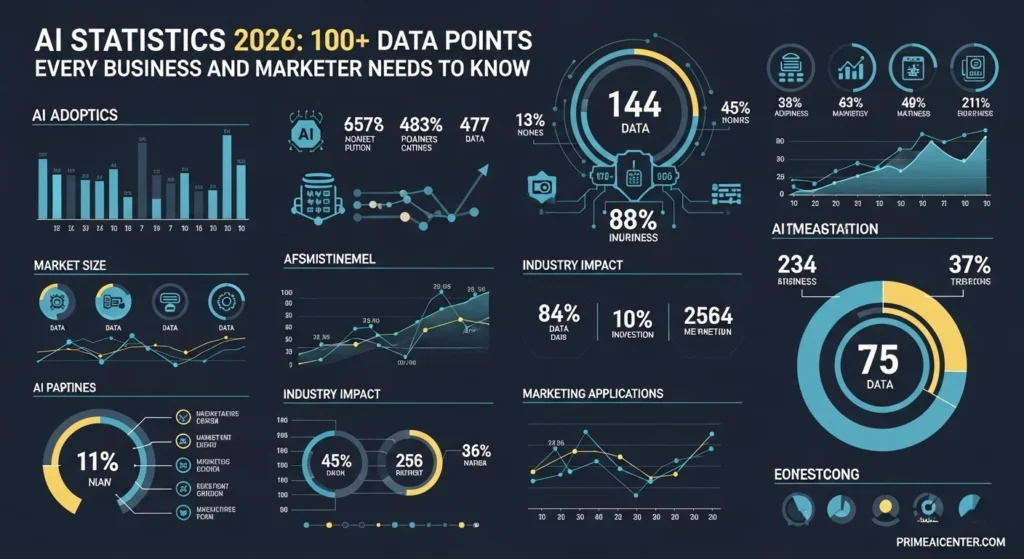
This guide compiles 120+ verified AI statistics for 2026, sourced from Stanford HAI, Gartner, McKinsey, Deloitte, NVIDIA, Forrester, Crunchbase, KPMG, Morgan Stanley, IDC, and primary reports from OpenAI, Anthropic, and Google. I organized them into ten categories so you can find exactly the numbers your decision requires — whether you’re building a business case for AI investment, benchmarking adoption rates, or figuring out why your search traffic is doing something weird.
Every stat is sourced. Where figures conflict — and they do — I explain why.
What surprised me most writing this update: the Stanford HAI 2026 AI Index found that employment for software developers aged 22 to 25 has fallen nearly 20% since 2024 — and the number of organizations expecting workforce reductions due to AI jumped to one in three. That’s not a prediction. That’s already happening. And nobody’s talking about it enough.
TL;DR — AI Statistics 2026 at a Glance
| Metric | Figure | Source |
|---|---|---|
| Global AI market size (software) | $514.5 billion | Statista / Resourcera |
| Global AI corporate investment (2025) | $581.7 billion (+130% YoY) | Stanford HAI 2026 |
| Q1 2026 global venture funding | $300 billion (all-time record) | Crunchbase |
| ChatGPT weekly active users | 900 million | OpenAI, February 2026 |
| ChatGPT daily prompts processed | 2.5 billion | OpenAI |
| OpenAI annualized revenue | $25 billion+ | Multiple sources, Feb 2026 |
| Anthropic run-rate revenue | $30 billion | Reuters, April 2026 |
| Companies using AI in one function | 88% | McKinsey State of AI 2025 |
| Enterprise apps with AI agents (Q1 2026) | 80% | Gartner |
| Young developer employment drop (22–25) | -20% since 2024 | Stanford HAI 2026 |
| AI Overviews query coverage | ~48% of queries | BrightEdge, Feb 2026 |
| Claude enterprise coding market share | 54% | Menlo Ventures, Dec 2025 |
AI Market Size and Investment Statistics 2026
Market size figures vary significantly depending on whether a source counts only software, or folds in hardware and infrastructure. Both are legitimate. Here’s the full picture.
- The global AI market generated $514.5 billion in software revenue in 2026 — up 19% from $390.9 billion in 2025. (Resourcera, citing Statista)
- A broader estimate including hardware and services places the 2026 global AI market at $757.58 billion. (AIStatistics.ai)
- Global corporate AI investment hit $581.7 billion in 2025 — up 130% from the prior year. Private investment alone reached $344.7 billion, with generative AI capturing nearly half. (Stanford HAI 2026 AI Index)
- The US AI market is $83.2 billion in 2026, representing 16.2% of global AI revenue. It’s projected to reach $207.1 billion by 2030 at a 25.6% CAGR. (Resourcera)
- The global AI market is projected to grow at a 30.6% CAGR between 2027 and 2033, reaching $3.5 trillion. Statista forecasts $1.675 trillion by 2031 — a 17.7× expansion in a decade. (Resourcera)
- AI could contribute up to $15.7 trillion to the global economy by 2030 — more than the current combined output of China and India. Of that, $6.6 trillion comes from productivity gains and $9.1 trillion from consumption side effects. (PwC)
- Hyperscaler AI capex hit $400 billion in 2025 and is projected to exceed $500 billion in 2026. (Goldman Sachs)
- Worldwide AI spending is on track to reach $632 billion by 2028, fueled by nearly 30% compound annual growth. (IDC)
- By 2028, generative AI will account for 32% of total AI investment, up from 17.2% today. GenAI spending is forecast to reach $202 billion by 2028 at a five-year CAGR of 59.2% — nearly double the broader AI market’s 30% growth rate. (IDC)
- 86% of companies say their AI budgets will increase in 2026. Nearly 40% plan increases of 10% or more. (NVIDIA State of AI Report 2026)
- The AI governance market — still small but fast-growing — is projected to reach $5.8 billion by 2029 from $890 million in 2024, a 45% annual growth rate. (MarketsandMarkets)
- Total worldwide AI spending is forecast by Gartner to exceed $2 trillion in 2026, rising to $3.3 trillion by 2029 at a 22% CAGR. (Vention / Gartner)
For a hands-on breakdown of the tools driving this market, see our 30 Best AI Tools 2026 guide — every major category with real pricing and benchmarks.
Q1 2026 AI Investment Surge: The Numbers That Rewrote the Record Books
The market size figures above are impressive. What happened in Q1 2026 alone makes them look modest. This is the full picture from Crunchbase’s Q1 2026 Global Venture Report.
- Global startup investment reached $300 billion in Q1 2026 — up 150%+ year-over-year and the highest single quarter in venture capital history. (Crunchbase)
- 80% of Q1 2026 venture funding went to AI companies — $242 billion out of $300 billion. The previous record was 55% in Q1 2025. (Crunchbase)
- Four of the five largest venture rounds ever recorded closed in Q1 2026: OpenAI ($122B at $852B valuation), Anthropic ($30B at $380B valuation), xAI ($20B), and Waymo ($16B). Together they represent 65% of all Q1 global venture funding. (Crunchbase)
- US companies raised $250 billion — 83% of global venture capital in Q1 2026, up from 71% in Q1 2025. (Crunchbase)
- The Crunchbase Unicorn Board added $900 billion in value in a single quarter — the largest valuation bump ever recorded. (Crunchbase)
- Organizations project an average of $186 million in AI spending over the next 12 months — nearly double last year’s figure. 74% say AI will remain a top investment priority even in a recession. (KPMG Global AI Pulse, March 2026)
- AI agent scaling is moving fastest in Asia-Pacific (49% of organizations actively scaling agents), followed by the Americas (46%) and EMEA (42%). (KPMG)
- Morgan Stanley estimates $2.9 trillion in global data center construction costs through 2028 — driven by AI compute demand that “vastly exceeds supply.” AI is expected to contribute approximately 25% of US GDP growth in 2026. (Morgan Stanley)
- Tech layoffs reached 142,000 in 2026 as profitable companies including Meta, Amazon, and Oracle cut jobs to fund a combined $700 billion AI infrastructure buildout. (Tech Times, May 2026)
To understand which models are driving this capital concentration, see our comparisons of GPT-5.5, the Claude Mythos breakdown, and our open-source AI models guide — where the cost-performance frontier is shifting fastest.
ChatGPT and OpenAI Statistics 2026
ChatGPT is still the most-used AI product on the planet. But the story in 2026 is more complicated than it was last year. Market share is eroding. The consumer-enterprise split is widening. And the competition has gotten genuinely serious.
Users and Traffic
- ChatGPT crossed 900 million weekly active users as of February 2026 — more than double the 400 million reported in February 2025. (Demand Sage)
- ChatGPT recorded 5.51 billion monthly website visits in April 2026. It processes over 2 billion prompts per day and over 2.5 billion prompts per day on peak days. (Demand Sage)
- ChatGPT is one of the top five most-visited websites globally, with year-over-year traffic growth of 48.67% — the highest of any site in the global top ten. (AI Business Weekly)
- Despite its scale, ChatGPT’s US mobile app market share has now fallen below 40% for the first time in Q2 2026 — driven by Claude, Gemini, and specialized apps stealing ground. (FatJoe, May 2026)
- ChatGPT holds approximately 62.5% of the B2C subscription market for AI tools, down from its previous ~80%+ dominance. (Backlinko)
- 92% of Fortune 500 companies now use OpenAI’s generative AI. (Second Talent)
- ChatGPT has over 1.44 billion lifetime mobile downloads and over 50 million paying subscribers across all tiers. (Demand Sage)
- In May 2026, GPTBot overtook ClaudeBot to become the third-largest AI web crawler on Cloudflare’s network (11.48% vs 9.73% of AI bot traffic) — after being behind in April. (TechnologyChecker, June 2026)
Revenue and Business Performance
- OpenAI’s annualized revenue exceeded $25 billion by February 2026, generating roughly $2 billion per month. It targets $29.4 billion for full-year 2026. (Backlinko)
- OpenAI closed its latest funding round at $122 billion in committed capital on March 31, 2026, at a post-money valuation of $852 billion. (FatJoe)
- ChatGPT has over 50 million paying consumer subscribers and over 9 million paying business users — a figure that grew 4x in under six months. (GetPanto)
- OpenAI plans to grow from 4,500 to 8,000 employees by end of 2026. It crossed 1 million business customers in November 2025. (GetPanto)
How People Actually Use ChatGPT
- 49% of ChatGPT usage is asking questions, 40% is getting work done (writing, coding), and 11% is exploring ideas. (OpenAI study of 1.5 million conversations)
- Users spend an average of 12 minutes and 34 seconds per web session on ChatGPT. (Backlinko)
- 43% of US knowledge workers use AI on the job. 79% of developers use ChatGPT in their work. (AmplifAI)
- ChatGPT only enables its web search feature on about 34.5% of queries — meaning most responses still rely on training data. Significant room to grow here. (FatJoe)
For a head-to-head breakdown of how GPT stacks up, see our GPT-5.5 Instant review and the full Claude vs GPT vs Gemini comparison.
Competing AI Platform Statistics 2026
Anthropic / Claude — The Enterprise Story
This is where the data gets genuinely interesting. Claude is smaller than ChatGPT by consumer metrics. But in enterprise, it’s winning.
- Anthropic raised $30 billion in February 2026, valuing the company at approximately $380 billion post-money. Reuters then reported the company’s annualized run-rate reached $30 billion in April 2026 — after Google committed to investing up to $40 billion. (GetPanto / Reuters)
- Anthropic’s revenue growth is unprecedented in enterprise software: $1 billion ARR (start of 2025) → $5 billion (August 2025) → $9 billion (December 2025) → $14 billion (February 2026) → $30 billion (April 2026). 10x annual growth sustained for three consecutive years. (AI Business Weekly)
- Anthropic holds 40% of enterprise LLM spend, with OpenAI at 27% and Google at 21%. (SQ Magazine, citing Menlo Ventures December 2025)
- Claude holds 54% of the enterprise coding-model market vs OpenAI’s 21% — the widest single-vendor lead of any LLM workload category. (SQ Magazine)
- 70% of Fortune 100 companies use Claude. Eight of the Fortune 10 are Claude customers. Anthropic serves 300,000+ business customers. Large accounts (over $100K annually) grew nearly 7x in the past year. (AI Business Weekly)
- Claude Code reached $2.5 billion in annualized run-rate revenue by February 2026 — more than doubling since January. It launched publicly in May 2025 and hit $1 billion ARR by November 2025, faster than any enterprise software product in history. (AI Business Weekly)
- Notable enterprise deployments: Deloitte (470,000 staff), Cognizant (350,000 staff), Accenture (30,000 employees trained).
- Claude’s estimated web MAU stands at around 18.9 million, with additional millions using mobile and enterprise APIs. Claude traffic grew 190% among AI search referrals in March to April 2026. (GetPanto)
For a detailed look at Anthropic’s most advanced model, see our Claude Mythos preview and the Claude Opus 4.7 review. For coding specifically, the Claude Cowork enterprise features breakdown shows what’s actually landing in production teams.
Google Gemini
- Google Gemini surpassed 750 million monthly active users as of Q4 2025. (AI Business Weekly)
- Google AI Overviews powered by Gemini reach approximately 2 billion monthly users inside Google Search. AI Overviews now appear on approximately 48% of all tracked search queries as of February 2026. (SQ Magazine / BrightEdge)
- Google’s AI Mode has reached 100 million monthly active users in the US and India — though only 6-8% of AI Mode sessions result in a visit to an external domain. (Exposure Ninja)
- Gemini serves 120,000 enterprise customers and processes 85 billion monthly API requests. It holds approximately 10.6% of measurable B2B AI referrals. (Goodie, May 2026)
- Google maintained over 90% conventional search market share one year after launching AI Overviews — rivals remain approximately one-tenth of ChatGPT’s traffic. (SQ Magazine / BrightEdge)
Perplexity AI
- Perplexity has approximately 45 million monthly active users by late 2025 / early 2026, more than doubling from 22 million at the start of 2025. It processes ~50 million weekly queries. (Digital Applied)
- Perplexity’s user base grew 800% year-over-year. It holds 7.3% of measurable B2B AI referrals and delivers an 18–22% CTR on cited sources — materially higher than Google AI Overviews. (Goodie / Digital Applied)
- Perplexity is valued at $20 billion and has committed $400 million in planned investment in India for 2026. (AI Business Weekly)
For how to optimize your content to appear in all these AI surfaces, see our GEO Optimization guide, our GEO Ranking Techniques for 2026, and our deep dive on how to rank in Claude search results.
AI Adoption Statistics by Business and Industry 2026
Overall Business Adoption
- 88% of organizations regularly use AI in at least one business function — up from 55% in 2023. But only 39% report enterprise-level EBIT impact from generative AI specifically. (McKinsey State of AI 2025)
- 70% of organizations now use generative AI in at least one business function. China and Europe posted the highest year-over-year increases. (Stanford HAI 2026)
- Only 8% of companies globally are considered AI front-runners — organizations with measurable competitive advantage. (Resourcera, citing Accenture)
- Businesses report an average return of $3.70 for every $1 invested in generative AI. 74% of companies are already seeing ROI from at least one generative AI project. (Elementor)
- A MIT NANDA study — based on 52 executive interviews, 153 leader surveys, and 300 public AI deployments — found that 95% of generative AI pilots delivered no measurable P&L impact. The contrast between adoption stats and impact stats is where most organizations are still stuck. (SQ Magazine / MIT)
- Despite its investment leadership, the United States ranks just 24th globally in AI adoption at 28.3%, behind Singapore (61%) and the UAE (54%). (Stanford HAI 2026)
By Industry — Adoption Rates
- Healthcare: Over 70% of organizations are implementing or testing generative AI. 100% of healthcare payer CIOs report AI and ML will be embedded in their systems by 2026. (Vena)
- Retail: 64% of large retailers have adopted AI; 22% more are exploring it. 90% of UK retailers are exploring AI agents. (AIStatistics.ai)
- Telecom: Nearly 90% of telecom companies regularly use AI in at least one business function. 52% use AI chatbots for customer service. (AIStatistics.ai, citing McKinsey)
- Marketing and Sales: 42% of departments now use generative AI regularly — rising to 55% in technology companies. 75.7% of digital marketers rely on AI tools. (LoopexDigital)
- Software Development: Nearly 95% of developers use AI to generate or fix code. Stack Overflow’s 2025 survey: around 84% use AI tools in workflow, 51% use AI daily. (Tenet)
- Enterprise (1,000+ employees): 76% report active AI usage. Just 2% say they do not use AI at all. (NVIDIA)
- Banking: The AI banking market alone is projected to reach $34.58 billion in 2026. AI agents in production in banking and insurance lead all industries at 47%. (Digital Applied)
Implementation Challenges — What’s Actually Blocking Progress
- 53% of businesses cite data privacy as their top AI challenge. 56% report high integration complexity. 66% say establishing clear ROI metrics is a major challenge. (Elementor)
- 51% of organizations using AI have experienced at least one negative consequence — roughly one-third cite inaccuracy as the specific issue. (McKinsey)
- Only 1 in 5 companies (21%) has a mature governance model for autonomous AI agents — meaning 80% of organizations deploying agents are doing so without proper oversight infrastructure. (Azumo, citing Deloitte 2026)
For practical guidance on these challenges, see our Enterprise AI Agent Deployment guide and our AI agents in production breakdown.
AI Productivity Statistics 2026
The productivity numbers are where the business case becomes most concrete — and most honest. I’m including the study that found AI can actually slow things down, because it matters.
- Workers using generative AI save 5.4% of their work hours weekly — a 33% productivity gain for every hour spent using AI tools. (AmplifAI)
- Daily generative AI users report productivity gains at 92% versus only 58% of less frequent users. Frequency of use is the single biggest predictor of benefit. (AmplifAI)
- Professionals write 40% faster with ChatGPT as a co-writer, quality remaining equal or better. (MIT Sloan)
- Developers using AI for code completion and debugging work 55% faster. Programmers completed 126% more projects per week. (GitHub and Microsoft Research)
- Workers’ throughput of daily tasks increased by 66% when using AI tools — equivalent to 47 years of natural US productivity gains compressed into current AI deployment. (Vena)
- Marketing teams are 44% more productive with AI, saving an average of 11 hours per week. Teams using AI for content have achieved 113% increases in blog output and 40% increases in website traffic. (LoopexDigital)
- GenAI will boost productivity by up to 4.7% economy-wide by 2026, adding $200–340 billion in annual revenue across sectors. (GloriumTech, citing Goldman Sachs)
- Companies deploying ChatGPT Enterprise achieve an average 4.1x return on investment within 6 months. (Forrester TEI)
The critical caveat: A 2026 METR study on experienced open-source developers found that those using AI on complex tasks took 19% longer, even while believing they worked faster. AI amplifies capability on routine tasks. It creates false confidence on complex ones. This distinction matters more than any headline productivity stat. (Elementor)
The estimated US consumer surplus from AI tools reached $172 billion annually by early 2026, up from $112 billion a year earlier — with the median value per user tripling. Most of these tools are free or near-free. (Stanford HAI 2026)
AI Marketing and SEO Statistics 2026
- 68% of marketers use AI, but only 17% have received comprehensive, job-specific AI training. 32% report receiving no formal AI training whatsoever. (LoopexDigital)
- Organizations that invest in employee AI training report 43% higher success rates in deploying AI projects. (LoopexDigital)
- AI-powered campaign management delivers 20–30% higher ROI compared to traditional methods. Organizations see sales ROI improve 10–20% on average, with leading companies achieving 1.5x higher revenue growth over three years. (LoopexDigital)
- AI personalization increases conversion rates by up to 10% in e-commerce. AI-powered product recommendations can increase average order value by up to 369%. (LoopexDigital)
- Marketing job listings requiring AI skills increased by 71%, with AI-proficient professionals commanding 20–30% salary premiums. (LoopexDigital)
- AI marketing spend is growing at a 36.6% CAGR globally. A 12% increase in martech spend is projected for the rest of 2026. (LoopexDigital)
- Netflix generates $1 billion annually from AI-powered personalized recommendations — and 80% of everything people watch on Netflix is driven by AI recommendation models. (GloriumTech)
AI Search and SEO — The Traffic Shift Nobody’s Talking About
This is where I’d focus most of my attention right now. The click-through data has changed more in the last six months than in the previous three years.
- AI Overviews appear on approximately 48% of all tracked search queries as of February 2026, per BrightEdge. Organic click-throughs have fallen nearly 30% since the AI Overviews launch — even as Google holds over 90% conventional search share. (SQ Magazine / BrightEdge)
- Zero-click rates: 34% on standard Google Search, 43% on queries with an AI Overview, and a staggering 93% in Google’s full AI Mode. (Sedestral)
- AI referral traffic converts at dramatically higher rates: ChatGPT (15.9%), Perplexity (10.5%), Claude (5%), and Gemini (3%) — versus approximately 2.8% for traditional organic traffic. (Position Digital, citing Ahrefs 2025)
- ChatGPT Search processes 250–500 million weekly queries. Combined with Perplexity, Google AI Mode, and Copilot, AI-mediated queries now represent a structural category that didn’t exist four years ago. (Digital Applied)
- Measured B2B AI referrals breakdown (March–April 2026): ChatGPT 62.6%, Claude 18.5%, Gemini 10.6%, Perplexity 7.3%, Copilot ~4%. ChatGPT lost 27 percentage points from its October 2025 dominance of 89.1%. (Goodie Research, May 2026)
- 3 out of 4 Americans use AI search tools weekly. 17% of consumers now turn to generative AI to discover new products. (AI Rank Lab)
- Adding schema markup produced no measurable uplift in AI Overview citations — schema has no meaningful impact on AI visibility. The optimization strategies that matter are different. (Position Digital)
Appearing in AI-generated answers is now as strategically important as traditional search ranking — and the optimization methods are completely different. Our GEO Optimization guide covers the full framework. For the WebMCP approach to making your site AI-readable, see our WebMCP tutorial.
Agentic AI Statistics 2026 — The Most Important Section
The shift from AI that responds to AI that acts — autonomously, across multiple steps, with real-world consequences — is the defining enterprise technology story of 2026. The numbers are both more impressive and more sobering than the headlines suggest.
- 80% of enterprise applications shipped or updated in Q1 2026 embed at least one AI agent, per Gartner — up from 33% in 2024. The decision is no longer whether to deploy agents, but which workflows justify the overhead. (Digital Applied / Gartner)
- Only 17% of organizations have actually deployed AI agents to date, yet more than 60% expect to do so within two years — the most aggressive adoption curve among all emerging technologies measured in Gartner’s 2026 CIO survey. (Gartner, April 2026)
- 31% of enterprises have at least one AI agent in production — banking and insurance lead at 47%, healthcare and government trail at 18% and 14% respectively. (Digital Applied)
- Gartner predicts 40% of enterprise applications will include task-specific AI agents by end of 2026, up from less than 5% in 2025. By 2028, 33% of enterprise software will include agentic AI enabling 15% of day-to-day work decisions to be made autonomously. (Gartner)
- The agentic AI market is projected to expand from $7.06 billion in 2025 to $93.20 billion by 2032 at a 44.6% CAGR. (Azumo)
- Average ROI from deployed AI agents: 171% (US enterprises average 192%). Median payback period: 5.1 months. But the failure rate is sobering — 88% of agent pilots never reach production. (SaaS Ultra, Forrester and BCG 2026)
- Gartner predicts that over 40% of agentic AI projects will be canceled by 2027 due to escalating costs, unclear business value, and inadequate risk controls. (Gartner)
- More than 80% of organizations believe “AI agents are the new enterprise apps, triggering a reconsideration of investments in packaged software.” (OneReach.ai, citing IDC)
- By 2028, 25% of enterprise breaches will be traced to AI agent abuse — from both external attackers and malicious insiders. Most current deployments lack the security architecture to handle agent-level data access. (Azumo / Gartner)
- 93% of IT leaders report intentions to introduce autonomous agents within the next two years. Nearly half have already implemented some form. (OneReach.ai, citing MuleSoft and Deloitte Digital)
For a complete breakdown of how AI agents work in production and how to deploy them in your business, see our AI Agents guide, our Enterprise AI Agent Deployment article, and our Microsoft Agent 365 review. For the protocol layer that enables agent communication, see our MCP vs A2A protocol comparison.
AI Workforce Statistics 2026 — The Data That Matters Most
The workforce numbers are where the AI story gets uncomfortable. I’m not going to soften this.
- Employment for software developers aged 22 to 25 has fallen nearly 20% since 2024 — the exact period during which generative AI coding tools became standard. Stanford has put a verified sector-level econometric number on what practitioners have been watching happen. (Stanford HAI 2026 AI Index)
- One in three organizations expects AI will cause workforce reductions in the next year — the largest such signal in Stanford HAI’s annual survey history. (CIO Dive / Stanford HAI)
- Tech layoffs reached 142,000 in 2026, with profitable companies citing AI infrastructure investment as justification. Deutsche Bank analysts warned of “AI redundancy washing” as a significant feature of 2026. (Tech Times, May 2026)
- AI is projected to create 97 million new jobs by 2026 while displacing 85 million — a net creation of 12 million positions. A separate projection points to 170 million new jobs globally by 2030. The displacement and creation don’t happen in the same place, to the same people. (AIStatistics.ai, WEF)
- Workers with advanced AI skills earn 56% more than peers in the same roles without AI skills. Daily AI users report higher job security and salary increases at nearly double the rate of occasional users. (Gloat, citing PwC)
- AI skills claiming a larger share of job postings in every major market. Singapore leads at 4.7% of all postings mentioning AI skills, followed by Hong Kong (3.5%), Luxembourg (3.4%), Spain (3.3%), and the US at 2.6%. California alone has 170,881 AI-related job postings (17.18% of the national total). (Stanford HAI / Lightcast)
- Gartner predicts 50% of organizations will require “AI-free” skills assessments by 2026, due to concerns about critical-thinking atrophy from generative AI use. (Gloat)
- 59% of the global workforce will require reskilling or upskilling by 2030 due to AI. Only 29% of companies report that at least one-quarter of their employees have received any AI training. (AIStatistics.ai)
- 81% of business owners see AI as augmenting their workforce, not replacing it. That’s the official story. The Stanford data on junior developer employment tells a different one for specific roles. (Elementor, citing Goldman Sachs)
AI Small Business Statistics 2026
- Over two-thirds of US small businesses now use AI regularly to automate tasks, personalize customer service, and optimize marketing. (ColorWhistle)
- 82% of small businesses using AI increased their workforce — not reduced it. (ColorWhistle, citing US Chamber of Commerce)
- Small businesses using AI report cost savings of $500–2,000 per month and time savings of 20+ hours per month. (ColorWhistle, citing Thryv)
- 52% of small businesses apply AI for content creation and design. 31% use it to automate marketing promotions and outreach. (Tenet)
- 85% of open-source tools are considered moderately to extremely important to small companies’ AI strategy — they prefer to build rather than buy commercial products. (NVIDIA)
- By 2027, approximately 50% of Asia-Pacific SMBs will have substantially restructured their IT budgets to prioritize AI and generative AI. (ColorWhistle, IDC forecast)
For AI tools built specifically for smaller teams, see our roundup of best AI tools for solopreneurs and our guide to making money with AI. The WhatsApp AI agents guide covers automating customer communication at near-zero cost.
Global AI Demographics and Access Statistics 2026
- At least 1.35 billion people worldwide actively use AI tools — approximately 16.3% of the global population. (Resourcera)
- China leads with 515 million generative AI users. Gemini leads in India with 52% of AI chatbot downloads versus ChatGPT’s 32%. (AIStatistics.ai, citing McKinsey)
- Employees aged 18–29 are twice as likely to use ChatGPT at work compared to those over 50. 45% of workers with postgraduate degrees use ChatGPT at work, versus 17% with high school or less.
- ChatGPT is available in 161 countries and 95 languages. AI adoption rates in the world’s lowest-income nations are growing more than 4x faster than in the wealthiest nations. (OpenAI)
- AI agent deployment correlates strongly with GDP per capita — though Singapore (61% adoption) and the UAE (54%) outperform what their income would predict. (Stanford HAI 2026)
PrimeAIcenter Score: How We Evaluate AI Statistics Sources
Not all AI statistics are created equal. I’ve been burned before by citing figures that turned out to be vendor-inflated or methodologically questionable. So for this article, I applied our standard evaluation framework to the sources themselves.
Testing Methodology
Every statistic in this article was evaluated against four criteria before inclusion:
- Primary sourcing: Can the stat be traced to an original study, company disclosure, or institutional report — not just a blog citing another blog?
- Recency: Is it from 2025 or 2026? Anything older than 18 months in AI is often misleading given how fast the landscape changes.
- Methodology disclosure: Does the source explain how the data was collected? Survey sizes, sample frames, and collection periods matter.
- Cross-verification: Does a second independent source corroborate the figure, or at least not contradict it?
Where figures conflict (market size estimates are notorious for this), I note the range and explain the methodological difference. Where a figure is unverifiable, I excluded it.
PrimeAIcenter Score — Source Reliability Ratings
| Source | Reliability | Recency | Independence | Overall Score |
|---|---|---|---|---|
| Stanford HAI 2026 AI Index | 9.5/10 | 9/10 | 10/10 | 9.5/10 |
| McKinsey State of AI | 9/10 | 8.5/10 | 8/10 | 8.8/10 |
| Crunchbase Q1 2026 Report | 9/10 | 10/10 | 9/10 | 9.3/10 |
| KPMG Global AI Pulse | 8.5/10 | 9/10 | 8/10 | 8.5/10 |
| Gartner Research | 8.5/10 | 8/10 | 7.5/10 | 8/10 |
| NVIDIA State of AI | 7.5/10 | 9/10 | 6/10 | 7.5/10 |
| OpenAI Self-Reported Stats | 7/10 | 10/10 | 5/10 | 7/10 |
| Vendor-Commissioned Surveys | 5/10 | varies | 4/10 | 5/10 |
The biggest statistical distortion I see in AI coverage: vendor-commissioned studies that show implausibly high ROI figures, always missing sample size disclosure and methodology. The METR productivity study (which found AI can slow complex work by 19%) is one of the most methodologically rigorous pieces of AI research published in 2026 — and one of the most underreported.
Three Prompts That Help You Verify AI Statistics
These prompts work well with Claude, ChatGPT, or Perplexity when you want to stress-test a claimed statistic:
Prompt 1 — Source tracing:
“I’ve seen the claim that [X% of companies do Y]. Can you trace this to its original source and tell me the study methodology, sample size, and collection date? If you can’t verify the primary source, tell me that clearly.”
Prompt 2 — Conflict checking:
“Here are two statistics that seem to contradict each other: [Stat A] and [Stat B]. Can you explain what methodological or definitional differences might explain the gap? Which source should I trust more for a business presentation?”
Prompt 3 — Recency filter:
“This statistic is from [year]. Given how fast AI adoption is moving, how much might this figure have changed? What’s the most recent comparable data point you know of, and what’s its source?”
What These Statistics Actually Mean for Your Business in 2026
Five conclusions that hold up regardless of which specific stats you weight most.
The gap between using AI and extracting advantage from it is widening. 88% of companies use AI. Only 8% are front-runners. 95% of generative AI pilots delivered no measurable P&L impact. The adoption-to-impact gap is the most important number in this guide — and where almost all organizations are stuck.
Frequency beats tool choice. Daily users report productivity gains at 92%. Occasional users at 58%. The variable that predicts your AI ROI most is how consistently your team uses the tools — not which tools they subscribe to. This seems obvious once you see it, and almost nobody builds their AI training programs around it.
Training investment is the highest-ROI action you can take. Organizations that invest in AI training report 43% higher success rates. Only 17% of marketers have received comprehensive training despite 68% using AI. The skills gap — not the technology gap — is your real constraint.
Agentic AI is here and most organizations are not ready for it. 40% of enterprise apps now embed AI agents. Only 21% of companies have mature governance for autonomous AI agents. 88% of pilots never reach production. The organizations building governance and evaluation infrastructure now will have a structural advantage when this wave fully arrives. See our top AI workflow automation tools guide for what’s actually working in production.
AI search is not the future — it’s already the present. 3 in 4 Americans use AI search weekly. Zero-click rates hit 93% in Google’s full AI Mode. Claude’s share of measurable B2B referrals jumped from under 2% to 18.5% in eight months. Organic click-throughs fell 30%. If your content strategy hasn’t adapted, it’s already losing ground. Our best AI tools for content creators guide covers how to build content that surfaces across all these new surfaces. And our full AI statistics hub stays updated as these figures evolve.
FAQs: AI Statistics 2026
How many people use AI in 2026?
At least 1.35 billion people worldwide actively use AI tools as of 2026 — approximately 16.3% of the global population. ChatGPT alone has 900 million weekly active users and processed over 2 billion prompts per day. China leads with 515 million generative AI users. ChatGPT is available in 161 countries and 95 languages.
What is the AI market size in 2026?
The global AI market generated $514.5 billion in software revenue in 2026, a 19% increase from 2025. Including hardware and services, broader estimates reach $757.58 billion. Global corporate AI investment hit $581.7 billion in 2025, up 130% year-over-year per Stanford HAI. The AI market is projected to grow at a 30.6% CAGR, reaching $3.5 trillion by 2033.
How many companies use AI in 2026?
88% of organizations regularly use AI in at least one business function, per McKinsey’s State of AI 2025 — up from 55% in 2023. Stanford HAI reports 70% use generative AI specifically. However, only 8% of companies are considered AI front-runners who have achieved measurable competitive advantage. And 95% of generative AI pilots, per MIT NANDA research, delivered no measurable P&L impact.
What is the ROI of AI for businesses in 2026?
Businesses report an average return of $3.70 for every $1 invested in generative AI. 74% of companies already see ROI from at least one project. Companies deploying ChatGPT Enterprise achieve an average 4.1x ROI within 6 months. AI agents deliver 171% average ROI with a 5.1-month median payback — but 88% of agent pilots never reach production. Small businesses report $500–2,000 in monthly cost savings and 20+ hours saved per month.
How much does AI improve productivity in 2026?
Workers using generative AI save 5.4% of their work hours weekly — a 33% productivity gain per hour spent. Daily users report productivity gains at 92% versus 58% for occasional users. Developers work 55% faster with AI coding tools. Marketing teams are 44% more productive. Important caveat: a 2026 METR study found that experienced developers using AI on complex tasks took 19% longer than without it, while believing they worked faster.
How much revenue does OpenAI make in 2026?
OpenAI’s annualized revenue exceeded $25 billion by February 2026, generating roughly $2 billion per month. It targets $29.4 billion for full-year 2026. ChatGPT has over 50 million paying subscribers and over 9 million paying business users. OpenAI closed a $122 billion funding round at an $852 billion post-money valuation in March 2026.
How is Claude performing vs ChatGPT in 2026?
ChatGPT leads consumer metrics with 900 million weekly active users. But Claude leads in enterprise: Anthropic holds 40% of enterprise LLM spend vs OpenAI’s 27%, and Claude holds 54% of the enterprise coding-model market. Claude’s run-rate revenue reached $30 billion in April 2026 after Google committed up to $40 billion in investment. B2B AI referral share: ChatGPT 62.6%, Claude 18.5%, Gemini 10.6%, Perplexity 7.3%.
What are the biggest challenges in AI adoption in 2026?
Top challenges: data privacy (53%), integration complexity (56%), and difficulty proving ROI (66%). 51% of organizations have experienced at least one negative consequence from AI. 95% of generative AI pilots delivered no measurable P&L impact. Only 1 in 5 companies has a mature governance model for autonomous AI agents. 40%+ of agentic AI projects are predicted to be canceled by 2027 due to unclear value and governance failures.
Is AI causing job losses in 2026?
Yes, for specific roles. Stanford HAI’s 2026 AI Index found employment for software developers aged 22–25 fell nearly 20% since 2024. One in three organizations expects workforce reductions due to AI in the next year. Tech layoffs reached 142,000 in 2026 with AI cited as justification. At the same time, AI is projected to create 97 million new jobs while displacing 85 million — a net positive, but not for the same workers in the same roles.
What percentage of Fortune 500 companies use AI in 2026?
92% of Fortune 500 companies use OpenAI’s generative AI. 70% of Fortune 100 companies use Claude (Anthropic), with eight of the Fortune 10 as Claude customers. Nearly all Fortune 500 organizations are actively deploying AI across at least one function. Only 8% have achieved the level of AI integration that produces measurable competitive advantage.
How is AI changing search in 2026?
Significantly. Google AI Overviews now appear on approximately 48% of all tracked queries. Zero-click rates hit 93% in Google’s full AI Mode. Organic click-throughs fell nearly 30%. AI referral traffic converts at much higher rates: ChatGPT at 15.9%, Perplexity at 10.5%, Claude at 5%, and Gemini at 3% — versus 2.8% for traditional organic. All major platforms are expected to introduce paid placement in AI-generated answers before end of 2026.
How big is the agentic AI market in 2026?
The agentic AI market is projected to expand from $7.06 billion in 2025 to $93.20 billion by 2032 at a 44.6% CAGR. Only 17% of organizations have actually deployed AI agents to date, though 60%+ expect to do so within two years. 80% of enterprise applications shipped in Q1 2026 embed at least one AI agent. But only 31% have an agent in full production, and 88% of pilots never reach production.
Explore More from PrimeAIcenter
Every article linked here is updated to June 2026 and covers a specific dimension of the AI landscape this statistics guide touches on.