
AI Statistics 2026: 100+ Data Points Every Business and Marketer Needs to Know
The numbers tell a story that would have been impossible to believe three years ago. The global AI market crossed $514 billion in revenue in 2026. More than 1.35 billion people now use AI tools regularly — roughly 16% of the entire global population. ChatGPT alone processes 2.5 billion requests every single day. And 94% of companies globally report using AI in at least one business function.
These are not forecasts. They are the current reality.
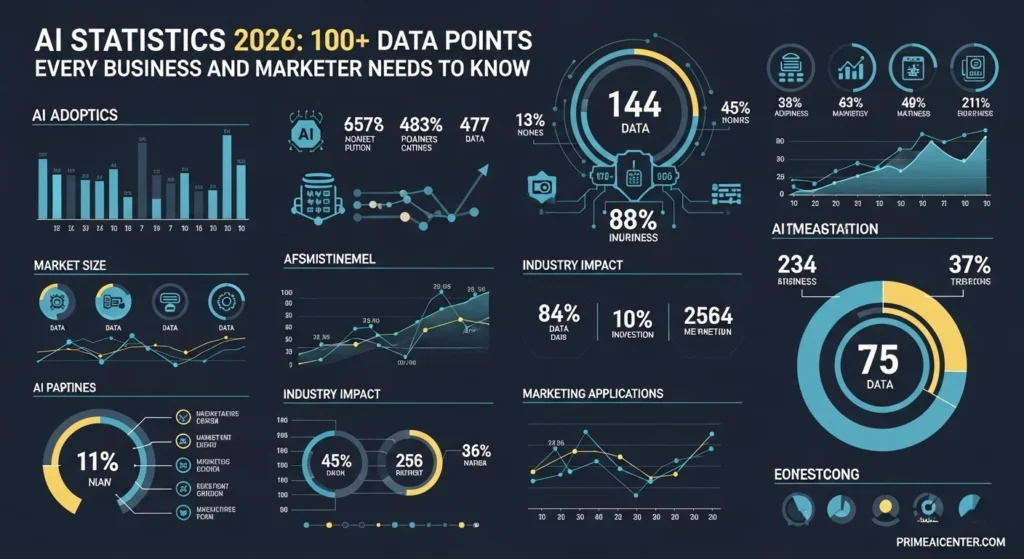
This guide compiles 100+ verified AI statistics for 2026 from Gartner, McKinsey, Deloitte, PwC, NVIDIA, Forrester, OpenAI, Anthropic, Bloomberg, Statista, and independent research firms. We organized them into eight categories so you can find the numbers relevant to your specific decisions — whether you are making a business case for AI investment, benchmarking your adoption against peers, or understanding where the market is heading next.
Every statistic is sourced. Where sources conflict — and some do — we note the range and explain why the figures differ.
AI Market Size and Investment Statistics 2026
The headline figures on AI market size vary significantly depending on whether a source counts only software, or includes hardware and services. Both are legitimate frameworks. Here are the most-cited figures alongside their sources.
- The global AI market generated $514.5 billion in revenue in 2026 — a 19% increase from $390.9 billion in 2025. (Resourcera, citing Statista)
- A broader estimate including hardware and services places the 2026 global AI market at $757.58 billion. (aistatistics.ai)
- The US AI market alone is $83.2 billion in 2026, representing 16.2% of global AI revenue. (Resourcera)
- The global AI market is projected to grow at a 30.6% CAGR between 2027 and 2033, reaching $3.5 trillion. (Resourcera)
- The US AI market is projected to reach $207.1 billion by 2030, growing at a 25.6% CAGR. (Resourcera)
- AI could contribute up to $15.7 trillion to the global economy by 2030 — more than the current combined output of China and India. (Intuition, citing PwC)
- Of that $15.7 trillion, $6.6 trillion is projected to come from productivity gains and $9.1 trillion from consumption-side effects. (Intuition)
- In 2025, AI investments hit $225.8 billion — 48% of all global venture funding was concentrated in AI. (GloriumTech)
- Private investment in generative AI alone reached $33.9 billion in 2024, part of $252 billion in total AI funding worldwide. (AmplifAI, citing McKinsey)
- The AI-as-a-Service (AIaaS) market is projected to reach $123.89 billion by 2031. (GloriumTech)
- 86% of companies say their AI budgets will increase in 2026. Another 12% say budgets will stay the same. (NVIDIA State of AI Report 2026)
- Nearly 40% of respondents said their AI budgets will increase by 10% or more in 2026. (NVIDIA)
- The AI banking market alone is projected to reach $34.58 billion in 2026. (aistatistics.ai)
- The AI healthcare market is valued at $64.8 billion in 2026, growing at 36% year-over-year. (Resourcera)
- AI has an expected annual growth rate of 36.6% between 2024 and 2030. (Intuition)
For the specific tools driving this market growth, see our 30 Best AI Tools 2026 guide — every major category covered with real pricing and benchmarks.
ChatGPT and OpenAI Statistics 2026
ChatGPT is the most-used AI product in the world by every measurable metric. Its usage data offers the clearest picture of how AI has moved from experimental to essential in less than four years.
Users and Traffic
- ChatGPT has 900 million weekly active users as of January 2026. (Backlinko)
- Monthly active users reach 2.8 billion. (AI Rank Lab)
- ChatGPT processes 2.5 billion requests every day in 2026.
- ChatGPT is the 4th most visited website globally with 5.6 billion monthly visits — rivaling Instagram and surpassing X and Wikipedia.
- ChatGPT holds a 64.5% market share in generative AI platforms, though this has declined from 69.1% in January 2025 as Gemini (25.2%) and Grok (15.2%) have grown.
- 76% of ChatGPT’s desktop traffic comes direct — it is a destination, not a discovery platform.
- 64% of generative AI users are now mobile-only.
- 92% of Fortune 500 companies now use OpenAI’s generative AI. (AmplifAI, citing McKinsey)
Revenue and Business Performance
- OpenAI’s annualized revenue surpassed $25 billion in early 2026, up from approximately $21.4 billion the prior year. (Financial Times)
- OpenAI targets $29.4 billion in revenue for 2026 and 220 million paying users by 2030.
- ChatGPT has over 50 million paying consumer subscribers and over 9 million paying business users.
- OpenAI’s most recent funding round valued the company at $730 billion pre-money, with $110 billion in new investment.
- ChatGPT costs approximately $700,000 per day to operate.
- OpenAI plans to grow from 4,500 to 8,000 employees by end of 2026.
How People Actually Use ChatGPT
- 49% of ChatGPT usage is asking questions, 40% is getting work done (writing, coding), and 11% is exploring ideas. (OpenAI‘s study of 1.5 million conversations)
- 28% of all employed US adults use ChatGPT for work tasks.
- 43% of US knowledge workers use AI on the job.
- 79% of developers rely on ChatGPT in their work.
- 77% of marketers use ChatGPT. 85% report accelerated content production.
Competing AI Platform Statistics 2026
Anthropic / Claude
- Anthropic raised $30 billion in February 2026, valuing the company at approximately $380 billion post-money. (getpanto.ai, citing Reuters)
- Anthropic’s annualized revenue run-rate reached approximately $14 billion by early 2026, up from $1 billion at end of 2024 — representing 10x annual growth for three consecutive years. (AI Business Weekly)
- Anthropic projects $26 billion in revenue for full-year 2026. (AI Business Weekly)
- 70% of Fortune 100 companies use Claude, with Claude holding a 29% enterprise market share. (AI Business Weekly)
- Anthropic serves 300,000+ business customers. Large accounts (over $100K annual revenue) grew nearly 7x in the previous year. (getpanto.ai)
- Claude Code alone accounts for approximately $2.5 billion in annualized run-rate revenue.
- By the first half of 2025, Anthropic’s enterprise revenue surpassed OpenAI’s enterprise revenue. (AI Business Weekly)
- Notable deployments: Deloitte (470,000 staff), Cognizant (350,000 staff), Accenture (30,000 employees trained).
Google Gemini
- Google Gemini surpassed 750 million monthly active users as of Q4 2025. (AI Business Weekly)
- Google AI Overviews powered by Gemini reach approximately 2 billion monthly users inside Google Search.
- Gemini holds approximately 13.5% of the global AI chatbot market.
- Gemini leads in India with 52% of AI chatbot downloads versus ChatGPT’s 32%.
- Gemini serves 120,000 enterprise customers and processes 85 billion monthly API requests.
- Gemini 3.1 Pro scored 77.1% on ARC-AGI-2 — more than doubling predecessor performance.
Perplexity AI
- Perplexity has 45 million active users and processes 780 million monthly queries. (AI Business Weekly)
- Perplexity’s user base grew 800% year-over-year. Lifetime mobile downloads reached 80.5 million.
- Perplexity achieves a 93.9% benchmark accuracy score and an 85% user retention rate.
- Perplexity is valued at $20 billion and has committed $400 million in planned investment in India for 2026.
For more on how AI search is reshaping discoverability, see our GEO Optimization guide and GEO Ranking Techniques for 2026.
AI Adoption Statistics by Business and Industry
Overall Business Adoption
- 78% of global companies report using AI in their operations as of late 2026. (Elementor)
- 94% of companies globally use AI in at least one business function. (Resourcera)
- 71% of organizations are now regularly using generative AI in at least one business function — up from 65% in early 2024. (AmplifAI)
- Only 8% of companies globally are considered AI front-runners — organizations that have achieved measurable competitive advantage. (Resourcera, citing Accenture)
- Businesses report an average return of $3.70 for every $1 invested in generative AI. (Elementor)
- 74% of companies are already seeing ROI from at least one generative AI project. (Tenet)
- 83% of businesses say they use AI to enhance user satisfaction and personalization. (Tenet)
- Companies that invest in AI are seeing revenue growth of 3-15% attributable to AI integration.
By Industry — Adoption Rates
- Healthcare: Over 70% of organizations (hospitals, payers, tech providers) are already implementing or testing generative AI. 100% of healthcare payer CIOs report AI and ML will be in their systems by 2026. (Vena)
- Retail: 64% of large retailers have adopted AI; another 22% are exploring it. 90% of UK retailers are exploring AI agents; one-third have already implemented them. (aistatistics.ai)
- Telecom: Nearly 90% of telecom companies regularly use AI in at least one business function. 52% use AI chatbots for customer service. (aistatistics.ai, citing McKinsey)
- Marketing and Sales: 42% of departments now use generative AI regularly — rising to 55% in technology companies. (LoopexDigital)
- Software Development: Nearly 95% of developers use AI to generate or fix code. (Tenet)
- Financial Services: More than 3 in 10 financial companies use AI in product development and customer analytics. (Tenet)
- Enterprise (1,000+ employees): 76% report active AI usage; just 2% say they do not use AI at all. (NVIDIA)
Implementation Challenges
- 53% of businesses cite data privacy as their top AI challenge. (Resourcera)
- 56% of companies report high integration complexity as a significant barrier. (Elementor)
- 66% of companies report that establishing clear ROI metrics for AI projects is a major challenge. (Elementor)
- 51% of organizations using AI have experienced at least one negative consequence; about one-third cite inaccuracy as the specific issue. (McKinsey)
- 45% of martech leaders say AI agents offered by vendors fail to meet performance expectations. (Gartner, cited by PwC)
- Only 8% of companies have moved beyond early-stage AI experimentation to achieve real competitive advantage. (NVIDIA, citing Accenture)
For practical guidance on overcoming these challenges, see our Enterprise AI Agent Deployment guide and our deep-dive on how AI agents work in production.
AI Productivity Statistics 2026
The productivity numbers are where the business case for AI becomes most concrete and most measurable. These figures come from controlled studies and large-scale surveys.
- Workers using generative AI save 5.4% of their work hours weekly — a 33% productivity gain for every hour spent using AI tools. (AmplifAI)
- Daily generative AI users report productivity gains at 92%, compared to only 58% of less frequent users. Frequency of use is the single biggest predictor of benefit. (AmplifAI)
- Over half of ChatGPT users report saving 3 or more hours per week. Active users save between 40 and 60 minutes per day.
- Professionals write 40% faster with ChatGPT as a co-writer, with quality remaining the same or improving. (MIT Sloan)
- Developers using AI for code completion and debugging work 55% faster. (GitHub and Microsoft Research)
- Customer service support agents handled 13.8% more inquiries per hour. Business professionals wrote 59% more work documents per hour. Programmers completed 126% more projects per week. (Vena, citing research studies)
- Workers’ throughput of realistic daily tasks increased by 66% when using AI tools — the equivalent of 47 years of natural US productivity gains compressed into current AI deployment. (Vena)
- Marketing teams are 44% more productive thanks to AI, with the average professional saving 11 hours per week. (LoopexDigital)
- Teams using AI for content generation report 60% faster editing and 30% improvement in SEO rankings. (LoopexDigital)
- GenAI will boost productivity by up to 4.7% economy-wide by 2026, adding $200-340 billion in annual revenue across sectors. (GloriumTech, citing Goldman Sachs)
- Companies deploying ChatGPT Enterprise achieve an average 4.1x return on investment within 6 months. (Forrester TEI)
- 80% of staff who use AI and automation tools say their improved productivity is thanks to the technology. (Vena)
- A quarter of American companies have saved between $50,000 and $70,000 using AI tools, with 11% saving over $100,000.
- 60% of business owners predict AI implementation will drive sales growth. 64% believe it will improve customer relations and increase productivity. (Vena)
The productivity paradox — worth noting: a 2026 METR study on experienced open-source developers found that those using AI on complex tasks actually took 19% longer, even while believing they worked faster. (Elementor) AI amplifies capability on routine tasks. It can create false confidence on complex ones.
AI Marketing Statistics 2026
- 68% of marketers use AI, but only 17% have received comprehensive, job-specific AI training. 32% report receiving no formal AI training whatsoever. (LoopexDigital)
- Organizations that invest in employee AI training report 43% higher success rates in deploying AI projects. (LoopexDigital)
- AI-powered campaign management delivers 20-30% higher ROI compared to traditional methods. (LoopexDigital)
- Organizations investing in AI see sales ROI improve by 10-20% on average, with leading companies achieving 1.5x higher revenue growth over three years compared to peers. (LoopexDigital)
- 49% of marketers use AI for market research and analytics, reducing competitive analysis time from days to hours. (LoopexDigital)
- AI personalization increases conversion rates by up to 10% in e-commerce. AI-powered product recommendations can increase average order value by up to 369%. (LoopexDigital)
- Teams using AI for content production have achieved 113% increases in blog post output, with a corresponding 40% increase in website traffic. (LoopexDigital)
- Marketing job listings requiring AI skills have increased by 71%, with AI-proficient professionals commanding 20-30% salary premiums. (LoopexDigital)
- Netflix generates $1 billion annually from AI-powered personalized recommendations. (LoopexDigital)
- AI marketing spend is growing at a 36.6% CAGR with global adoption at 35.9%. A 12% increase in martech spend is projected for the rest of 2026. (LoopexDigital)
- 57% of small businesses already use AI for marketing tasks such as ad targeting and campaign analysis. (Tenet)
- Professional AI marketing certification enrollment has increased by 300% since 2023. (LoopexDigital)
For building AI-optimized content that surfaces in both search and AI engines, see our GEO Ranking Techniques guide and our WebMCP Tutorial on turning your website into an AI-readable resource.
AI Small Business Statistics 2026
- Over two-thirds of US small businesses now use AI regularly to automate tasks, personalize customer service, and optimize marketing. (ColorWhistle)
- 82% of small businesses using AI increased their workforce — not reduced it. (ColorWhistle, citing US Chamber of Commerce)
- 85% of small businesses using AI report increased efficiency. (Elementor)
- Small businesses using AI report cost savings of $500-2,000 per month and time savings of 20+ hours per month. (ColorWhistle, citing Thryv survey)
- In India, 66% of small businesses whose technology investments include AI reported improved profitability. (ColorWhistle)
- 61% of small business owners say AI helps them manage their workload more efficiently. (Tenet)
- 52% of small businesses apply AI for content creation and design. (Tenet)
- 31% of small businesses use AI to automate marketing promotions and outreach. (Tenet)
- By 2027, approximately 50% of Asia-Pacific SMBs will have substantially restructured their IT budgets to prioritize AI and GenAI. (ColorWhistle, IDC forecast)
- 85% of open-source tools are moderately to extremely important to small companies’ AI strategy, since they prefer to build rather than buy commercial products. (NVIDIA)
For AI automation tools specifically built for small business workflows, see our WhatsApp AI Agents guide — including how to automate customer communication at zero cost.
AI Workforce and Jobs Statistics 2026
- AI is projected to create 97 million new jobs by 2026 while displacing 85 million — a net creation of 12 million positions. (aistatistics.ai, citing World Economic Forum)
- A separate, more optimistic projection: AI is projected to generate 170 million new jobs worldwide by 2030. (Vena)
- 59% of the global workforce will require reskilling or upskilling by 2030 due to AI. (aistatistics.ai)
- Current AI systems have the technical capability to perform tasks equivalent to 11.7% of total US wage value. (aistatistics.ai)
- Workers with advanced AI skills earn 56% more than peers in the same roles without AI skills. (Gloat, citing PwC)
- Productivity growth has nearly quadrupled in industries most exposed to AI since 2022. (Gloat)
- AI and machine learning specialists rank #1 on the list of fastest-growing jobs in the modern workforce. (Vena, WEF)
- Daily users of generative AI report higher job security and salary increases at nearly double the rate of occasional users. (AmplifAI)
- 29% of companies report that at least one-quarter of their employees have received AI or generative AI training. (Tenet)
- Gartner predicts that 50% of organizations will require “AI-free” skills assessments by 2026, due to concerns about critical-thinking atrophy from GenAI use. (Gloat)
- 66% of organizations report improving productivity and efficiency as the primary benefit achieved from enterprise AI adoption so far. (Deloitte State of AI in the Enterprise 2026)
- 74% of organizations hope to grow revenue through AI in the future — but only 20% are already doing so. (Deloitte)
- 81% of business owners see AI as augmenting their workforce, not replacing it. (Elementor, citing Goldman Sachs)
AI Search and Discoverability Statistics 2026
- AI-generated answers are now the standard experience on Google — AI Overviews appear on the majority of informational queries. (AI Rank Lab)
- 3 out of 4 Americans use AI search tools weekly. (AI Rank Lab)
- 50% of US mobile users use voice search daily — powered by AI voice assistants. (Intuition)
- There will be 8 billion AI-powered voice assistants in use by 2026. (Intuition)
- 17% of consumers now turn to generative AI to discover new products — a significant shift in how purchase journeys begin. (GloriumTech)
- 80% of everything people watch on Netflix is driven by AI recommendation models, saving the company $1 billion annually in subscriber retention. (GloriumTech)
- AI search monetization is imminent — all major platforms are expected to introduce paid placement within AI-generated answers by end of 2026. (AI Rank Lab)
- Generative AI reached 54.6% adoption in just three years — outpacing the personal computer and the internet at the same point in their respective timelines. (AmplifAI)
Appearing in AI search answers — not just traditional search results — is the defining content challenge of 2026. Our GEO Optimization guide and new Siri iOS 26 analysis cover both why this matters and what to do about it.
Agentic AI Statistics 2026
The shift from AI that responds to AI that acts autonomously is the defining business trend of 2026. These statistics capture where that transition stands right now.
- 81% of martech leaders are already piloting or have implemented AI agent initiatives. (Elementor, citing Gartner)
- 33% of enterprise software applications will include agentic AI by 2028, up from less than 1% in 2024. (Intuition, citing Gartner)
- McKinsey describes the emerging model as the “agentic organization” — human teams working in collaboration with a workforce of autonomous AI agents. (Elementor)
- 60% of AI leaders say that Responsible AI (RAI) boosts ROI and efficiency. 55% report improved customer experience and innovation from RAI practices. (PwC 2026 AI Business Predictions)
- 1 in 2 HR leaders have now deployed generative AI in their HR function. (Gloat, citing Gartner)
- A manufacturer using AI agents in new product development has cut time-to-market decisions by optimizing competing objectives like cost and speed — a use case Deloitte identifies as one of the clearest early ROI signals for agentic AI. (Deloitte)
For a comprehensive look at how AI agents work and how to deploy them in your business, see our AI Agents guide and our Enterprise AI Agent Deployment article.
Global AI Demographics and Access Statistics 2026
- As of 2026, at least 1.35 billion people worldwide actively use AI tools — approximately 16.3% of the global population. (Resourcera)
- China leads the world in generative AI users with 515 million, focusing on rapid scale-up. (aistatistics.ai, citing McKinsey)
- 21% of US workers say at least some of their work is done with AI. (aistatistics.ai)
- 45% of workers with postgraduate degrees use ChatGPT at work, compared with 38% with a bachelor’s degree and 17% with high school or less.
- Employees aged 18-29 are twice as likely to use ChatGPT at work compared to those over 50.
- ChatGPT is available in 161 countries and 95 languages.
- AI adoption rates in the world’s lowest-income nations are growing more than 4x faster than in the wealthiest nations. (OpenAI data)
- 72% of business leaders believe AI implementation will improve productivity among their teams. (Intuition)
- 88% of business leaders are prioritizing the acceleration of AI adoption to meet consumer expectations and gain competitive advantage. (aistatistics.ai)
- 79% of college students report that their instructors have discussed the ethics and usage of AI tools in class. (Tenet)
What the Statistics Mean for Your Business in 2026
The numbers converge on five actionable conclusions.
The adoption gap is closing, but slowly. 94% of companies use AI in some function. Only 8% are AI front-runners. The gap between using AI and extracting real competitive advantage from it is where most businesses are stuck — and that gap is the most important number in this entire guide.
Frequency matters more than which tool you choose. Daily generative AI users report productivity gains at 92%. Occasional users report gains at 58%. The technology is less important than the habit. The biggest variable in your AI ROI is how consistently your team uses the tools, not which tools they are subscribed to.
Training is the highest-ROI investment. Organizations that invest in employee AI training report 43% higher success rates in AI projects. Only 17% of marketers have received comprehensive job-specific training despite 68% using AI. The skills gap — not the technology gap — is the primary barrier to extracting value.
The agentic shift is beginning. 81% of martech leaders are already piloting AI agents. 33% of enterprise software will include agentic AI by 2028. The transition from AI that assists to AI that acts is the defining infrastructure investment of the next 18 months. Organizations building toward agent-ready workflows now will have a structural advantage over those waiting for the market to mature.
AI search is changing discovery fundamentally. 3 in 4 Americans use AI search tools weekly. 17% of consumers now begin purchase journeys in AI. All major platforms are expected to introduce paid placement in AI answers by end of 2026. Appearing in AI-generated answers is becoming as important as ranking in traditional search — and the optimization strategies are different. For how to adapt, see our GEO Optimization guide and our full coverage of the best AI tools for business in 2026.
FAQS: AI Statistics
How many people use AI in 2026?
At least 1.35 billion people worldwide actively use AI tools as of 2026 — approximately 16.3% of the global population. ChatGPT alone has 900 million weekly active users and 2.8 billion monthly active users. China leads with 515 million generative AI users.
What is the AI market size in 2026?
The global AI market generated $514.5 billion in revenue in 2026, a 19% increase from $390.9 billion in 2025, according to Statista data compiled by Resourcera. A broader estimate including hardware and services places it at $757.58 billion. The AI market is projected to grow at a 30.6% CAGR between 2027 and 2033, reaching $3.5 trillion.
How many companies use AI in 2026?
94% of companies globally use AI in at least one business function. 78% report using AI in their operations. 71% regularly use generative AI specifically. However, only 8% of companies are considered AI front-runners who have achieved measurable competitive advantage from the technology.
What is the ROI of AI for businesses in 2026?
Businesses report an average return of $3.70 for every $1 invested in generative AI. 74% of companies are already seeing ROI from at least one AI project. Companies deploying ChatGPT Enterprise achieve an average 4.1x ROI within 6 months. Small businesses report cost savings of $500-2,000 per month and time savings of 20+ hours per month.
How much does AI improve productivity in 2026?
Workers using generative AI save 5.4% of their work hours weekly — a 33% productivity gain per hour spent on AI tools. Daily users report productivity gains at 92% versus 58% for occasional users. Developers work 55% faster with AI coding tools. Marketing teams are 44% more productive, saving 11 hours per week on average.
How much revenue does OpenAI make in 2026?
OpenAI’s annualized revenue surpassed $25 billion in early 2026, with targets of $29.4 billion for full-year 2026. ChatGPT has over 50 million paying consumer subscribers and over 9 million paying business users. The company is valued at $730 billion pre-money following its most recent funding round.
How is AI changing marketing in 2026?
68% of marketers use AI, but only 17% have received comprehensive training. AI marketing delivers 20-30% higher campaign ROI. Teams using AI for content produce 60% faster, with 30% better SEO rankings. Marketing job listings requiring AI skills increased 71%, with AI-proficient professionals earning 20-30% salary premiums.
What are the biggest challenges in AI adoption in 2026?
The top challenges are data privacy (53% of businesses cite this), integration complexity (56%), and difficulty proving ROI (66%). 51% of organizations using AI have experienced at least one negative consequence, with inaccuracy cited by about one-third. 45% of martech leaders say vendor AI agents fail to meet performance expectations.
How is AI affecting jobs in 2026?
AI is projected to create 97 million new jobs by 2026 while displacing 85 million — a net creation of 12 million positions. Workers with advanced AI skills earn 56% more than peers in the same roles without those skills. Daily AI users report higher job security and salary increases at nearly double the rate of occasional users. 81% of business owners see AI as augmenting their workforce, not replacing it.
What percentage of Fortune 500 companies use AI in 2026?
92% of Fortune 500 companies now use OpenAI’s generative AI. 70% of Fortune 100 companies use Claude (Anthropic). Eight of the Fortune 10 are Claude customers. Nearly all Fortune 500 organizations are actively deploying AI across at least one business function.