
Best AI Chatbots 2026
The chatbot market hit $12.98 billion in 2026, growing at 24.8% annually. ChatGPT alone has 800 million weekly users. And yet the question most professionals are asking right now is not “should I use an AI chatbot?” — it is “which one, for what, and is the price justified?”
This guide answers that directly. We reviewed 30 chatbots across five categories: general-purpose models, research and search tools, business and productivity assistants, customer service platforms, and open-source alternatives. Every tool was evaluated on output quality, pricing, privacy, integrations, and real-world performance data from independent sources including First Page Sage’s March 2026 market share report and SaaS CRM Review’s hands-on testing.
No padding. No sponsored picks. Thirty tools, five categories, one clear recommendation at the end of each section.
General-Purpose AI Chatbots
These are the tools you use for writing, research, reasoning, and daily professional work. The category is dominated by three platforms that have each carved out a distinct position — and a fourth that is disrupting the market from a completely different angle.
1. ChatGPT (OpenAI)
ChatGPT is the market leader by every measurable metric. First Page Sage’s March 2026 data confirms it holds the largest share of the generative AI chatbot market — though that share has declined slightly as competitors improve. GPT-5.4, released March 5, 2026, scores 57 on the Artificial Analysis Intelligence Index, tied with Gemini 3.1 Pro for the global top position. The model reduces hallucinations by 33% versus GPT-5.2 and achieves a 75% score on OSWorld-Verified computer use, surpassing human performance at 72.4%.
What makes ChatGPT the default choice for most users is not any single benchmark — it is the ecosystem. 7,000+ custom GPTs, 220+ connected apps, DALL-E 3 for images, Sora 2 for video, Advanced Voice Mode, Deep Research agents that synthesize information across dozens of sources. GPT-5.4 Mini is now available on the free tier via the Thinking feature. For users who want one tool that handles most things well, ChatGPT remains the clearest starting point in 2026.
Best for: General professional work, writing, coding, research, and anyone who needs a single versatile tool.
Pricing: Free (GPT-5.4 Mini via Thinking) / $20/month Plus / $200/month Pro / $25/user/month Business
Verdict: Still the benchmark. Best ecosystem. Not always the best specialized tool.
2. Claude (Anthropic)
Claude Opus 4.6 scores 80.8% on SWE-Bench Verified — the strongest coding result of any model — and 53 on the Artificial Analysis Intelligence Index. Claude Sonnet 4.6 is the free default on claude.ai and is preferred over Opus 4.5 in Claude Code 59% of the time in production usage, meaning it delivers near-flagship output for most tasks at a lower price point. SaaS CRM Review scores Claude 9.0/10 — second only to ChatGPT’s 9.2 — praising its long-context handling and naturally written output that reads less robotically than competitors.
The practical difference from ChatGPT: Claude produces better long-form writing, handles complex multi-file code understanding more reliably, and manages 200K-token context windows in its current release. It does not have native image generation. For writers, analysts, and engineers who prioritize output quality over ecosystem breadth, Claude is the stronger daily driver.
Best for: Writing quality, long-form content, complex coding tasks, large document analysis.
Pricing: Free (Sonnet 4.6) / $20/month Pro / $25/user/month Team / API from $3/M input tokens
Verdict: Best output quality for writing and code. The specialist to ChatGPT’s generalist.
3. Google Gemini 3.1 Pro
Gemini 3.1 Pro holds the #2 position in First Page Sage’s March 2026 market share ranking by quarterly user growth, trailing only ChatGPT. The model scores 57 on the Artificial Analysis Intelligence Index — tied with GPT-5.4 — and posted a 77.1% ARC-AGI-2 score that more than doubled its predecessor’s reasoning performance. At $2/$12 per million tokens via API, it offers one of the strongest price-to-performance ratios in the frontier tier. The 2M-token context window is the largest currently available from any major provider.
Gemini’s distribution advantage is significant and growing. It is the reasoning backend for the new Siri on iOS 26.4 — meaning 2.2 billion Apple devices now use Gemini for their most complex AI tasks. Deep integration with Google Workspace (Docs, Gmail, Drive, YouTube) makes it the natural choice for teams already in the Google ecosystem. For context on the Apple-Google partnership, see our new Siri iOS 26 guide.
Best for: Long-context processing, Google Workspace users, multimodal analysis, cost-effective frontier reasoning.
Pricing: Free (Gemini app) / $20/month Advanced / $2/$12 per million tokens API
Verdict: Best context length and price-to-performance. Equal to GPT-5.4 on the Intelligence Index.
4. Microsoft Copilot
Microsoft Copilot is not a standalone chatbot — it is an embedded AI assistant that lives inside Word, Excel, PowerPoint, Outlook, and Teams. That distinction matters. Rather than asking it questions in a separate window, you use it inside the document you are already working on. It summarizes meetings from the recording, drafts emails based on prior thread context, analyzes data in spreadsheets using natural language, and generates presentations from an outline. The Copilot Vision feature analyzes screen content in real time for contextual help.
For organizations already paying for Microsoft 365, Copilot adds AI across the tools employees use every day without new software. Outside the Microsoft ecosystem, its value drops considerably. At $30/user/month for the M365 Copilot license, it is the most expensive per-user option in this category — but for the right organization, it eliminates the need for separate AI subscriptions entirely.
Best for: Microsoft 365 organizations, finance teams (Excel + Python), enterprise workflow automation within Microsoft tools.
Pricing: Free (limited, no registration required) / $22/month Pro / $30/user/month M365 Copilot
Verdict: Best choice for Microsoft 365 organizations. Limited value for teams outside the Microsoft ecosystem.
5. Grok 4.20 (xAI)
Grok 4.20, released March 2026, is integrated natively into X and has real-time access to the platform’s complete data stream. This gives it a capability no other general-purpose chatbot can match: up-to-the-minute social signal data. Trend monitoring, social listening, tracking breaking news and emerging narratives — these are tasks where Grok’s X integration creates a genuine advantage. Image and video generation are included in the X interface. For most professional workflows, Grok functions as a complement to ChatGPT or Claude rather than a replacement. The general reasoning performance is competitive but does not lead the category.
Best for: Real-time trend monitoring, social listening, X platform workflows, breaking developments research.
Pricing: Free (limited) / included with X Premium ($8-16/month)
Verdict: Best for real-time social intelligence. A complement, not a replacement, for general professional work.
6. Meta AI (LLaMA 4)
Meta AI, powered by LLaMA 4, is integrated directly into Instagram, Facebook, WhatsApp, and Messenger — accessible inside platforms 3+ billion people already use daily without downloading anything extra. For businesses communicating through Meta’s platforms, this distribution is significant. The chatbot handles conversational queries, image generation, and real-time responses within DMs and comment sections. For more on WhatsApp-specific AI automation workflows, see our WhatsApp AI Agents guide.
Best for: Social media users, businesses communicating through Meta platforms, quick conversational queries.
Pricing: Free (included with Meta platform accounts)
Verdict: Best free chatbot for Meta platform users. Not a professional replacement for ChatGPT or Claude.
AI Research and Search Chatbots
These tools are built around a different core premise: accuracy through sourcing. They retrieve and synthesize information rather than generating it from training data, which makes them categorically more reliable for research, fact-checking, and staying current on fast-moving topics.
7. Perplexity AI
Perplexity has become the AI research standard. Every answer includes sourced citations you can verify — a structural advantage over ChatGPT and Claude for any work where accuracy matters. First Page Sage’s March 2026 data shows Perplexity gaining market share quarter-over-quarter as users discover it for research-intensive workflows. Pro Search provides deeper analysis with multiple source synthesis. For researchers, journalists, analysts, and knowledge workers who need current, citable information, Perplexity has no peer in this category. Its limitation is also clear: it is a research tool, not a generation tool. It does not write your article or generate code.
Best for: Research, fact-checking, real-time information synthesis, market research, replacing Google for knowledge work.
Pricing: Free / $20/month Pro
Verdict: Best AI research tool available in 2026. Essential for professionals who work with information daily.
8. Perplexity Comet
Perplexity Comet extends the research capability into a full AI browser launched in mid-2025. It aggregates web data, tracks research threads across sessions, and surfaces relevant information as you browse without manual search queries. For professionals who manage research across dozens of tabs daily, Comet reduces the overhead of maintaining context while switching between sources. Included with Perplexity Pro, making it the best value add-on in the research category.
Best for: Research-intensive professionals, journalists, analysts who need continuous web intelligence during browsing.
Pricing: Included with Perplexity Pro ($20/month)
Verdict: The natural evolution of AI research from chat to full browsing. Changes how research-intensive work operates.
9. You.com
You.com is an AI-powered search engine that displays results alongside chat responses — search results appear in a sidebar rather than being subordinated to the AI answer. This makes it useful for users who want AI synthesis and traditional search results simultaneously. YouCode handles coding queries, YouWrite supports content generation, and YouImagine handles image creation — making it an increasingly complete platform rather than a single-purpose tool. For users who find Perplexity too citation-heavy and ChatGPT too disconnected from web sources, You.com sits in a useful middle ground.
Best for: Users who want AI and traditional search results side-by-side, coding and writing queries with web context.
Pricing: Free / $20/month Pro
Verdict: Best hybrid search-and-chat experience. Useful for users who want both AI synthesis and web results visible simultaneously.
10. NotebookLM (Google)
NotebookLM answers questions using your own documents. Upload PDFs, research papers, meeting transcripts, or long-form reports and ask detailed questions — NotebookLM cites specific passages in its responses. The Audio Overview feature converts source material into podcast-style conversations. For researchers, students, and professionals managing large document sets, NotebookLM solves a problem general-purpose chatbots handle poorly: accurate, citable knowledge retrieval from a specific source set you define. Completely free — one of the best zero-cost AI tools in 2026.
Best for: Research, document-heavy workflows, knowledge synthesis from multiple proprietary sources.
Pricing: Free / included in Google One AI Premium
Verdict: Best document-based AI research tool available. Genuinely useful, genuinely free.
11. Phind
Phind is a developer-focused AI search engine that retrieves and synthesizes current technical documentation, Stack Overflow threads, GitHub issues, and coding tutorials. First Page Sage’s March 2026 data specifically identifies Phind as one of the fastest-growing developer-focused AI chatbots. Unlike ChatGPT or Claude, Phind optimizes specifically for technical query accuracy and sources its answers from live developer resources rather than training data alone. For developers looking up framework documentation, debugging approaches, or library-specific questions, Phind produces more current and reliably sourced answers than general-purpose alternatives.
Best for: Developers searching technical documentation, debugging help, framework-specific queries with current sources.
Pricing: Free / $20/month Pro
Verdict: Best AI search tool specifically for developers. Outperforms general chatbots for technical documentation queries.
12. Pi (Inflection AI)
Pi is designed for conversational depth and emotional intelligence rather than task completion. Launched May 2023, it focuses on long-form personal conversations — brainstorming, processing decisions, exploring ideas — with a tone that feels distinctly more human and less transactional than ChatGPT or Claude. It is not the right choice for coding, research, or business tasks. It is the right choice for users who want an AI that engages with their thinking rather than just answering their questions. For personal reflection, creative ideation, and extended intellectual discussion, Pi has a distinct character that general-purpose models do not replicate.
Best for: Personal reflection, extended intellectual conversations, brainstorming, users who want conversational depth over task execution.
Pricing: Free
Verdict: Best conversational AI for personal use. Not a professional productivity tool — a thinking partner.
AI Business and Productivity Chatbots
These tools are designed for specific business workflows: sales, lead generation, workflow automation, and team productivity. They are not general-purpose models — they are optimized for the specific jobs businesses need done repeatedly and at scale. For a broader view of how AI agents are transforming business operations, see our guide to AI agents and our Enterprise AI Agent Deployment guide.
13. Zapier Chatbots
Zapier Chatbots are built for action rather than conversation. Connected to 7,000+ apps (Slack, Notion, Salesforce, HubSpot, and more), they trigger workflows automatically from chat interactions — adding leads to a CRM, sending calendar invites, routing support tickets, updating records. For entrepreneurs and small business owners who want to automate business operations without writing code, Zapier Chatbots are the most accessible no-code automation chatbot available. The distinction from ChatGPT or Claude: this tool is not trying to have a smart conversation — it is trying to complete a business task without human intervention.
Best for: Entrepreneurs, small business owners, no-code developers who want to automate business operations through chat.
Pricing: Included in Zapier plans / Free (100 tasks/month) / $19.99/month Starter
Verdict: Best no-code business automation chatbot. Not a conversational AI — an action-oriented workflow tool.
14. Intercom Fin AI
Intercom Fin is purpose-built for customer service resolution. It pulls answers from your existing Help Center, support documentation, and past resolved conversations to handle tier-one support queries autonomously — without requiring you to write extensive FAQs. Digital Elevator’s independent testing ranked it as the fastest support bot tested, handling a majority of common queries without human handoff. Lindy.ai’s hands-on review confirmed that Fin responds to standard questions in seconds with answers that sound natural and contextually accurate. The limitation: it is built for customer service specifically — it does not handle creative or exploratory tasks.
Best for: Companies with high support volume, SaaS and e-commerce businesses, teams wanting to automate tier-one support.
Pricing: $39/seat/month (Enterprise plan) / 14-day free trial
Verdict: Best AI customer support chatbot for SaaS and e-commerce. Fast, accurate, and requires minimal setup.
15. HubSpot Breeze
HubSpot Breeze is the AI layer built into HubSpot’s CRM — performing company research, contact insights, and contextual content suggestions directly within HubSpot’s interface. Lindy.ai’s testing identified Breeze as particularly strong for CRM-native tasks: it surfaces relevant prospect information, suggests follow-up messaging, and assists with support queries using your existing knowledge base, all without leaving the HubSpot environment. Its usefulness is largely bounded by the HubSpot ecosystem — for teams that live in HubSpot for sales and marketing, it is a genuine productivity multiplier; for teams outside it, the value diminishes quickly.
Best for: HubSpot users, sales and marketing teams who want AI inside their existing CRM workflow.
Pricing: Included in HubSpot plans / Free tier available
Verdict: Best AI for HubSpot users. Limited value outside the HubSpot ecosystem.
16. Drift
Drift specializes in AI-powered virtual assistants for sales lead generation and conversational marketing. It engages website visitors, qualifies leads, and books meetings — with newer AI models enabling greater personalization and relevance in sales conversations. For marketing and sales teams that need to convert website traffic into pipeline, Drift is purpose-built for this specific workflow. The focus on sales-led mobile experiences makes it one of the stronger options for converting mobile visitors with targeted conversations. Less suited for complex customer support or general business productivity.
Best for: Sales and marketing teams, lead generation, converting website visitors into booked meetings.
Pricing: Custom pricing (contact sales)
Verdict: Best AI chatbot for sales lead generation and conversational marketing. Not a general support or productivity tool.
17. Manus AI
Manus represents a shift from conversational chatbot to autonomous agent. Rather than responding to prompts in a conversation, it plans and executes multi-step tasks end-to-end with minimal user input — research, analysis, content generation, and workflow execution completed autonomously. Digital Elevator identifies Manus as a glimpse into the next phase of AI assistants: a tool that acts rather than responds. For advanced users who want AI to operate more independently across complex tasks, Manus is the most capable autonomous option in this category. Its interface is less conversational than other tools — the experience is closer to delegating a project than having a discussion.
Best for: Advanced users who want autonomous multi-step task execution, complex workflow delegation.
Pricing: Contact for pricing
Verdict: Most autonomous business AI agent available. Not a standard chatbot — a task executor for complex workflows.
18. Lindy AI
Lindy is an AI assistant platform focused on automating repetitive business workflows — scheduling, email management, research compilation, and internal knowledge retrieval. It connects to your email, calendar, and productivity tools to handle the administrative overhead that consumes knowledge worker time. The platform allows creating multiple specialized AI assistants (“Lindies”) for different workflows, each configured to handle a specific recurring task. For professionals drowning in scheduling, email triage, and meeting preparation, Lindy addresses the specific friction points that general-purpose chatbots do not eliminate because they require manual prompting for each task.
Best for: Professionals who want to automate scheduling, email management, and recurring administrative workflows.
Pricing: Free (limited) / $49.99/month Pro
Verdict: Best AI for automating administrative workflows. Not a general-purpose chatbot — a task automation platform.
AI Customer Service Chatbots
Customer service chatbots are a distinct category from general-purpose models. The decision criteria here are different: resolution rate, integration depth with help desks and CRMs, channel support, compliance certifications, and cost per resolution. Gartner estimates conversational AI could reduce contact center labor costs by $80 billion by 2026 — the ROI case is clear for businesses with significant support volume.
19. Tidio Lyro
Tidio Lyro is the best free starting point for small businesses adding AI customer support. Its visual chatbot builder with drag-and-drop templates handles common use cases — sales, lead capture, support — without coding. Lyro AI resolves up to 70% of customer inquiries automatically by pulling from your knowledge base. The platform centralizes messages from Instagram, Facebook Messenger, and email into one dashboard. eesel.ai’s customer service testing ranked Tidio highly for SMB deployments specifically because of setup speed and the free plan’s genuine utility for small teams just beginning with AI support automation.
Best for: Small to mid-sized e-commerce businesses, teams wanting a simple free starting point for AI customer support.
Pricing: Free plan available / Lyro AI Agent from $32.50/month / Starter Suite from $24.17/month
Verdict: Best free starting point for small business customer support. Outgrown by enterprise teams at scale.
20. Zendesk AI
Zendesk AI agents resolve tickets autonomously with seamless integration into the Zendesk ticketing system. For teams already standardized on Zendesk Suite, the AI layer is the natural extension — it pulls from your existing help articles, handles intent detection, provides context-rich handoffs to human agents, and feeds detailed resolution analytics back into the platform. boei.help’s independent testing noted that Zendesk’s AI capabilities have caught up significantly since 2025 and that the omnichannel support (email, chat, phone, social, WhatsApp) is now production-ready. The complexity and cost add up fast — the base Suite plan does not include advanced AI without additional licenses.
Best for: Teams already on Zendesk Suite, mid-market to enterprise support operations.
Pricing: Suite from $55/agent/month / Advanced AI add-on required for full features
Verdict: Best AI for Zendesk-native teams. Expensive outside an existing Zendesk investment.
21. Intercom
Intercom is the most complete AI customer service platform combining live chat, AI support automation, and product tours in one system. Widely used in SaaS and e-commerce. The Fin AI Agent handles tier-one queries while Intercom’s broader platform manages the escalation workflow, conversation history, and reporting. Lindy.ai’s comparison placed Intercom at the top of customer service platforms for companies that need to unify support across channels — the platform’s strength is not just the AI chatbot but the entire customer support workflow built around it.
Best for: SaaS and e-commerce companies that want to unify live chat, AI, and support automation in one platform.
Pricing: $39/seat/month (Essential) / 14-day free trial
Verdict: Best full customer service platform with AI. Most complete solution for teams that want live chat and automation unified.
22. Ada
Ada is enterprise-grade automation for large organizations with complex, multi-step customer journeys. Strong multilingual capabilities (20+ languages with native-like fluency), deep integrations with enterprise CRMs and help desks, and no-code flow building for complex automation without technical resources. TeamSupport’s B2B chatbot guide ranks Ada among the strongest platforms specifically for enterprises that need high deflection rates at scale across multiple channels. The platform is less suited for small businesses — the pricing and complexity are calibrated for organizations with significant support volume.
Best for: Large enterprises with complex customer journeys, multilingual support requirements, high-volume deflection at scale.
Pricing: Custom enterprise pricing
Verdict: Best enterprise customer service chatbot for complex, high-volume, multilingual deployments.
23. Chatbase
Chatbase lets you build a custom AI chatbot trained on your own data — websites, PDFs, text files — with control over the underlying AI model. eesel.ai’s testing identified it as the most flexible platform for users who have a specific use case and the time to build a tailored solution. You feed it your company documentation, product guides, and support history; it becomes a knowledge-base chatbot specific to your business. For businesses with highly specific support content that generic chatbots handle poorly, Chatbase offers a level of customization that out-of-the-box platforms cannot match.
Best for: Businesses with specific knowledge bases, custom support use cases, teams willing to invest time in configuration.
Pricing: Free (limited) / $19/month Hobby / $49/month Standard / $99/month Pro
Verdict: Best custom AI chatbot builder. Most flexible option for organizations with specialized support content.
24. Crescendo.ai
Crescendo.ai positions itself as an enterprise live chat agent platform that goes beyond standard chatbots with human-like decision-making and emotional intelligence at scale. Crescendo’s own data claims 99.8% resolution accuracy and 10x faster customer support — figures that require independent verification but reflect the platform’s premium positioning. Pricing starts at $1.25 per resolution plus a fixed monthly fee, covering deployment, integrations, licensing, QA, and maintenance. For enterprises that need a fully managed AI support operation including onboarding and ongoing QA, this pricing model provides cost predictability that per-seat models do not.
Best for: Enterprises that want a fully managed AI customer support operation with per-resolution pricing.
Pricing: From $1.25/resolution + fixed monthly fee / enterprise contracts from $3,000-$39,000/month
Verdict: Best fully managed enterprise AI support platform. Per-resolution pricing model suits high-volume operations.
25. Boei
Boei is the best flat-rate customer service chatbot for small to mid-sized businesses. At €14/month flat for 2,000 AI messages, 50+ communication channels (WhatsApp, Instagram, Facebook Messenger, live chat, email, phone), and unlimited seats, boei.help’s own independent chatbot comparison found it outperformed Tidio, Zendesk, and several enterprise tools on cost predictability and channel breadth for SMBs. The flat pricing model eliminates the per-conversation billing that makes most AI chatbots unpredictable at scale for growing businesses.
Best for: Small to mid-sized businesses that want flat-rate AI chat across 50+ channels without seat or conversation limits.
Pricing: €14/month Pro (flat rate) / 7-day free trial, no credit card required
Verdict: Best cost-predictable customer service chatbot for SMBs. Strongest channel breadth at this price point.
Open-Source and Developer AI Chatbots
Open-source chatbots give developers and organizations capabilities that closed-model platforms cannot provide: full model control, self-hosting for data sovereignty, fine-tuning for specialized use cases, and zero per-query costs after infrastructure. This category has matured significantly in 2026 — the performance gap between open and closed models has narrowed to the point where open-source alternatives are viable for production use in many contexts. For more on how open-source AI models are being integrated into production agent workflows, see our Enterprise AI Agent Deployment guide and our WebMCP Tutorial.
26. LLaMA (Meta)
LLaMA has become the backbone of the open-source LLM ecosystem in 2026. Since LLaMA 3 and 3.1, Meta’s models achieve performance levels that rival mid-to-upper-tier proprietary systems — free to use (with licensing conditions) and fully customizable. Unlike API-only models, LLaMA gives you direct access to model weights for fine-tuning, domain adaptation, and offline deployment. Knock AI’s comprehensive chatbot testing identifies LLaMA as the go-to foundation model for developers, startups, and enterprises that need power without vendor lock-in. The thriving community provides tooling through Ollama, vLLM, and LM Studio for accessible local deployment.
Best for: Developers, startups, researchers, and enterprises needing full model control, self-hosting, or fine-tuning for specialized domains.
Pricing: Free (open weights with Meta license) / Compute costs for self-hosted deployment
Verdict: Best open-source foundation model. The go-to choice for organizations that need data sovereignty or specialized fine-tuning.
27. DeepSeek V4
DeepSeek V4 is an open-source model from Chinese AI lab DeepSeek that has drawn significant developer attention for its deep-topic exploration and long-form reasoning capabilities. Unlike most chatbots that provide surface-level answers, DeepSeek is designed for in-depth responses backed by extensive reasoning chains — making it particularly well-suited for researchers, learners, and professionals exploring complex topics. The igmguru.com review of best AI chatbots in 2026 highlights DeepSeek specifically for research-intensive queries where depth of analysis matters more than speed. The free chat interface is available without cost; API access carries standard pricing.
Best for: Researchers, learners, deep-topic exploration, professionals who need comprehensive analytical responses.
Pricing: Free (DeepSeek Chat) / API pricing for developers
Verdict: Best open-source model for deep analytical reasoning. Strong for research; less optimized for fast conversational workflows.
28. HuggingChat
HuggingChat is Hugging Face’s open-source chat interface providing free access to multiple open-source models — including LLaMA, Mistral, and others — without requiring API keys or technical setup. SaaS CRM Review identifies it as one of the genuinely useful free chatbot options in 2026. For developers evaluating open-source models before deployment, HuggingChat provides the fastest path to model comparison without infrastructure overhead. For non-technical users who want free access to capable open-source models through a clean interface, it is the simplest entry point into open-source AI chat.
Best for: Developers evaluating open-source models, users who want free access to multiple models through a single interface.
Pricing: Free
Verdict: Best free multi-model open-source chat interface. Essential for developers evaluating open-source options.
29. Mistral Le Chat
Mistral Le Chat is the chat interface for Mistral AI’s model family — a European AI lab focused on efficient, high-performance open models. The Mistral family is particularly well-regarded for performance at smaller model sizes, making it suitable for edge deployment and resource-constrained environments. Gradually.ai’s chatbot comparison specifically recommends Mistral for European businesses that need strong performance with data residency in EU infrastructure. For organizations with GDPR requirements or EU data localization needs, Mistral’s European infrastructure is a compliance advantage that US-based providers cannot offer.
Best for: European businesses with GDPR requirements, organizations needing EU data residency, efficient deployment on limited hardware.
Pricing: Free (Le Chat) / API pricing from €0.14/million tokens (Mistral Small)
Verdict: Best choice for European organizations with compliance requirements. Strong performance-per-parameter ratio for resource-constrained deployments.
30. Ollama
Ollama is not a chatbot — it is the easiest way to run open-source chatbots locally on your own machine. Download a model (LLaMA, Mistral, Gemma, Phi, and dozens more), run it with a single command, and interact with it through a local API or web interface. No cloud, no API costs, no data leaving your machine. For developers who need to test open-source models locally, organizations with strict data privacy requirements that cannot use cloud AI services, or users who want zero-cost unlimited inference on their own hardware, Ollama removes every technical barrier to local AI deployment. igmguru.com and gradually.ai both identify it as essential infrastructure for the open-source AI ecosystem.
Best for: Developers running models locally, privacy-conscious users, organizations that cannot use cloud AI, zero-cost inference on personal hardware.
Pricing: Free (open source)
Verdict: Best tool for running AI chatbots locally. Essential infrastructure for anyone working with open-source models.
The Right Chatbot by Use Case
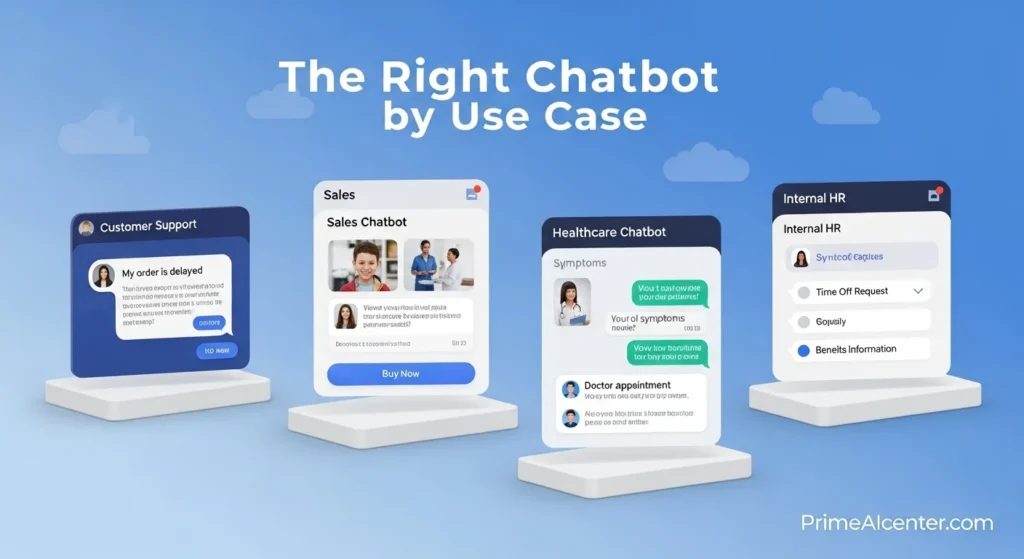
| Your Situation | Best Tool | Why |
|---|---|---|
| General professional work | ChatGPT Plus | Broadest capability + ecosystem |
| Writing and long-form content | Claude Sonnet 4.6 | Best output quality for prose |
| Research and fact-checking | Perplexity Pro | Real-time sourced citations |
| Google Workspace user | Gemini Advanced | Native Docs/Gmail/Drive integration |
| Microsoft 365 user | Microsoft Copilot | Embedded in Word, Excel, Teams |
| Social media monitoring | Grok 4.20 | Real-time X data access |
| Document analysis | NotebookLM | Citation-accurate answers from your docs |
| Small business customer support | Tidio Lyro or Boei | Affordable, fast setup, free tiers |
| Enterprise customer support | Intercom Fin or Ada | High-volume resolution + compliance |
| Sales lead generation | Drift or HubSpot Breeze | CRM-native + visitor conversion |
| Business workflow automation | Zapier Chatbots or Lindy | Action-oriented, 7,000+ app connections |
| Full model control / self-hosting | LLaMA + Ollama | Open weights + zero cloud dependency |
| EU data compliance | Mistral Le Chat | European infrastructure + GDPR alignment |
| Deep analytical research | DeepSeek V4 | Long-form reasoning depth |
| Developer technical queries | Phind | Live technical documentation retrieval |
What 2026 Market Data Tells You
First Page Sage’s March 10, 2026 market share report confirms three patterns worth understanding before making tool decisions.
ChatGPT remains the leader but its market share has declined year-over-year. Gemini has declined more. Perplexity and Claude have each gained share consistently — Perplexity through its research differentiation, Claude through its writing and coding quality reputation. The market is not consolidating around one winner. It is fragmenting around use cases, and the winning strategy for professionals is the same one the data describes among power users: use multiple tools for different jobs rather than one tool for everything.
The fastest-growing segment in the chatbot category is not general-purpose assistants — it is specialized business tools. Developer-focused chatbots like Phind, customer-service-focused platforms like Intercom Fin and Ada, and sales-focused tools like Drift are growing faster than the general market because they solve a specific problem better than any general-purpose model. The businesses seeing the highest ROI from AI in 2026 are the ones who matched the right specialized tool to the right workflow rather than deploying ChatGPT for everything.
The free tier landscape improved dramatically in early 2026. Claude Sonnet 4.6 is free on claude.ai. GPT-5.4 Mini is accessible free via ChatGPT’s Thinking feature. NotebookLM remains completely free. LLaMA and Ollama remove cloud costs entirely for users with their own hardware. For the first time, a professional-grade AI workflow is achievable at near-zero cost — and that changes the calculus for every budget-constrained team evaluating these tools. For more on using AI tools to build productive, cost-effective workflows, see our GEO Optimization guide and our GEO Ranking Techniques for staying visible as AI reshapes search.
FAQS: Best AI Chatbots
What is the best AI chatbot in 2026?
ChatGPT with GPT-5.4 is the best overall AI chatbot in 2026 — SaaS CRM Review scores it 9.2/10. Claude Sonnet 4.6 is better for writing quality and coding (9.0/10). Perplexity is best for research with cited sources. The right choice depends on your use case: ChatGPT for versatility, Claude for quality, Perplexity for research accuracy.
What is the best free AI chatbot in 2026?
Several strong free options exist in 2026. Claude Sonnet 4.6 is the free default on claude.ai. ChatGPT’s free tier now includes GPT-5.4 Mini via the Thinking feature. NotebookLM is completely free for document-based research. Grok is included with X Premium. HuggingChat provides free access to multiple open-source models. MetaAI is free inside Instagram, Facebook, and WhatsApp.
Is Claude better than ChatGPT in 2026?
Claude Opus 4.6 leads ChatGPT GPT-5.4 on SWE-Bench Verified (80.8% vs ~80%) and long-form writing quality. ChatGPT leads on computer use (75% OSWorld), ecosystem breadth, and overall Intelligence Index score (57 vs 53). Claude is better for writing, analysis, and coding quality. ChatGPT is better for versatility and ecosystem integrations. Most professional users benefit from using both.
What is the best AI chatbot for business in 2026?
Depends on the business use case. For customer support: Intercom Fin or Ada for enterprise, Tidio or Boei for SMBs. For sales lead generation: Drift. For workflow automation: Zapier Chatbots or Lindy. For general professional productivity: ChatGPT Business or Claude Team. For Microsoft 365 organizations: Microsoft Copilot.
What is the best AI chatbot for customer service in 2026?
Intercom Fin for SaaS and e-commerce, Ada for large enterprise with multilingual requirements, Zendesk AI for teams already on Zendesk, Tidio Lyro for small businesses starting out, Chatbase for highly customized knowledge-base deployments, and Boei for flat-rate SMB deployments across 50+ channels.
What are the best free open-source AI chatbots in 2026?
LLaMA (Meta) is the best open-source foundation model. Ollama makes it easy to run LLaMA and other models locally at zero cost. HuggingChat provides free web access to multiple open-source models. DeepSeek V4 offers strong analytical reasoning at no cost. Mistral Le Chat provides EU-compliant free access to Mistral’s model family.
What is the best AI chatbot for research in 2026?
Perplexity AI is the best AI research tool — every answer includes verifiable citations from real-time web sources. NotebookLM is the best tool for research using your own documents. Phind is best for developer technical research. You.com is best for users who want AI answers alongside traditional search results. Perplexity Comet extends research into a full AI browsing environment.
How much do AI chatbots cost in 2026?
Most leading AI chatbots offer free tiers. Paid plans for general-purpose models: ChatGPT Plus ($20/month), Claude Pro ($20/month), Gemini Advanced ($20/month), Perplexity Pro ($20/month), Microsoft Copilot Pro ($22/month). Customer service platforms range from €14/month (Boei) to $39/seat/month (Intercom) to enterprise contracts. Open-source options like LLaMA are free with infrastructure costs only.
What is the difference between an AI chatbot and an AI agent in 2026?
An AI chatbot responds to prompts in conversation — you ask, it answers. An AI agent plans and executes multi-step tasks autonomously with minimal user input. Tools like Manus, Lindy, and Zapier Chatbots operate as agents — completing tasks end-to-end rather than answering questions. Most general-purpose chatbots (ChatGPT, Claude, Gemini) now include agent-like capabilities through their advanced features.
Which AI chatbot is best for writing in 2026?
Claude is widely regarded as the best AI chatbot for writing quality in 2026. SaaS CRM Review scores it 9.0/10 specifically noting that outputs “read more naturally than most competitors.” Claude Sonnet 4.6 is available free on claude.ai. For long-form articles, reports, and creative writing, Claude consistently outperforms ChatGPT on output naturalness and instruction-following precision.