
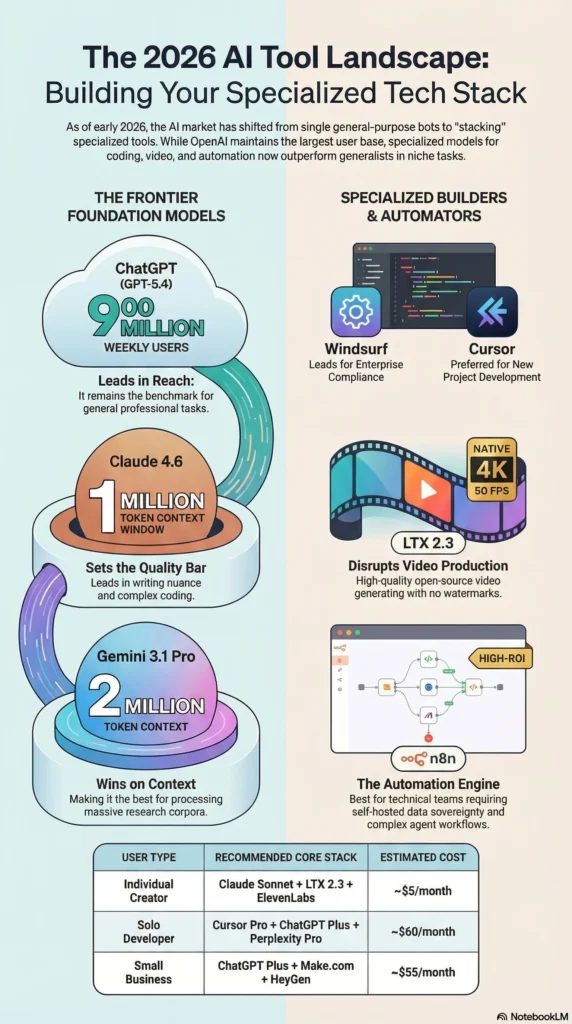
OpenAI now has 900 million weekly active users. The a16z ranking of the 100 most-used AI tools shows ChatGPT generating nearly 2.7x more web traffic than its closest competitor in early 2026. And yet the same data reveals something more important: the market is fragmenting fast. Users are not replacing ChatGPT with one tool — they are stacking specialized tools on top of it for specific jobs.
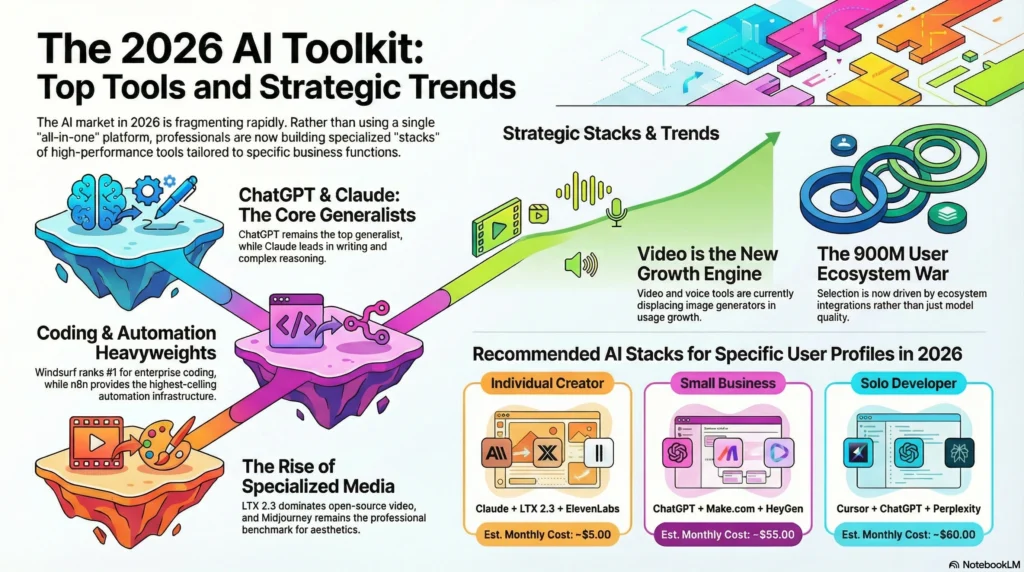
That fragmentation is exactly the problem this guide solves. There are thousands of AI tools in 2026. Most lists just name them. This one tells you which ones actually work, what they cost, who they are right for, and which ones are not worth your time despite the hype. We reviewed 30 Best AI Tools 2026 across six categories using real benchmarks, LogRocket’s March 2026 Power Rankings, and independent community testing data.
No sponsored picks. No filler. A direct answer to which tools belong in your stack right now.
AI Chatbots and Foundation Models
The foundation model you choose shapes everything else. Three names dominate — but the performance gap between them has narrowed considerably in Q1 2026, and pricing is increasingly the real decision point.
1. ChatGPT — GPT-5.4 (OpenAI)
ChatGPT remains the most-used AI product on the planet. GPT-5.4, released March 5, 2026, scores 57 on the Artificial Analysis Intelligence Index — tied with Gemini 3.1 Pro at the global top. The model achieves a 33% reduction in hallucinations versus GPT-5.2 and a 75% score on OSWorld-Verified for computer use, surpassing human performance at 72.4%. The ecosystem is unmatched: 220+ connected apps, GPT-5.4 Mini on the free tier via the Thinking feature, Sora 2 for video, and DALL-E 3 for images — all inside one subscription.
For most users, ChatGPT is the default starting point because it handles more tasks well than any other single tool. It is not always the best specialized tool — Claude leads on writing quality, Gemini on context length — but nothing matches its breadth.
Best for: General professional work, research, writing, coding, and any workflow needing a single tool that handles everything.
Pricing: Free (GPT-5.4 Mini via Thinking) / $20/month Plus / $200/month Pro
Verdict: Still the benchmark. The most capable generalist in 2026.
2. Claude — Opus 4.6 and Sonnet 4.6 (Anthropic)
Claude Opus 4.6 scores 53 on the Artificial Analysis Intelligence Index and 80.8% on SWE-Bench Verified — the strongest coding score of any model currently available. Claude Sonnet 4.6 is the free default on claude.ai and is preferred over Opus 4.5 in Claude Code 59% of the time, meaning it delivers near-flagship output at a lower price. The 1M token context window in beta makes it the right choice for long-document analysis, extended code reviews, and large research tasks that exhaust other models.
The practical difference from ChatGPT: Claude is materially better at long-form writing quality, nuanced reasoning, and complex multi-file code. For content creators and researchers who produce a lot of text daily, Claude Sonnet 4.6 is the stronger daily driver.
Best for: Writing quality, long-form content, complex coding, large document analysis.
Pricing: Free (Sonnet 4.6) / $20/month Pro / API from $3/M input (Sonnet 4.6)
Verdict: Best model for writing and code quality. The specialist to ChatGPT’s generalist.
3. Gemini 3.1 Pro (Google)
Gemini 3.1 Pro entered LogRocket’s rankings at #2 in March 2026 with a 77.1% ARC-AGI-2 score — more than doubling its predecessor’s reasoning performance. Priced identically to Gemini 3 Pro at $2/$12 per million tokens, it offers one of the best price-to-performance ratios in the frontier tier. The 2M-token context window — the largest available — makes it the right choice for processing extremely long documents, hours of video, or entire research corpora in a single session. Its integration as the reasoning backend for the new Siri on iOS 26.4 is perhaps its most significant distribution advantage. For the full breakdown, see our new Siri iOS 26 guide.
Best for: Long-context processing, multimodal analysis, cost-effective frontier reasoning.
Pricing: Free (Gemini app) / $20/month Advanced / $2/$12 per million tokens API
Verdict: Best context length and price-to-performance. Narrow general gap versus GPT-5.4.
4. Perplexity AI
Perplexity has replaced Google for research tasks among a fast-growing segment of knowledge workers. Every answer includes sourced citations you can verify — a fundamental advantage over ChatGPT and Claude for research work where accuracy matters. Pro Search and the Comet browser extend it into a full web intelligence platform. a16z’s January 2026 data ranks Perplexity among the top AI platforms by traffic — remarkable for a product launched well after ChatGPT. The limitation: it is a research tool, not a generation tool. It does not write articles or generate code. For research and fact-checking, it has no peer on this list.
Best for: Research, fact-checking, real-time information synthesis, replacing Google for knowledge work.
Pricing: Free / $20/month Pro
Verdict: Best AI research tool available. Essential for professionals who work with information daily.
5. Grok 4.20 (xAI)
Grok 4.20, released March 2026, is integrated natively into X and has real-time access to the platform’s entire data stream. For trend monitoring, social listening, and staying current on breaking developments, this gives Grok a capability no other model can replicate. Image and video generation are available directly inside X without additional subscriptions. For most professional users, Grok complements ChatGPT or Claude rather than replacing them — the real-time X integration is genuinely valuable for marketers and researchers tracking live developments, but the general reasoning performance does not lead the field.
Best for: Real-time trend monitoring, social listening, X platform workflows, breaking news research.
Pricing: Free (limited) / included with X Premium ($8-16/month)
Verdict: Best for real-time social intelligence. A complement, not a replacement, for general work.
AI Coding Tools
The coding tool category changed more in Q1 2026 than any other. Three acquisitions, two major pricing changes, and a new class of terminal agents reshaped the competitive landscape. LogRocket’s March 2026 Power Rankings are the most reliable current reference point for this category. For more on how AI agents are changing software development, see our guide to AI agents and our Enterprise AI Agent Deployment guide.
6. Windsurf Wave 13 (Cognition)
Windsurf held the #1 position in LogRocket’s March 2026 AI Dev Tool Power Rankings. Wave 13 introduced parallel Cascade sessions with Git worktrees, a dedicated Cascade Terminal in its own zsh profile, and made SWE-1.5 free for all users through March 2026. SWE-1.5 runs 13x faster than Claude Sonnet 4.5 at near-SOTA coding quality on Cerebras hardware at 950 tokens per second for paid users.
The significant development this month: Windsurf raised its Pro plan from $15 to $20 and replaced its credit system with daily usage quotas. The change sparked developer backlash — heavy users report quota exhaustion in two intensive days. For enterprise teams with compliance requirements (HIPAA, FedRAMP, ITAR), Windsurf is the only viable choice since Cursor offers SOC 2 only.
Best for: Large codebase navigation, enterprise compliance, teams using JetBrains IDEs, continuous development sessions.
Pricing: Free / $20/month Pro / $40/user/month Teams
Verdict: #1 for large codebases and enterprise. Daily quota system hurt value for heavy burst users.
7. Cursor (Anysphere)
Cursor ranks #2 in LogRocket’s March 2026 Power Rankings. JetBrains support launched this month — removing the most-requested limitation for 18 months. Bugbot adds autonomous PR branch scanning with single-click fixes. Parallel background subagents and Automations handle recurring workflows without manual prompting. The Composer model runs 4x faster than competitors with support for eight simultaneous parallel agents. Multi-model access — GPT-5.4, Claude Opus 4.6, Gemini 3.1 Pro, Grok Code — is Cursor’s clearest advantage over Windsurf.
In aimultiple’s real-world web app benchmark, Cursor ranked #1 in both frontend and backend task completion — outperforming Windsurf on self-contained feature development. The .cursorrules ecosystem (thousands of community-shared configurations) compounds Cursor’s value over time.
Best for: Greenfield development, feature sprints, multi-model access, developers who want granular AI control.
Pricing: Free / $20/month Pro / $40/user/month Teams
Verdict: Best for new project development and maximum control. Now price-equal with Windsurf.
8. Antigravity
Antigravity holds the #2 position in LogRocket’s March 2026 AI Dev Tool Power Rankings — above Cursor — due to its free multi-model access during preview. It supports Claude Opus 4.5, Gemini 3 Flash, GPT-OSS, and others at no cost. For developers who want access to multiple frontier models in a coding environment without the $20/month commitment, Antigravity is the clearest free option in March 2026. Preview pricing will not last indefinitely — evaluate before it changes. For more context on accessing frontier models free, see our guide to free frontier AI tools.
Best for: Developers wanting multi-model free access during preview period.
Pricing: Free (preview) — post-preview pricing TBD
Verdict: Best free coding tool in March 2026. Act before preview ends.
9. Claude Code (Anthropic)
Claude Code is Anthropic’s terminal-based coding agent released March 2026. It operates outside any IDE — full filesystem access, shell command execution, autonomous multi-step engineering work without GUI overhead. Claude Opus 4.6 scores 66.3 on ClawEval agentic benchmarks — the highest of any model — making Claude Code the strongest option for complex autonomous engineering tasks that exceed IDE-based agents. For the WebMCP infrastructure that connects agents to web resources, see our WebMCP Tutorial.
Best for: Full-codebase autonomous refactoring, complex multi-step engineering, teams already on Claude API.
Pricing: Usage-based via Claude API ($5/$25 per million tokens for Opus 4.6)
Verdict: Best autonomous terminal agent for complex engineering. Not a daily IDE — a power tool.
10. GitHub Copilot
GitHub Copilot added a full autonomous coding agent in 2026: assign GitHub issues directly, receive autonomous PRs back. The tightest GitHub integration of any tool on this list. At $10/month Pro it is the most affordable paid coding AI available — half the price of Windsurf and Cursor. The general agentic capability does not match either IDE, but for GitHub-native teams who do not want to change their IDE, Copilot is the pragmatic choice.
Best for: GitHub-native teams, developers who want AI without changing their IDE, budget-conscious developers.
Pricing: Free (limited) / $10/month Pro / $19/user/month Business
Verdict: Best budget coding AI. Most practical for teams fully committed to the GitHub ecosystem.
AI Video Generation
AI video crossed a professional quality threshold in early 2026. The category is now defined by the choice between closed commercial tools (Veo, Kling, Runway) and the open-source challenger (LTX 2.3) — a gap that narrowed dramatically with LTX 2.3’s March release.
11. Google Veo 3.1
Veo 3.1 is the category leader for native audio, dialogue, and physics realism. It generates synchronized speech, ambient sound, and music in a single diffusion pass — dialogue that matches lip movement, environmental sound that fits the scene. For agencies, brand campaigns, and content requiring professional voiceover quality, nothing on this list competes with Veo 3.1’s audio output. The cost reflects the quality: approximately $0.20/second via API.
Best for: Dialogue-heavy content, talking-head ads, audio-critical campaigns, professional agency work.
Pricing: ~$0.20/second via API / available through Google Vertex AI
Verdict: Best audio-visual quality in the category. The price matches the output.
12. Kling AI — Kling 3.0
Kling 3.0 leads the category for multi-shot narrative generation and character consistency across scenes. Native multi-shot sequences (3-15 seconds with consistent subject across camera angles) have no equivalent in any other tool on this list. For content requiring the same character across multiple shots — product ads, short films, social series — Kling is the right choice. Pricing at $0.07-$0.14/second places it between LTX 2.3 and Veo 3.1.
Best for: Multi-shot narratives, character consistency, high-volume UGC, social media series.
Pricing: ~$0.07-$0.14/second / subscription plans available
Verdict: Best for narrative continuity and character consistency across shots.
13. Runway Gen-4.5
Runway Gen-4.5 leads independent benchmarks for character consistency within single shots and VFX-quality output. The World Consistency architecture keeps a person, product, or environment visually stable across a generated clip — essential for brand content where visual identity is non-negotiable. Pricing at $0.15-$0.40/second is steep but justified for the output quality on character-critical brand work.
Best for: Brand campaigns, product visualization, VFX-heavy content, single-shot character consistency.
Pricing: $12/month Standard / $28/month Pro / $76/month Unlimited
Verdict: Best character consistency for brand work. Expensive for high-volume production.
14. LTX 2.3 (Lightricks) — Open Source
LTX 2.3, released March 5, 2026, is the most significant open-source AI video release to date. A 22-billion-parameter Diffusion Transformer generating native 4K at 50 FPS with synchronized audio, native portrait mode (1080×1920), no watermark, and no cloud dependency — free locally for organizations under $10M revenue. Model weights are on HuggingFace, code on GitHub, and desktop app at LTX Desktop. At ~$0.04/second via fal.ai, it is the cheapest production-grade video API in 2026. Awesome Agents scored it 8.2/10 on March 20, 2026.
Best for: Budget-conscious creators, social media portrait content, developers building video products, privacy-sensitive local workflows.
Pricing: Free (local) / ~$0.04/second via fal.ai API
Verdict: Best free AI video tool in 2026. Closes the quality gap with paid tools for most creator use cases.
15. Sora 2 (OpenAI)
Sora 2 focuses on cinematic, story-driven clips with emotional coherence and dialogue integration. Included directly in ChatGPT Plus and Pro — no separate subscription required — making it the most accessible AI video for users already paying for ChatGPT. Strong for narrative and emotionally resonant short-form content. The limitation: no standalone API, which limits developer integration compared to LTX 2.3 or Veo 3.1.
Best for: Story-driven cinematic video, ChatGPT Plus/Pro users who need video without a separate subscription.
Pricing: Included with ChatGPT Plus ($20/month) and Pro ($200/month)
Verdict: Best narrative video for ChatGPT users. Not suited for high-volume commercial production.
AI Image Generation
Image generation is commoditizing. The a16z data confirms standalone image tools are losing ground to ChatGPT and Gemini’s native image capabilities. The tools that survive will be those with specialized capabilities general-purpose models cannot match. For how image content affects AI search rankings, see our GEO Optimization guide.
16. Midjourney V7
Midjourney V7 remains the aesthetic benchmark. For photorealistic editorial imagery, artistic illustration, and brand visual identity, no tool produces output that design professionals consistently prefer over Midjourney in blind comparisons. The web interface launched alongside Discord access. The lack of a public API limits automated production pipelines — the tool is optimized for creative professionals who prompt manually.
Best for: Editorial imagery, brand identity, artistic illustration, professional visual creative work.
Pricing: $10/month Basic / $30/month Standard / $60/month Pro
Verdict: Still the aesthetic leader. Limited for automated pipelines.
17. DALL-E 3 (OpenAI)
DALL-E 3 is the most accessible image generation tool because it requires no separate subscription — included in ChatGPT Plus and available with limited usage on the free tier. Strong for text-heavy images (logos, product mockups with text) and photorealistic commercial imagery. For ChatGPT users who need image generation without managing another tool, DALL-E 3 is the obvious starting point. Output lacks Midjourney’s artistic quality for purely aesthetic work.
Best for: Commercial imagery, product mockups, text-in-image content, users already on ChatGPT.
Pricing: Included with ChatGPT Plus / limited on free tier
Verdict: Best for accessibility and commercial use. Not the artistic leader.
18. Flux (Black Forest Labs)
Flux Pro is the leading open-weights image model for photorealism and anatomical accuracy. The Flux.1 family (Pro, Dev, Schnell) covers production output to rapid local iteration. API access, open weights, and fine-tuning capabilities make it the most flexible professional option for developers building image generation into products. Midjourney has better aesthetics; Flux has better infrastructure and developer access.
Best for: Photorealistic imagery, product visualization, developers building image features, fine-tuned style models.
Pricing: API-based from $0.003/image (Schnell) / Pro higher
Verdict: Best open-weights image model for developers and photorealism.
19. Adobe Firefly
Adobe Firefly is the only major image generation tool trained exclusively on licensed content — Adobe Stock, openly licensed works, and public domain material. The only tool suitable for commercial work where IP clearance is non-negotiable. Generative Fill, Generative Expand, and Text Effects integrate directly into Photoshop and Illustrator. For teams with legal or compliance requirements, Firefly is not a creative choice — it is a compliance necessity.
Best for: Commercially safe imagery, design team workflows, legally clearable AI content for enterprise.
Pricing: Included in Adobe Creative Cloud / standalone credits available
Verdict: The only IP-safe choice for enterprise commercial use. Best legal protection, not best image quality.
20. Ideogram 3.0
Ideogram 3.0 leads the field on text rendering accuracy. For image content that includes readable text — posters, social media graphics, product labels, infographics — Ideogram’s accuracy is materially better than Midjourney, DALL-E 3, and Flux. V3 added photorealistic mode and improved general quality to a competitive level, making it a capable general tool that excels at the specific use case every other model handles poorly.
Best for: Images with text (posters, graphics, labels, infographics), social media creative.
Pricing: Free (limited) / $8/month Starter / $20/month Plus
Verdict: Best text-in-image tool available. Use Midjourney for text-free artistic work, Ideogram when your image needs readable text.
AI Automation Tools
The automation category delivers the highest ROI for businesses in 2026. McKinsey estimates AI-accelerated automation could unlock hundreds of billions in annual value. These tools connect AI models to real workflows — replacing the repetitive work that consumes the majority of knowledge worker time. For real-world automation use cases, see our WhatsApp AI Agents guide.
21. n8n
n8n is the most powerful open-source automation platform in 2026. AI agent workflows embed models directly into automation sequences — research, data enrichment, and decision-making run automatically. Self-hosting makes it the right choice for organizations with data sovereignty requirements. The learning curve is steeper than Zapier or Make.com, but the power ceiling is correspondingly higher. For technical teams building serious automation infrastructure, n8n is the professional-grade choice.
Best for: Technical teams, self-hosted automation, complex multi-step AI workflows, data-sensitive organizations.
Pricing: Open source (self-hosted free) / $20/month Starter cloud / $50/month Pro
Verdict: Best automation tool for technical teams. Highest capability ceiling in the category.
22. Zapier
Zapier connects 7,000+ apps with AI-enhanced automation steps available across its workflow builder. For non-technical users who need to automate processes between SaaS tools without writing code, Zapier is the most accessible and best-documented option. AI steps (summarization, categorization, extraction) integrate Claude, GPT-5.4, and Gemini directly into Zaps. The limitation: per-task pricing becomes expensive for high-volume workflows compared to n8n and Make.com.
Best for: Non-technical users, SaaS-to-SaaS automation, teams that need setup speed over maximum power.
Pricing: Free (100 tasks/month) / $19.99/month Starter / $49/month Professional
Verdict: Best automation tool for non-technical users. Outgrown by technical teams at scale.
23. Make.com
Make.com sits between Zapier’s accessibility and n8n’s power. Its visual workflow builder supports complex branching logic, error handling, and data transformation without server management overhead. Operations-based pricing makes it more economical than Zapier for high-frequency workflows. For growing teams that have outgrown Zapier but are not ready for n8n’s technical demands, Make.com is the right step up.
Best for: Growing teams, complex branching workflows, mid-scale automation with visual building.
Pricing: Free (1,000 operations/month) / $9/month Core / $16/month Pro
Verdict: Best mid-market automation tool. The natural step between Zapier and n8n.
24. OpenClaw (OpenAI)
OpenClaw was the most-starred repository on GitHub before its acquisition by OpenAI — surpassing both React and Linux in stars. It is an open-source agentic framework that connects AI models to tools, understands user intent, and executes multi-step tasks end-to-end. For developers building AI-powered products rather than automating existing workflows, OpenClaw is the most important new tool in this category. For context on how agent frameworks work, see our WebMCP Tutorial and our AI agents guide.
Best for: Developers building AI agent products, teams integrating AI into custom applications.
Pricing: Open source (self-hosted free)
Verdict: Most important open-source agentic framework in 2026. Requires development resources — not a no-code tool.
25. Microsoft Copilot (Wave 2)
Microsoft Copilot Wave 2 introduced Copilot Pages — a multiplayer AI collaboration canvas — and deep integration across Excel (with Python), PowerPoint, Teams, SharePoint, and Outlook. Python in Excel allows finance teams to perform advanced forecasting using natural language. For organizations already in Microsoft 365, Copilot provides AI automation across the tools employees already use without new software procurement. Highest ROI for organizations where Excel, Teams, and Outlook are the primary productivity tools.
Best for: Microsoft 365 organizations, finance teams (Excel + Python), enterprise workflow automation within Microsoft tools.
Pricing: $30/user/month (Microsoft 365 Copilot)
Verdict: Best choice for Microsoft 365 organizations. Limited value for teams outside the Microsoft ecosystem.
AI Productivity Tools
These tools extend AI into specific workflows: research, note-taking, presentations, voice, and video communication. They complement foundation models rather than replace them. For how AI search is changing content discovery, see our GEO Ranking Techniques guide.
26. NotebookLM (Google)
NotebookLM answers questions using your own documents with citations. Upload PDFs, research papers, or meeting transcripts and ask detailed questions — NotebookLM cites specific passages. The Audio Overview feature converts source material into podcast-style conversations. For researchers and professionals who work with large document sets, NotebookLM solves a problem general-purpose chatbots handle poorly: maintaining accurate, citable knowledge from a specific source set.
Best for: Research, document-heavy workflows, knowledge synthesis from multiple sources.
Pricing: Free / included in Google One AI Premium
Verdict: Best document-based research tool available. Genuinely useful and genuinely free.
27. ElevenLabs
ElevenLabs is the voice generation standard. Voice cloning and text-to-speech quality — naturalness, emotional range, multilingual accuracy — leads the field by a meaningful margin. Converts scripts to audio in minutes. For creators producing podcasts, audiobooks, and video narration, ElevenLabs enables a complete audio content pipeline without recording equipment. Combined with Claude or ChatGPT for scripting, the entire audio production workflow becomes one person and a laptop.
Best for: Podcast production, audiobook creation, video narration, multilingual voice content at scale.
Pricing: Free (limited) / $5/month Starter / $22/month Creator / $99/month Pro
Verdict: Best AI voice generation tool. Category leader with no close second for naturalness.
28. HeyGen
HeyGen generates presenter-style videos using AI avatars that speak in multiple languages with lip-sync accurate dubbing. Clones appearance and voice from a short video sample to create a personalized avatar that speaks any script in any language. For enterprises scaling video content across markets — onboarding, sales scripts, training — HeyGen replaces a production team for most corporate video use cases at a fraction of the cost.
Best for: Corporate training, onboarding, sales content, multilingual video production without a production team.
Pricing: Free (limited) / $29/month Creator / $89/month Business
Verdict: Best AI avatar video tool. Replaces a production team for most corporate video workflows.
29. Gamma
Gamma builds full presentations from text prompts. Describe your topic, audience, and key points — Gamma returns a complete deck with structure, layout, design, and images. The Remix feature restructures existing content into new presentation formats. For professionals who produce presentations regularly without design resources, Gamma eliminates the gap between having an idea and having a shareable deck. Output quality is not Figma-level — but for internal communication, client pitches, and educational content, it delivers professional results in minutes.
Best for: Presentation creation, internal communication decks, rapid content repurposing into visual formats.
Pricing: Free (limited) / $8/month Plus / $15/month Pro
Verdict: Best AI presentation tool. Replaces PowerPoint for building presentations from scratch.
30. Perplexity Comet
Perplexity Comet is the AI browser launched in mid-2025 that extends Perplexity’s real-time research capabilities into a full browsing environment. It aggregates web data, tracks research threads across sessions, and surfaces relevant information as you browse without manual search queries. For professionals who spend significant time researching and synthesizing web content, Comet reduces the overhead of managing research context across dozens of tabs. The natural evolution of AI-assisted research from chat interface to full browsing environment.
Best for: Research-intensive professionals, journalists, analysts, knowledge workers who need continuous web intelligence.
Pricing: Included with Perplexity Pro ($20/month)
Verdict: The most forward-looking productivity tool on this list. Changes how research-intensive work gets done.
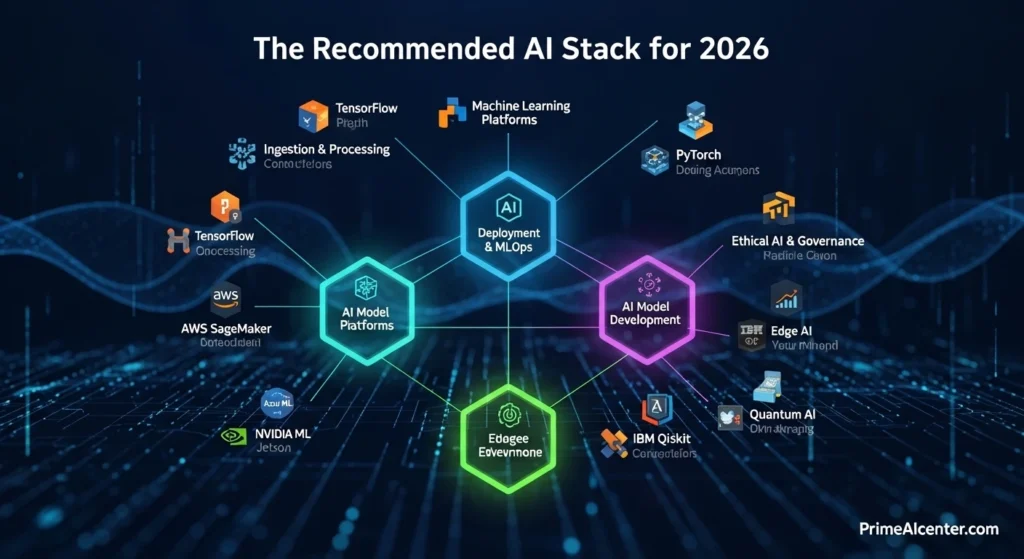
The Recommended AI Stack for 2026
| User Type | Core Stack | Monthly Cost |
|---|---|---|
| Individual Creator | Claude Sonnet 4.6 (free) + LTX 2.3 (free local) + ElevenLabs Starter + Gamma Free + NotebookLM (free) | $5/month |
| Solo Developer | Cursor Pro + Antigravity (free) + ChatGPT Plus + Perplexity Pro | $60/month |
| Content Agency | Claude Pro + Kling AI + Midjourney Standard + ElevenLabs Creator + HeyGen Creator + Zapier Starter | ~$140/month |
| Small Business | ChatGPT Plus + Make.com Pro + HeyGen Creator + Gamma Pro + NotebookLM (free) | ~$55/month |
| Developer Team | Windsurf Teams + Claude API + n8n Pro + Perplexity Pro | ~$110/month per developer |
| Enterprise | Windsurf Enterprise + Microsoft Copilot + Adobe Firefly (CC) + Veo 3.1 (usage) | Custom |
What the Data Tells You About Where AI Is Heading in 2026
The a16z January 2026 ranking reveals three structural trends worth building your tool decisions around.
First, image generation is commoditizing. Standalone image tools are losing ground as ChatGPT and Gemini integrate native image generation that is good enough for most use cases. The tools that survive will be specialists: Firefly for commercial safety, Ideogram for text-in-image, Flux for developers who need API access and fine-tuning.
Second, video is replacing image as the growth category. The a16z ranking shows video, music, and voice tools displacing image generators in the top lists. LTX 2.3’s open-source release and Veo 3.1’s audio quality are the leading edges of a wave that will make AI video as accessible as AI text by end of 2026.
Third, the competition is now ecosystem-driven. ChatGPT’s 220 connected apps versus Claude’s growing professional connector ecosystem is not a feature race — it is a platform war. The AI tool you choose in 2026 increasingly determines which ecosystem’s integrations you access. OpenAI is building a mass-market super app. Anthropic is building a professional operating system. Choosing between them is less about model quality and more about which integrations your specific workflow needs most.
FAQS: Best AI Tools 2026
What are the best AI tools in 2026?
The best AI tools in 2026 depend on your use case. For general professional work: ChatGPT GPT-5.4 or Claude Sonnet 4.6. For coding: Windsurf or Cursor. For video: LTX 2.3 (free) or Veo 3.1 (professional). For image: Midjourney (artistic) or Adobe Firefly (commercial safety). For automation: n8n (technical) or Zapier (non-technical). For productivity: NotebookLM for research and ElevenLabs for voice.
What is the best free AI tool in 2026?
Several strong free options exist. Claude Sonnet 4.6 is the free default on claude.ai. ChatGPT’s free tier includes GPT-5.4 Mini via the Thinking feature. NotebookLM is completely free for document research. LTX 2.3 generates watermark-free video locally at zero cost. Antigravity provides free access to multiple frontier coding models during its preview period.
Which AI tools are best for content creators in 2026?
For content creators: Claude Sonnet 4.6 for writing, LTX 2.3 for social video (native portrait mode, no watermark), ElevenLabs for voice, Ideogram for text-in-image graphics, and Gamma for presentations. Total cost using free tiers strategically: as low as $5/month.
Is ChatGPT still the best AI in 2026?
ChatGPT with GPT-5.4 ties with Gemini 3.1 Pro at the top of the Artificial Analysis Intelligence Index in March 2026. It remains the most-used AI globally with 900 million weekly active users. However, Claude Opus 4.6 leads on coding and writing quality, Gemini 3.1 Pro on context length, and Windsurf on coding tool rankings. ChatGPT is the best generalist — not always the best specialist.
What AI tools are best for small businesses in 2026?
The highest-ROI AI stack for small businesses: ChatGPT Plus or Claude Pro ($20/month), Make.com for workflow automation ($9-16/month), HeyGen for video content ($29/month), and Gamma for presentations (free tier available). The right stack saves 15-20 hours per employee per week.
What is the best AI coding tool in 2026?
LogRocket’s March 2026 Power Rankings put Windsurf at #1 and Cursor at #2. Both cost $20/month Pro after Windsurf’s March 19 price change. Windsurf is better for large codebases and enterprise compliance. Cursor is better for greenfield development and multi-model access. Antigravity is the best free option during its preview period. GitHub Copilot at $10/month is the most affordable paid choice for GitHub-native teams.
What AI automation tools are worth paying for in 2026?
n8n for technical teams (open source, $20-50/month cloud), Zapier for accessibility ($20-49/month), Make.com for growing teams ($9-16/month), and Microsoft Copilot for 365 organizations ($30/user/month). At $20-50/month, the ROI calculation is straightforward for any team paying more than $15/hour in labor costs for repetitive tasks.
What AI tools actually make money in 2026?
AI tools generate income through three main models: affiliate commissions from reviewing and recommending tools, productized services (AI video production, automation consulting, content creation at scale), and building AI-powered products using APIs. Highest-earning categories: AI video production services ($50-500/video), AI automation consulting ($100-300/hour), and content creation using AI writing and image tools.
What is the best AI video generator in 2026?
Veo 3.1 for professional audio-visual quality. Kling AI for character consistency and multi-shot narratives. Runway Gen-4.5 for brand campaigns and VFX. LTX 2.3 for free, no-watermark, open-source video with portrait mode. Sora 2 for narrative video within ChatGPT. Best choice depends on whether you prioritize audio quality, character consistency, or budget.