
The GEO Optimization Framework: Why LLMs Prioritize Your Competitors (And How to Change That)
Is your content invisible to the machines that now rule search? In 2026, the digital landscape has shifted from “ranking on page one” to “being the answer.” As AI Overviews and LLM-powered engines like Perplexity and Search Generative Experience (SGE) take over, traditional tactics are failing. Enter GEO Optimization (Generative Engine Optimization)—the critical evolution of SEO designed to ensure your brand isn’t just indexed, but cited and synthesized as the primary authority by Large Language Models.
In this masterclass, we break down how GEO Optimization works, why it’s the only way to survive the “Zero-Click” era, and the exact framework you need to dominate AI search results.
Introduction: Why Search Is Fundamentally Changing
Search is no longer a list of blue links competing for attention. By 2026, the dominant interface for information discovery is increasingly driven by AI-generated answers, LLM-powered summaries, and conversational search experiences.
Google’s Search Generative Experience (SGE), Bing Copilot, Perplexity, and enterprise-grade LLM search engines have redefined how content is consumed, evaluated, and cited. Instead of ranking ten web pages and letting users decide, modern search engines now synthesize knowledge directly, citing a small subset of trusted sources to construct a single authoritative response.
This shift introduces a new optimization discipline: Generative Engine Optimization (GEO).
GEO is not an evolution of SEO. It is a parallel optimization layer focused on ensuring that your content is:
- Understood by large language models
- Selected as a trusted citation source
- Extractable, quotable, and contextually reliable
- Aligned with AI-driven intent resolution
Traditional SEO optimizes for rank position. GEO optimizes for inclusion in the answer itself.
In a world where users increasingly accept AI summaries without clicking through, visibility is no longer about traffic alone. It is about authority injection into machine-generated knowledge.
From Ranking Pages to Training Machines
Search engines powered by LLMs do not behave like classical crawlers. They do not simply index keywords and backlinks. Instead, they evaluate:
- Semantic coherence
- Factual density
- Entity relationships
- Contextual completeness
- Source trustworthiness
When an AI Overview answers a query, it is effectively performing a real-time synthesis task. The pages it references are chosen not because they rank #1, but because they provide clean, unambiguous, high-signal information that can be safely reused.
GEO exists to engineer content for this exact selection process.
Traditional SEO vs GEO Optimization
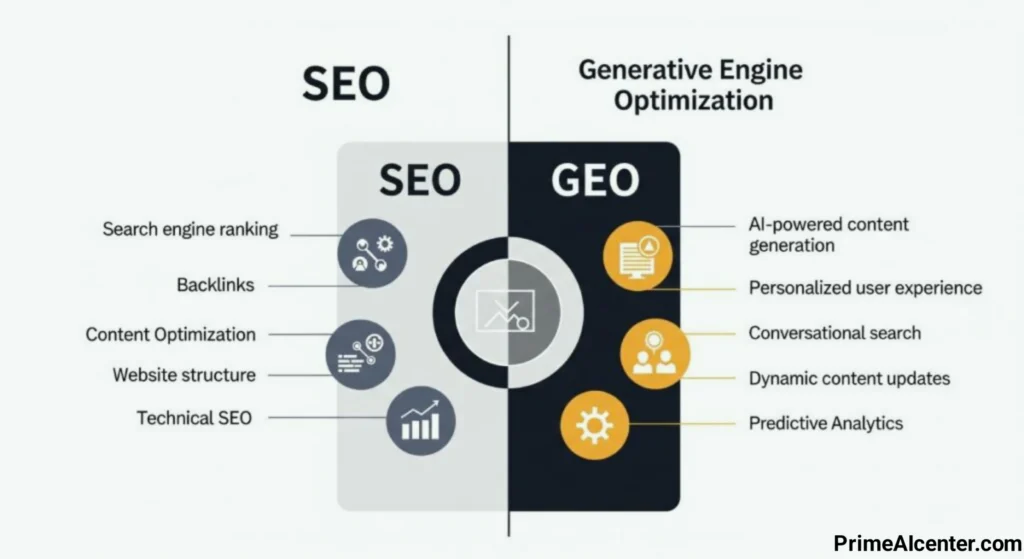
To understand why GEO requires a fundamentally different mindset, the following table outlines the core differences between Traditional SEO and Generative Engine Optimization.
| Dimension | Traditional SEO | GEO Optimization |
|---|---|---|
| Primary Goal | Rank pages in SERPs | Be cited and synthesized by AI engines |
| Core Output | Clicks and organic traffic | Answer inclusion and authority signaling |
| Ranking Factors | Backlinks, keywords, CTR, dwell time | Semantic clarity, factual accuracy, entity depth, structure |
| User Intent Model | Query-to-page matching | Query-to-answer resolution |
| AI Processing | Limited NLP for ranking signals | Full semantic parsing, summarization, reasoning |
| Content Structure | Optimized for readers and crawlers | Optimized for machine extraction and reuse |
| Authority Signals | Domain authority and link equity | Entity authority, citation reliability, factual consistency |
| Measurement of ROI | Traffic, rankings, conversions | AI visibility, citation frequency, brand mention persistence |
How LLMs Process and Cite Digital Content
1. Content Ingestion and Representation
Large Language Models such as GPT-4 and Gemini do not “read” pages like humans. They transform content into high-dimensional vector representations that encode:
- Meaning rather than keywords
- Relationships between entities
- Contextual intent and constraints
Poorly structured content, ambiguous phrasing, and marketing-heavy language degrade these representations, making the content less reusable in generative responses.
2. Retrieval-Augmented Generation (RAG)
Modern AI search engines rely heavily on Retrieval-Augmented Generation. In this architecture:
- The model retrieves a small set of documents
- Extracts relevant passages
- Synthesizes a unified answer
GEO-optimized content is engineered to survive this retrieval filter by being:
- Explicit in definitions
- Precise in terminology
- Modular and sectioned
- Low in fluff, high in signal
3. Citation and Trust Selection
AI Overviews and LLM-based search engines apply internal trust heuristics when deciding which sources to cite. These heuristics evaluate:
- Topical authority consistency
- Historical accuracy of the domain
- Entity alignment with known knowledge graphs
- Absence of contradictions and hallucination risk
Unlike traditional SEO, where backlinks can artificially inflate authority, GEO rewards epistemic reliability. If your content repeatedly provides clean, verifiable explanations, it becomes a preferred source for AI synthesis.
4. Why This Changes Optimization Forever
LLMs do not optimize for engagement. They optimize for correctness, usefulness, and coherence. This means:
- Clickbait loses value
- Keyword stuffing becomes irrelevant
- Clear explanations outperform clever copy
GEO is the discipline of aligning your digital presence with how machines learn, reason, and communicate.
The Core Pillars of GEO Optimization
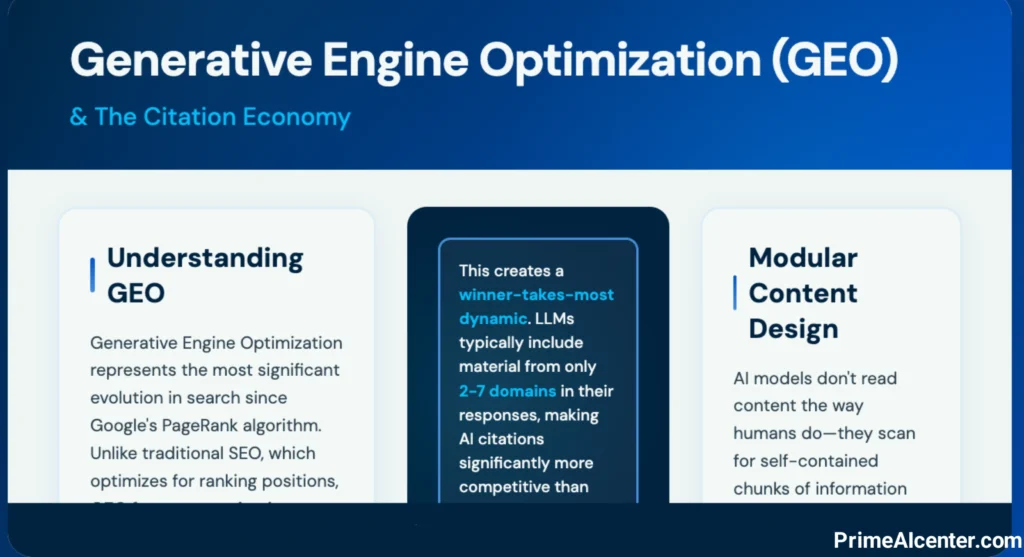
Generative Engine Optimization is not a checklist tactic. It is a structural discipline that aligns content creation with how large language models understand, evaluate, and reuse information. In this section, we break down the foundational pillars that determine whether your content is ignored, summarized, or cited as an authoritative source in AI-generated answers.
1. Semantic Density & Entity-Based Writing
Traditional SEO teaches creators to optimize for keywords. GEO requires a shift toward entities.
An entity is a uniquely identifiable concept, object, organization, or person that exists independently of language. Google’s Knowledge Graph, Bing’s Satori, and internal LLM knowledge representations are all built around entities and their relationships, not strings of text.
For example, “GEO Optimization” is not just a keyword. It is an entity connected to:
- Search Generative Experience (SGE)
- Large Language Models
- AI Overviews
- Retrieval-Augmented Generation (RAG)
- Traditional SEO
Semantic density refers to how efficiently your content expresses these entity relationships without redundancy or ambiguity. High semantic density does not mean long paragraphs. It means each sentence adds new, non-overlapping information about the entity.
Consider the difference between these two explanations:
Poor for LLMs:
“GEO optimization is a new SEO strategy that helps websites rank better in AI search engines by using modern techniques.”
Optimized for LLMs:
“Generative Engine Optimization (GEO) is the practice of structuring digital content so that large language models can accurately extract, synthesize, and cite it when generating AI-based search responses.”
The second version defines the entity clearly, establishes its function, and connects it directly to LLM behavior. This clarity dramatically increases the likelihood of reuse in AI-generated answers.
2. Citation Optimization Strategies
In the GEO era, visibility is no longer about ranking first. It is about being selected as a citation source. AI Overviews typically reference a small number of sources that meet strict internal quality thresholds.
Below are three actionable strategies to increase citation probability.
Strategy 1: Direct Answer Patterns
LLMs favor content that provides immediate, well-structured answers. This mirrors how encyclopedias and technical documentation are written.
Effective patterns include:
- “X is defined as…”
- “The primary function of X is…”
- “X differs from Y in three key ways…”
These patterns reduce interpretation effort for the model and make extraction safer.
Strategy 2: Explicit Lists and Ordered Logic
AI systems prefer content that exposes internal structure. Numbered lists, clear sequences, and cause-effect explanations are easier to transform into generated answers.
Instead of embedding insights inside narrative paragraphs, surface them explicitly:
- Define the concept
- Explain how it works
- Describe why it matters
Strategy 3: Neutral, Verifiable Claims
AI systems avoid citing sources that make exaggerated, promotional, or unverifiable claims. Statements like “the best,” “revolutionary,” or “guaranteed” introduce hallucination risk.
Replace them with:
- Measured language
- Technical explanations
- Cause-based reasoning
3. The “Source” Strategy and Off-Page GEO
GEO is not confined to your website. Large language models learn authority through distributed consensus. When the same brand or concept appears consistently across trusted platforms, its credibility increases.
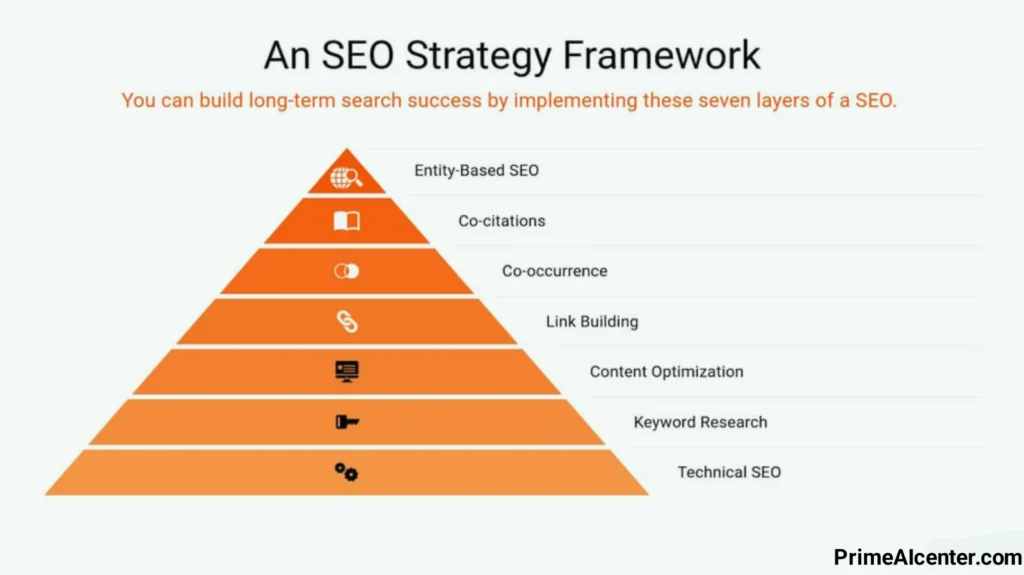
High-signal platforms include:
- Reddit (topic-specific subreddits)
- Quora (expert-level answers)
- Niche forums and professional communities
- Technical blogs and documentation hubs
The goal is not link building. It is entity reinforcement.
When your brand is mentioned in explanatory, non-promotional contexts, it becomes associated with specific knowledge domains. Over time, LLMs learn that association and increase trust.
Effective off-page GEO practices include:
- Publishing detailed answers under your brand identity
- Being cited organically by others in discussions
- Maintaining consistency in terminology and positioning
4. Tone and Authoritative Neutrality
Tone is no longer a stylistic choice. It is a ranking and citation factor.
LLMs are optimized to avoid misinformation and bias. Content that appears emotionally charged, overly persuasive, or commercially aggressive is treated as lower reliability.
Authoritative neutrality means:
- Confident but restrained language
- Clear explanations without hype
- Focus on accuracy over persuasion
This does not mean your content must be dull. It means credibility is earned through precision, not enthusiasm.
5. Technical Structure: The Chunking Method
One of the most overlooked GEO tactics is content chunking.
AI systems do not ingest entire pages as a single unit. They extract discrete sections, often at the paragraph or subsection level, known as information chunks.
Each chunk should:
- Address one clear question or concept
- Be semantically self-contained
- Use descriptive subheadings
- Avoid cross-dependencies
Effective chunking allows AI engines to lift specific explanations without misrepresenting the source.
Structurally, this means:
- Shorter paragraphs with higher density
- Clear H2 and H3 hierarchy
- Minimal filler transitions
GEO Pro-Tip: Every subheading should function as a question the AI might answer. Every paragraph beneath it should resolve that question fully.
Together, these pillars form the foundation of GEO. In the next section, we will move from principles to execution, outlining advanced frameworks, measurement models, and real-world GEO workflows.
Implementation at Scale – From SEO to GEO
Understanding GEO is meaningless without execution. The transition from traditional SEO to Generative Engine Optimization is not a redesign. It is an operational shift that affects content architecture, authority signals, and measurement frameworks.
Below is a pragmatic, enterprise-ready roadmap for implementing GEO today.
Step 1: GEO Audit (Semantic & Entity Analysis)
A GEO audit goes beyond keyword gaps. It evaluates whether your existing content can be safely reused by large language models.
Key audit dimensions include:
- Entity clarity: Are core concepts explicitly defined?
- Semantic overlap: Does content repeat ideas without adding value?
- Extraction risk: Would isolated paragraphs remain accurate?
- Tone neutrality: Is language informational or promotional?
The output of a GEO audit is not a keyword list. It is a map of entity weaknesses and ambiguity zones that reduce AI trust.
Step 2: Information Architecture Rebuild
GEO favors structured knowledge over blog-style storytelling. This requires reorganizing content around entities and questions rather than campaigns.
Effective GEO architecture includes:
- Pillar pages that define core entities
- Supporting pages that explain sub-entities
- Clear internal linking that reinforces entity relationships
Each page should answer one primary question completely, instead of partially addressing multiple intents.
Step 3: Content Synthesis and Rewriting
GEO content is not written. It is synthesized.
This means:
- Replacing narrative intros with definitions
- Breaking long articles into extractable sections
- Removing opinion unless it is explicitly labeled
The goal is to reduce cognitive load for both humans and machines.
Step 4: Authority Building Beyond Links
Authority in GEO is cumulative and distributed. Backlinks still matter, but they are no longer sufficient.
Priority actions include:
- Consistent brand mentions in expert discussions
- Participation in high-signal Q&A platforms
- Publishing reference-grade content
Authority is established when multiple independent sources describe your brand using similar language.
Step 5: Tracking AI Visibility and Citations
GEO success is measured by presence, not position.
Tracking must include:
- AI Overview citations
- Brand mentions in generative answers
- Consistency of entity associations
Industry-Specific GEO Use Cases

SaaS and B2B: Documentation as a GEO Asset
For SaaS companies, documentation is the highest-value GEO surface.
LLMs frequently cite:
- API references
- Setup guides
- Technical explanations
Optimized documentation uses:
- Explicit definitions at the top of each page
- Clear use-case segmentation
- Error-state explanations
When AI tools answer “How does X work?”, they prefer documentation over marketing pages.
E-commerce: Structured Product Reviews for AI Assistants
AI shopping assistants prioritize products with clear, structured evaluation data.
Effective GEO for e-commerce includes:
- Pros and cons lists
- Use-case-specific performance
- Objective comparisons
Reviews written as analysis outperform emotional testimonials in AI synthesis.
Local Business: GEO for Hyper-Local AI Queries
Local GEO is about contextual relevance.
AI-driven local queries often include:
- Service availability
- Geographic qualifiers
- Reputation signals
Structured service pages, consistent NAP data, and neutral reviews improve AI map-based recommendations.
The GEO Tech Stack
GEO requires new measurement tools. Key categories include:
- AI SERP Monitors: Track AI Overview appearances
- Brand Mention Trackers: Detect LLM citation frequency
- Entity Analysis Tools: Map topical authority
- Log File Analyzers: Observe AI crawler behavior
- Content QA Systems: Validate factual consistency
Future Trends: GEO in 2027 and Beyond
Multimodal GEO
LLMs are becoming multimodal. GEO will extend beyond text into:
- Voice search optimization
- Video transcript structuring
- Image metadata and visual entities
Content that aligns text, audio, and visuals into a unified entity representation will dominate AI answers.
Conclusion: Mastering the New Era of AI-Driven Search
The transition from traditional search to generative discovery isn’t just a trend—it’s a fundamental shift in the digital contract between creators and platforms. As we’ve explored, GEO Optimization is the key to remaining relevant in a world where AI models act as the ultimate gatekeepers of information.
Success in 2026 no longer belongs to those who can “game the system” with keywords, but to those who provide the highest semantic value, factual clarity, and entity authority. By implementing the strategies outlined in this guide—from information chunking to authoritative neutrality—you are positioning your brand to be the primary source that AI engines trust, cite, and recommend.
The bottom line: In the era of Generative Engine Optimization, your goal is to become the “Knowledge Blueprint” for your industry. Don’t wait for your traffic to drop; start optimizing for the machines that are already shaping the future of human intent.
🚀 Ready to dominate? Start your first GEO audit today and ensure your brand is the voice behind the AI’s answer.