
Claude Mythos Review 2026: Anthropic’s Most Powerful AI Model Explained (Leaked Details, Capabilities & Release Date)
Anthropic never planned to announce Claude Mythos this way. On March 26, 2026, a basic configuration error in the company’s content management system accidentally exposed close to 3,000 unpublished internal documents to the open internet — including a complete draft launch post for a new AI model unlike anything the company had released before. Within hours, Fortune had reviewed the leaked files, cybersecurity stocks had started falling, and the AI world was collectively asking the same question: what exactly is Claude Mythos, and why is Anthropic so worried about it?
This is our full review of Claude Mythos — what we know from confirmed sources, what the leaked documents reveal, how it compares to every major model currently available, and what it means for developers, businesses, and the future of AI safety. We cover the Capybara tier, the cybersecurity paradox, the IPO angle, release timeline projections, and a brutally honest assessment of both the opportunity and the risk.
If you are trying to understand whether Claude Mythos matters for your work or business, this review covers everything you need to know as of March 31, 2026.
Claude Mythos at a Glance
| Detail | What We Know |
|---|---|
| Developer | Anthropic |
| Model Name | Claude Mythos (also referenced as Capybara) |
| Tier | Capybara — new fourth tier above Opus |
| Revealed | March 26–27, 2026 via accidental data leak |
| Training Status | Complete (confirmed by Anthropic) |
| Availability | Early access only (select cyber defense orgs) |
| Public Release | No confirmed date — Q3 2026 analyst consensus |
| Pricing | Not announced — estimated 2–3× Opus pricing |
| Key Strengths | Cybersecurity, coding, academic reasoning |
| Key Risk | “Unprecedented cybersecurity risks” per Anthropic |
| Anthropic’s Description | “A step change — the most capable we’ve built to date” |
How Did the Claude Mythos Leak Happen?
The leak was caused by a simple but consequential misconfiguration. Anthropic’s content management system was set to make uploaded assets publicly accessible by default — unless a team member explicitly changed the privacy setting. No one on the team managing the Mythos launch materials remembered to flip that switch.
Two independent cybersecurity researchers discovered the exposed data store: Roy Paz, senior AI security researcher at LayerX Security, and Alexandre Pauwels, a researcher at the University of Cambridge. They found approximately 3,000 unpublished assets linked to Anthropic’s blog — including draft launch announcements, internal planning documents, and details of an invite-only two-day CEO retreat at an 18th-century English countryside manor that Anthropic CEO Dario Amodei was scheduled to attend.
Fortune reviewed the materials and notified Anthropic on the evening of March 26. Anthropic restricted public access shortly after — but the information was already public. The company officially acknowledged the model in a statement, attributing the incident to “human error in the configuration of its content management system.”
The irony was immediate and widely noted. A company warning in its leaked documents that its new model poses “unprecedented cybersecurity risks” had exposed those same documents through one of the most basic security failures imaginable. As Futurism put it, Anthropic had leaked its upcoming model with unprecedented cybersecurity risks in the most ironic way possible.
The leak is directly relevant to understanding Mythos — it is the primary source of confirmed details, and Anthropic’s official statements since have largely confirmed rather than contradicted what the documents revealed. You can read the original reporting in Fortune’s exclusive report on the Claude Mythos leak.
What Is the Capybara Tier?
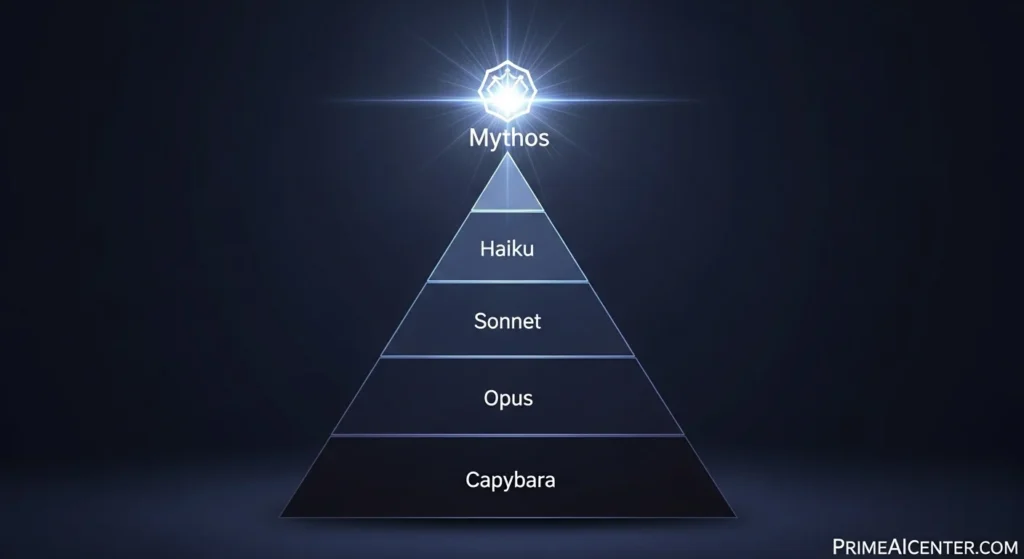
To understand Claude Mythos, you first need to understand where it sits in Anthropic’s product hierarchy. Until this leak, Anthropic offered three tiers of models:
- Haiku — fastest, cheapest, lightest
- Sonnet — balanced performance and cost
- Opus — most capable, most expensive
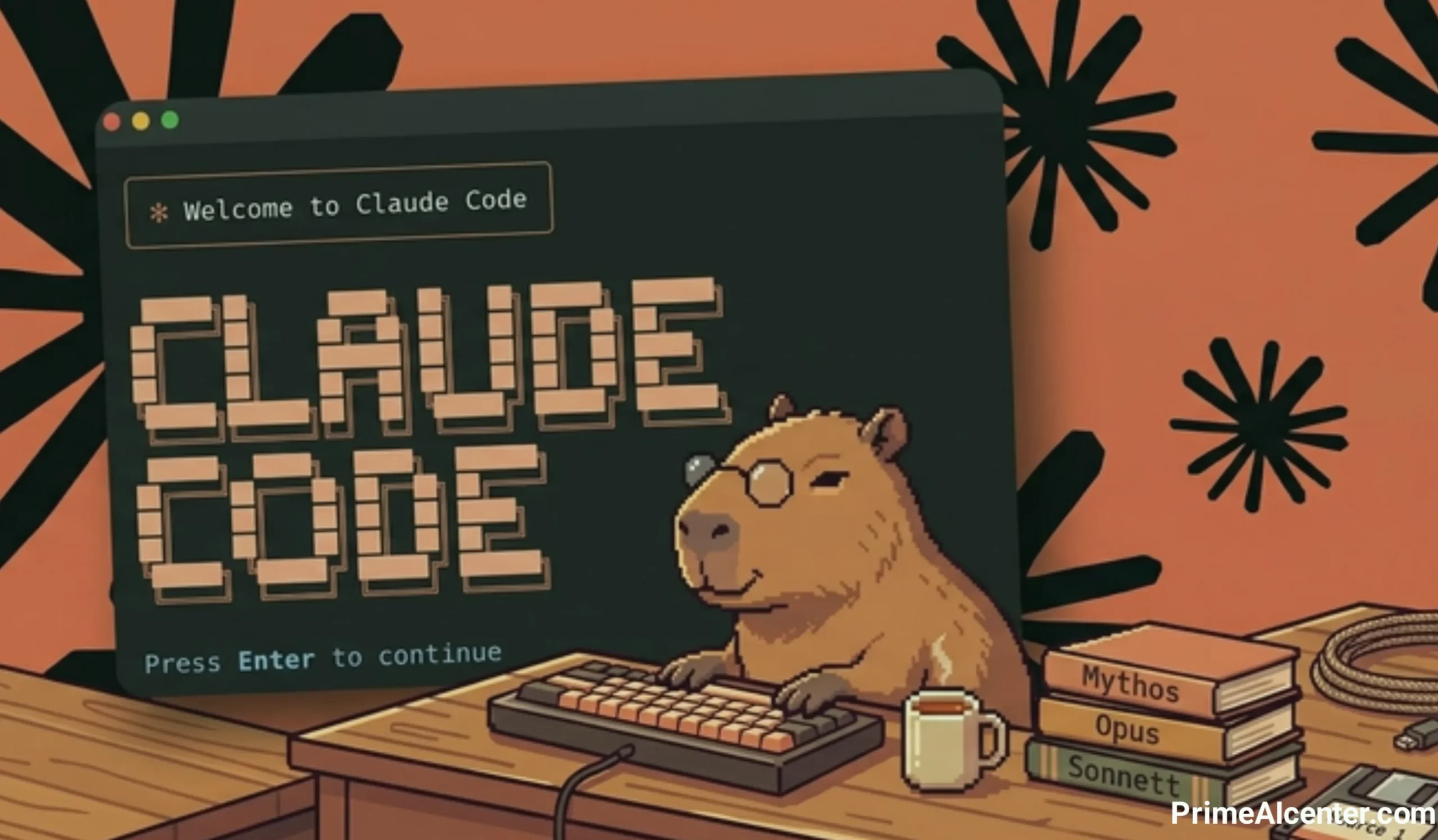
Claude Mythos introduces a fourth tier — Capybara — that sits above Opus entirely. The leaked draft described Capybara as “a new name for a new tier of model: larger and more intelligent than our Opus models, which were, until now, our most powerful.”
This is not an incremental upgrade. The shift from Opus to Capybara is structurally similar to the jump from GPT-3.5 to GPT-4 — a qualitative leap in capability rather than a version number increment. If you have been building applications on top of the best available Claude model, Claude Opus 4.6 just became the second-best option Anthropic has ever built.
| Tier | Current Model | Speed | Capability Level | Estimated Cost Range |
|---|---|---|---|---|
| Capybara (NEW) | Claude Mythos | Slower | ⭐⭐⭐⭐⭐ Step-change | ~$30–$45 / $150–$225 per M tokens (est.) |
| Opus | Claude Opus 4.6 | Moderate | ⭐⭐⭐⭐ High | $15 / $75 per M tokens |
| Sonnet | Claude Sonnet 4.6 | Fast | ⭐⭐⭐ Balanced | Moderate |
| Haiku | Claude Haiku 4.5 | Fastest | ⭐⭐ Lightweight | Low |
The naming question — Mythos vs. Capybara — has caused some confusion. The leaked data store contained two versions of the same draft blog post. The first version used Mythos throughout. The second had Capybara substituted in — but the subtitle still read “We have finished training a new AI model: Claude Mythos.” The most consistent interpretation: Capybara is the tier name, Mythos is the specific model within that tier. Anthropic appears to have been choosing between the two names at the time of the leak.
Claude Mythos Capabilities: Full Review
The leaked draft described Claude Mythos as scoring “dramatically higher” than Claude Opus 4.6 across three primary domains. Anthropic confirmed “meaningful advances in reasoning, coding, and cybersecurity” in its official statement. Here is a detailed breakdown of what we know about each area.
1. Cybersecurity — The Category-Defining Capability
This is where Claude Mythos diverges most sharply from every other model currently available. The leaked documents described the model as “currently far ahead of any other AI model in cyber capabilities” — language Anthropic does not use lightly. The draft went further, warning that Mythos “presages an upcoming wave of models that can exploit vulnerabilities in ways that far outpace the efforts of defenders.”
To appreciate the significance of this claim, consider what Claude Opus 4.6 already demonstrated before Mythos existed. Anthropic’s engineers used Opus 4.6 to identify more than 500 high-severity vulnerabilities in open-source production codebases. In one documented case, the model deduced the existence of a software flaw by analyzing a developer comment buried in a changelog — without being given the code itself. Mythos is described as dramatically beyond that.
The dual-use nature of these capabilities is the core tension: the same model that can scan your codebase for vulnerabilities and patch them can also be used to exploit those vulnerabilities at scale. Anthropic is restricting early access to cybersecurity defense organizations specifically to give defenders a head start before the model’s offensive capabilities become more broadly available. This is confirmed in the leaked draft and in Axios reporting on Anthropic’s government briefings about Claude Mythos.
A Dark Reading survey conducted after the leak found that 48% of cybersecurity professionals now rank agentic AI as the number one attack vector for 2026 — above deepfakes and every other threat category.
For a broader view of how AI agents are transforming enterprise security and deployment, see our guide to enterprise AI agent deployment and our breakdown of what AI agents actually are.
2. Software Coding
Claude Opus 4.6 had already topped Terminal-Bench 2.0 at 65.4%, surpassing GPT-5.2-Codex and establishing itself as the preferred model for developers building production applications. Claude Code — Anthropic’s AI-assisted development tool — became the de facto standard in enterprise software development through early 2026. Mythos is described as “dramatically higher” on coding benchmarks than Opus 4.6.
The practical implication is significant. AI-generated code from Mythos would be harder to distinguish from human-written code, more architecturally sound, and — given the cybersecurity capabilities — less likely to contain exploitable vulnerabilities. For development teams already using Claude Code, Mythos integration would represent a meaningful productivity and quality leap rather than an incremental improvement.
If you are evaluating AI coding tools right now, our Kilo Code review covers the current landscape of AI-powered development environments while we wait for Mythos access to expand.
3. Academic and Complex Reasoning
The third domain where Mythos outperforms Opus 4.6 is multi-step academic reasoning — the kind of structured problem-solving required for research analysis, legal review, financial modeling, and complex decision-making. Anthropic confirmed “meaningful advances in reasoning” in its official statement. No specific benchmark numbers have been released, but the description of “dramatic” improvement suggests this is more than a marginal gain on existing benchmarks.
The name Mythos itself signals something about this capability. The leaked draft explained it was chosen to evoke “the deep connective tissue that links together knowledge and ideas” — a model designed not for isolated task completion but for synthesizing information across domains in ways that produce genuinely novel insights. That framing is consistent with a model designed for agentic, multi-step workflows rather than single-turn question answering.
Claude Mythos Review: Benchmark Comparison
| Model | Company | Coding | Reasoning | Cybersecurity | Context Window | Availability |
|---|---|---|---|---|---|---|
| Claude Mythos | Anthropic | ⭐⭐⭐⭐⭐ | ⭐⭐⭐⭐⭐ | ⭐⭐⭐⭐⭐ (Category leader) | TBA | Early access only |
| GPT-5.4 | OpenAI | ⭐⭐⭐⭐ | ⭐⭐⭐⭐ | ⭐⭐⭐ | 1M tokens | Public (March 5, 2026) |
| Claude Opus 4.6 | Anthropic | ⭐⭐⭐⭐ | ⭐⭐⭐⭐ | ⭐⭐⭐⭐ | 200K tokens | Public |
| Gemini 3.1 Pro | Google DeepMind | ⭐⭐⭐⭐ | ⭐⭐⭐⭐ | ⭐⭐⭐ | 1M tokens | Public (Feb 2026) |
| Grok 4.20 | xAI | ⭐⭐⭐⭐ | ⭐⭐⭐ | ⭐⭐⭐ | TBA | Beta |
| Qwen 3.5 | Alibaba | ⭐⭐⭐ | ⭐⭐⭐ | ⭐⭐ | TBA | Public (open weights) |
For a comprehensive comparison of every major AI model currently available to the public, our best AI chatbots guide and best AI tools of 2026 cover the full landscape. We also have a detailed Gemini 3.1 Pro review for the model currently competing directly with Claude Opus 4.6.
The Cybersecurity Paradox: Why Anthropic Is Worried About Its Own Model
The most unusual aspect of the Claude Mythos story is that Anthropic is simultaneously proud of what it has built and genuinely concerned about releasing it. The leaked draft blog post described Mythos as posing “unprecedented cybersecurity risks” — and Anthropic has been actively briefing government officials about those risks before the model reaches the public.
According to Axios reporting on Claude Mythos cybersecurity briefings, Anthropic is privately warning senior government officials that Mythos makes large-scale cyberattacks substantially more likely in 2026. The model’s agentic capabilities allow it to autonomously identify, access, and exploit vulnerabilities with a level of sophistication that outpaces current defensive tooling.
This risk is not theoretical. Anthropic previously disclosed that a Chinese state-sponsored group had used Claude Code to infiltrate approximately 30 organizations — tech companies, financial institutions, and government agencies — by pretending to work for legitimate security-testing organizations. The company detected and disrupted the operation over a ten-day period. Mythos would make such operations meaningfully more capable. You can read more about the previous Claude system prompt security incident in our earlier coverage of the Claude system prompt leak.
The market’s reaction was swift. According to Yahoo Finance reporting on cybersecurity stocks after the Mythos leak, Palo Alto Networks fell nearly 10% in the week following the disclosure. The iShares Tech-Software ETF dropped 3% on the day of the leak. Investors are pricing in the possibility that AI-native security tools could erode the value proposition of traditional cybersecurity vendors.
Anthropic’s response to this paradox has been methodical: restrict early access to organizations specifically tasked with improving defensive capabilities, work to make the model more efficient before broader release, and complete rigorous safety evaluations under its Responsible Scaling Policy before general availability. Whether that approach is sufficient is a question the AI safety community is actively debating.
Claude Mythos vs. GPT-5.4: Direct Comparison
GPT-5.4, released by OpenAI on March 5, 2026, is currently the most capable publicly available AI model. It features a 1-million-token context window, strong agentic workflow support, and scored 75% on OSWorld-V — slightly above the human baseline of 72.4%. It represents a genuine step forward from GPT-5.2 and has become the benchmark comparison point for every new model release.
Here is how Claude Mythos compares based on available information:
| Factor | Claude Mythos | GPT-5.4 |
|---|---|---|
| Cybersecurity | Category leader (“far ahead of any other model”) | Strong but not specialized |
| Coding | Dramatically above Opus 4.6 (highest ever for Anthropic) | 75% OSWorld-V, strong agentic coding |
| Context Window | Not disclosed | 1 million tokens |
| Reasoning | Step-change improvement (confirmed) | Strong multi-step reasoning |
| Availability | Early access only | Publicly available |
| Pricing | TBA — estimated 2–3× Opus | Standard GPT-5 pricing |
| Agentic Workflows | “Improved consistency in agent workflows” (per leak) | Multi-step autonomous task execution |
| API Compatibility | Drop-in upgrade from Opus 4.6 | Standard OpenAI API |
The honest answer is that a direct benchmark comparison is not yet possible because Mythos has not been publicly released. What we can say: the leaked description of Mythos’s cybersecurity capabilities has no equivalent in GPT-5.4’s public documentation, and Anthropic’s track record on coding benchmarks (Opus 4.6 leading Terminal-Bench 2.0) gives credibility to the claim of “dramatic” improvement. GPT-5.4 has the advantage of being available right now.
Claude Mythos Release Date: What the Prediction Markets Say
Anthropic has not announced a public release date. The official position is that the timeline depends on safety evaluation outcomes, not a commercial schedule. However, several converging signals point toward a likely window.
Prediction markets — which aggregate real-money bets from informed traders — currently show:
| Release Milestone | Prediction Market Probability |
|---|---|
| Public release by May 2026 | 30% |
| Public release by June 2026 | 42% |
| Public release by July 2026 | 67% |
| Public release by August 2026 | 74% |
| Public release by October 2026 | 80% |
The IPO context matters here. Bloomberg and The Information both reported on March 27 — the same day the leak broke — that Anthropic is considering an IPO as early as October 2026, potentially raising up to $60 billion. Launching Mythos before or alongside the IPO would maximize market impact and serve as concrete evidence of technical leadership for institutional investors. This creates commercial pressure to release by late Q3 2026 at the latest.
At the same time, the model is described as “very expensive for us to serve” — meaning efficiency improvements through distillation or quantization are likely required before a cost-viable general release. That process typically takes several months. The most realistic scenario: expanded enterprise early access in Q2 2026, general API availability in Q3, consumer access on Claude.ai in Q4 alongside or after the IPO.
Claude Mythos Pricing: What to Expect
Anthropic has not published pricing for Claude Mythos. Based on current Opus 4.6 pricing ($15 per million input tokens, $75 per million output tokens) and the leaked description of Mythos as a tier above Opus, analyst estimates suggest:
| Scenario | Input (per M tokens) | Output (per M tokens) |
|---|---|---|
| Conservative (2× Opus) | ~$30 | ~$150 |
| Moderate (3× Opus) | ~$45 | ~$225 |
| Aggressive (5× Opus) | ~$75 | ~$375 |
The leaked draft explicitly stated the model is “very expensive for us to serve, and will be very expensive for our customers to use” — language that suggests the aggressive scenario is not out of the question at launch, with pricing expected to decrease as efficiency improves over time. This follows the same pattern as GPT-4 at launch versus its current pricing.
For businesses evaluating AI budget planning, our guide to making money with AI covers cost-effective strategies for integrating frontier models without breaking your budget.
What Claude Mythos Means for Developers
For developers currently building on the Claude API, the path to Mythos is straightforward. The API is model-agnostic — switching from Opus 4.6 to Mythos will require only a change to the model parameter string in API calls. Authentication, prompts, tool definitions, and streaming logic remain fully compatible.
The leaked draft confirmed that the Capybara tier supports the same tool use protocol as existing Claude models, including computer use, bash execution, and custom tool definitions. Mythos is specifically optimized for “improved consistency in agent workflows” — which is significant for any developer building multi-step autonomous pipelines.
If your application involves any of the following, Mythos will be particularly relevant:
- Automated code review and vulnerability detection
- Complex multi-step reasoning chains
- Agentic workflows requiring consistent behavior across long tasks
- Cybersecurity tooling for defense or compliance
- Research and academic analysis requiring high-accuracy synthesis
For developers exploring agentic architectures right now, our overview of WhatsApp AI agents and the WebMCP protocol cover practical deployment patterns you can implement today with Opus 4.6 as a foundation for Mythos-ready applications.
What Claude Mythos Means for Businesses
The business implications of Mythos extend significantly beyond the developer community. Several sectors face direct disruption from a model at this capability level:
Cybersecurity vendors: The immediate stock market reaction — Palo Alto Networks down nearly 10%, IGV down 3% — reflects a real structural question. If AI can find and remediate vulnerabilities faster than human-staffed security operations centers, what happens to the value proposition of traditional endpoint security? Organizations that integrate Mythos into their security workflows could achieve proactive threat detection that existing tools cannot match.
Software development firms: Claude Code has already displaced significant portions of the traditional software development market. Mythos integration would extend that displacement further, particularly in security-sensitive codebases where vulnerability-free code is a contractual requirement.
Enterprise AI strategy: For organizations currently planning AI infrastructure around Claude Opus 4.6 as a capability ceiling, the Capybara tier changes the equation. Building now for Mythos-ready architecture — agentic workflows, tool-use pipelines, security evaluation loops — is more valuable than waiting.
For solopreneurs and smaller businesses trying to understand how to position themselves relative to these developments, our best AI tools for solopreneurs covers the practical toolkit available today.
Claude Mythos and AI Regulation
Claude Mythos arrives at a moment of significant regulatory uncertainty in AI. On February 17, 2026, NIST announced an AI Agent Standards Initiative aimed at ensuring autonomous agents meet minimum safety requirements before being deployed in production systems. Claude Mythos — with its explicit cybersecurity capabilities and agentic architecture — will almost certainly be subject to those standards.
The EU AI Act enforcement timeline adds additional pressure. Anthropic’s Responsible Scaling Policy requires completed safety evaluations before broad deployment of models that reach certain capability thresholds. Mythos’s cybersecurity capabilities likely place it in the highest-risk category under that policy, meaning the evaluation process will be extensive.
Anthropic has been proactive on this front: the government briefings, the restricted early-access program focused on defense organizations, and the explicit safety framing in the leaked draft all reflect a company that understands what is at stake reputationally and commercially if a Mythos-enabled incident occurs before the IPO.
For background on how GEO and AI search optimization intersect with these regulatory developments, see our guides on GEO ranking techniques and GEO optimization strategies — the regulatory landscape is reshaping how AI models are cited and ranked in search as well.
The Competitive AI Race: Context for Claude Mythos
Claude Mythos did not emerge in isolation. The same week as the leak, OpenAI confirmed it had completed pretraining on its own next-generation model, internally codenamed Spud, with CEO Sam Altman describing it as capable of meaningfully accelerating economic output. A public launch is expected within weeks.
The broader competitive picture heading into Q2 2026 is more fragmented than it has ever been. Google released Gemini 3.1 Pro in February 2026 with a 1-million-token context window and multimodal capabilities across text, images, audio, video, and code. Alibaba shipped Qwen 3.5 with 201-language support and open weights. Moonshot AI released Kimi K2.5 with a swarm mode capable of orchestrating up to 100 sub-agents in parallel. Apple partnered with Google to integrate a 1.2-trillion-parameter Gemini model into iOS 26.4, as covered in our breakdown of New Siri iOS 26.
In this context, Mythos represents Anthropic’s attempt to escape the incremental benchmark competition and establish a genuinely new capability category — one where the primary differentiator is not context window size or benchmark scores but a qualitatively different level of autonomous reasoning and security awareness. Whether that strategy succeeds depends on whether the company can release Mythos at a price point and safety level that makes it commercially viable.
For the full picture of how AI model adoption is evolving — with statistics, market data, and adoption benchmarks — our comprehensive AI statistics guide is updated regularly.
Our Verdict: Claude Mythos Review Summary
Rating a model that is not yet publicly available requires a clear-eyed separation of what is confirmed from what is speculative. Here is our honest assessment based on everything we know as of March 31, 2026:
| Category | Score | Notes |
|---|---|---|
| Capabilities (potential) | ⭐⭐⭐⭐⭐ | Confirmed step-change in coding, reasoning, cybersecurity |
| Availability | ⭐⭐ | Early access only — no public release date |
| Pricing | ⭐⭐ | Expected to be very expensive — details TBA |
| Safety approach | ⭐⭐⭐⭐ | Deliberate, structured rollout — but risks are genuine |
| Developer readiness | ⭐⭐⭐⭐⭐ | Drop-in API upgrade from Opus 4.6 when available |
| Business impact | ⭐⭐⭐⭐⭐ | Category-defining for cybersecurity and dev tooling |
| Transparency | ⭐⭐⭐ | Accidental disclosure, but Anthropic confirmed details quickly |
Bottom line: Claude Mythos is not yet a product you can use — it is a preview of a capability threshold that will reshape the AI landscape when it arrives. The cybersecurity implications alone are significant enough to have moved global equity markets and prompted private government briefings. For developers and businesses building on AI today, the most valuable action is not to wait for Mythos but to build Mythos-ready architectures on Opus 4.6 now.
The model is real, training is complete, and early access is already underway. Q3 2026 is the most likely window for broader availability. When it arrives, it will not be an upgrade — it will be a new category.
Frequently Asked Questions
What is Claude Mythos?
Claude Mythos is Anthropic’s most powerful AI model to date, accidentally revealed through a data leak on March 26–27, 2026. It introduces a new fourth tier in Anthropic’s model hierarchy — called Capybara — that sits above Opus. Anthropic confirmed it represents a “step change” in AI capabilities with meaningful advances in reasoning, coding, and cybersecurity.
What is the Capybara tier in Claude?
Capybara is a new fourth product tier that Anthropic is adding above its existing Opus tier. Claude Mythos is the first model within this tier. The Capybara name appears to designate the tier, while Mythos is the specific model name — similar to how Claude Opus 4.6 is a model within the Opus tier.
When will Claude Mythos be released?
No official date has been confirmed. Prediction markets give 67% probability of public release by July 2026 and 74% by August 2026. Analyst consensus points to Q3 2026 for API access, potentially timed around Anthropic’s reported October 2026 IPO. Consumer access on Claude.ai would likely follow later.
How much will Claude Mythos cost?
No official pricing has been announced. Conservative estimates suggest 2–3× current Opus 4.6 pricing, meaning approximately $30–$45 per million input tokens and $150–$225 per million output tokens. The leaked draft described the model as “very expensive to serve,” suggesting higher initial pricing with potential reductions as efficiency improves.
What should developers do right now to prepare for Claude Mythos?
Build and test agentic workflows with Claude Opus 4.6, which will serve as a direct architectural foundation for Mythos integration. Monitor Anthropic’s official blog for April 2026 access announcements. Review your tool-use and agent architecture for Capybara-tier compatibility when specifications are released.
Sources used in this review: Fortune, Axios, Techzine, SiliconAngle, Euronews, Yahoo Finance, CoinDesk, The Decoder, Nerd Level Tech, Fello AI, Decode the Future, Claude Mythos Release Date Analysis, Manifold Markets prediction data, Uristocrat IPO analysis, Anthropic official. Page last updated April 1, 2026.