
Apple’s Siri is getting its most significant overhaul in 14 years. With iOS 26.4 confirmed and iOS 26.5 expected by late March 2026, the New Siri iOS 26 powered by Google Gemini is no longer a rumor — it is a confirmed, documented, imminent reality for 2.2 billion Apple devices worldwide.
This is not a minor update. Apple is replacing the intent-matching architecture that has powered Siri since 2011 with a neural reasoning engine backed by Google’s Gemini models. The result: on-screen context awareness, 10-step automated task chains, 50-turn conversational memory, and a Siri that can finally act instead of just respond.
This guide covers everything: the confirmed architecture, the real feature list, the privacy structure, what this means for how you use your iPhone — and what it means for businesses that depend on digital discovery when 2.2 billion AI assistants start completing tasks instead of sending users to search engines.
Apple Google Gemini deal: What Actually Happened
On January 12, 2026, Apple and Google released a joint statement that sent shockwaves through the tech industry:
“Apple and Google have entered into a multi-year collaboration under which the next generation of Apple Foundation Models will be based on Google’s Gemini models and cloud technology. These models will help power future Apple Intelligence features, including a more personalized Siri coming this year.”
This was not a surprise to everyone. Bloomberg’s Mark Gurman had reported in late 2025 that Apple was in advanced negotiations to pay Google approximately $1 billion per year for a custom Gemini model running on Apple’s Private Cloud Compute infrastructure. The announcement confirmed the deal was signed.
The strategic logic is straightforward. Apple spent 2025 watching OpenAI, Google, and Anthropic advance their models at a pace its own teams could not match. Rather than ship an inferior product, Apple made an unusual decision: it chose to pay for Google’s intelligence while maintaining control over everything else — the interface, the privacy layer, the hardware, and the user experience.
Apple CEO Tim Cook confirmed on the Q1 2026 earnings call: “We basically determined that Google’s AI technology would provide the most capable foundation for AFM, and we believe that we can unlock a lot of experiences and innovate in a key way due to the collaboration.”
What makes the deal architecturally interesting is the white-label structure. Gemini’s role is fully hidden from end users. There is no Google branding visible anywhere in the Siri interface. From a user’s perspective, this is Siri — just fundamentally smarter.
Apple’s current ChatGPT integration — available since iOS 18.2 — remains in place. The Gemini integration is not a replacement for ChatGPT in Siri. It is a replacement for Apple’s own Foundation Models as the reasoning backend. Apple confirmed to CNBC that the ChatGPT agreement is unchanged.
For context on how this AI partnership model is reshaping the industry, see our analysis of how AI agents are changing business in 2026.
Siri ios 26 release date
| Milestone | Date | Status |
|---|---|---|
| Apple-Google partnership announcement | January 12, 2026 | ✅ Confirmed |
| iOS 26.4 Release Candidate | March 18, 2026 | ✅ Released |
| iOS 26.4 Public Release | ~March 25, 2026 | 🔜 Expected |
| iOS 26.5 Developer Beta 1 | ~March 30, 2026 | 🔜 Expected |
| iOS 26.5 Public Release (Gemini Siri) | April–May 2026 | 📅 Planned |
| WWDC 2026 — iOS 27 Preview | June 2026 | 📅 Planned |
The timeline has been confirmed through multiple layers of reporting. 9to5Mac traced Apple’s exact release cadence — seven days between Release Candidate and public release, five days between public release and next developer beta — to project the iOS 26.5 beta landing on approximately March 30.
Ubergizmo confirmed this forecast independently, noting that an iOS 26.5 beta by late March would allow Apple to technically claim Q1 2026 delivery on its AI feature commitments — even if the broad consumer rollout happens in April or May.
Apple originally targeted iOS 26.4 for the first Gemini-powered features. Mark Gurman reported the shift to iOS 26.5 as the primary vehicle, with iOS 26.4 serving as a stability release. Features not ready for 26.5 will be deferred to WWDC 2026’s iOS 27 preview in June.
The practical implication: if you are an iPhone user waiting for a meaningfully smarter Siri, the wait ends within weeks, not months.
New Siri Features in iOS 26: The Full Confirmed List
| Feature | Description | Status |
|---|---|---|
| On-Screen Context Awareness | Siri reads and acts on what is currently displayed on your screen | ✅ iOS 26.4 |
| Multi-Step Task Chains | Up to 10 sequential actions from a single natural language request | ✅ iOS 26.4 |
| Gemini Reasoning Backend | Complex queries processed by Google Gemini via Apple’s privacy layer | ✅ iOS 26.4/26.5 |
| 50-Turn Conversational Memory | Siri remembers context across a full conversation session | ✅ iOS 26.4 |
| SiriKit Expansion | 340+ supported intent categories (up from 120 in iOS 25) | ✅ iOS 26.4 |
| Personal Context Understanding | Siri understands your calendar, email, and messages to personalize responses | ✅ iOS 26.5 |
| Cross-App Action Execution | Single requests that span multiple apps (email → calendar → messages) | ✅ iOS 26.5 |
| Safari + Spotlight AI Integration | Gemini-powered features extending beyond Siri to browser and search | 📅 Later 2026 |
| Smart Home AI Display | Hardware showcase for the new Siri — new home display device | 📅 2026 |
The SiriKit expansion from 120 to 340+ intent categories is the feature that matters most for developers and businesses. This means healthcare appointment booking, financial transaction approvals, real estate inquiries, and professional service scheduling now have dedicated frameworks developers can implement to make their apps fully Siri-native.
For a deeper look at how AI agents are reshaping business automation in 2026, see our Enterprise AI Agent Deployment guide.
On-Screen Context Awareness: What It Actually Does
On-screen context awareness is the single feature most likely to change how people use their iPhones daily. For the first time, Siri can see what is on your screen and use that information to take action — without you having to copy text, switch apps, or describe what you are looking at.
The on-screen analysis runs entirely on-device using Apple’s Neural Engine. Screen content is never sent to external servers. Only the resulting action request (the restaurant name, the flight details, the contact information) travels over the network when needed.
Real-World Examples — Confirmed in iOS 26.4
| Scenario | What You Say | What Siri Does |
|---|---|---|
| Safari — restaurant page open | “Book a table for two tonight” | Reads the restaurant name, checks OpenTable/Resy, completes the booking |
| Mail — flight confirmation open | “Add this to my calendar” | Extracts flight number, dates, times, terminal — creates full calendar event |
| Photos — business card photo | “Save this contact” | Reads name, phone, email, company from the image — creates contact |
| Instagram — product in post | “Find this cheaper” | Identifies the product, searches retail sources for lower prices |
| Maps — active route displayed | “Find a gas station on the way” | Understands the active route, suggests stations along the path |
| Messages — address in conversation | “Navigate there” | Extracts the address and opens it in Maps without copy-paste |
Developers can enhance this feature through a new ScreenContextProvider API that annotates UI elements with semantic metadata — allowing Siri to understand the meaning and available actions of app screens, not just their visual content. Apps implementing this API will have significantly richer Siri integrations than those relying on visual parsing alone.
This capability is directly relevant to content discovery. When Siri can read what is on a user’s screen and act on it, the apps and websites that make their content semantically clear — with structured data, schema markup, and clear intent signals — will be preferred by Siri’s action planner. For businesses, this is an immediate optimization priority. See our GEO Optimization guide for how to prepare your content for AI assistant discovery.
Multi-Step Task Chains: 10 Actions from One Request
The previous Siri handled one action per request. Multi-step task chains change that fundamentally. The new Siri decomposes a complex natural language request into sequential steps, executes them in order, and only pauses for user confirmation when a step requires payment authorization or sensitive data access.
Task Chain Specifications
| Parameter | Value |
|---|---|
| Maximum steps per chain | 10 sequential actions |
| Required confirmation gates | Payments, account access, data sharing (Face ID/Touch ID) |
| Error recovery | Step-level — Siri explains failures and offers alternatives without abandoning the chain |
| Context propagation | Each step’s output becomes the next step’s input automatically |
| Cross-app execution | Yes — single chain can span email, calendar, messages, booking apps, maps |
A Real Example — 5-Step Chain
“Siri, I need to fly to Chicago next Tuesday for a 2 PM meeting. Book the earliest morning flight, find a hotel near the Willis Tower, add everything to my calendar, and send the itinerary to the team Slack channel.”
This single request triggers: flight search and booking → hotel search and booking → calendar event creation → itinerary compilation → Slack message delivery. Siri handles each step, pauses twice for Face ID on the two purchases, and completes the workflow without further input.
For businesses, task chains have a direct strategic implication: apps that implement the new SiriKit chain intents become part of Siri’s automated workflows and get selected as the tool to complete steps. Apps that do not support chain intents require manual user intervention — making them less likely to be chosen by Siri’s action planner.
This is the same dynamic that pushed businesses to optimize for Google’s featured snippets in 2018 — except the stakes are higher. When Siri completes a booking, the user never visits a website. The discovery, evaluation, and transaction happen entirely within the AI layer. See our GEO Ranking Techniques guide for how to position your brand in AI-mediated discovery.
Privacy: How Apple Keeps Your Data Away from Google
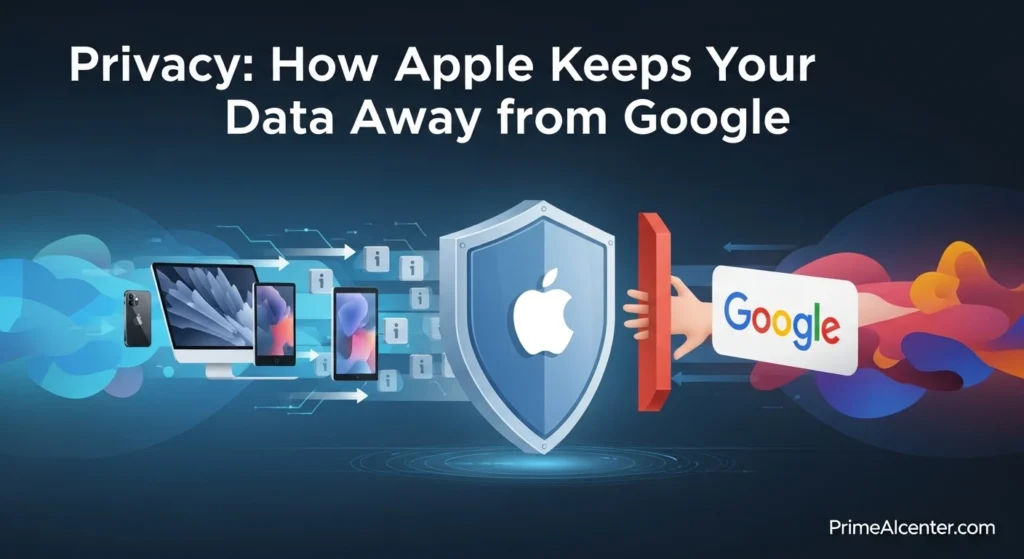
The most common question about the Apple-Google Gemini deal is the obvious one: does Google now see everything you say to Siri? The confirmed answer is no — and the architecture Apple built to prevent this is more sophisticated than a simple contractual promise.
Three-Tier Processing Model
| Tier | Where It Runs | What It Handles | % of Queries |
|---|---|---|---|
| Tier 1 — On-Device | Apple Neural Engine (your iPhone) | Simple commands, device controls, timers, quick calculations | ~60% |
| Tier 2 — Apple Private Cloud Compute | Apple’s dedicated AI servers | Email summarization, document analysis, multi-turn conversations | ~30% |
| Tier 3 — Gemini | Google Cloud (via Apple privacy proxy) | Complex reasoning, multi-step planning, real-time information | ~10% |
The routing happens in real-time. The on-device model first classifies query complexity. If it can be handled locally, no network request occurs. If it needs cloud processing, Apple’s Private Cloud Compute handles it. Only the most complex queries — approximately 10% — reach Google’s infrastructure, and they arrive fully anonymized through Apple’s privacy buffer layer.
Key privacy guarantees Apple has confirmed:
- Google never receives your Apple ID, device identifier, or any personal account information
- Queries are anonymized before reaching Google’s infrastructure
- Apple Private Cloud Compute retains no data after processing
- On-screen content analysis runs entirely on-device — screen content never leaves your iPhone
- Apple retains full control over the user interface and data routing at all times
Apple’s Private Cloud Compute Security Guide provides the technical documentation for independent verification. The architecture is auditable — Apple has published the cryptographic guarantees and invites third-party security researchers to verify them.
The practical summary: Google provides the reasoning capability for the hardest 10% of Siri queries. It does not receive your identity, your screen content, or your personal data. Apple acts as a privacy proxy — renting Google’s intelligence while keeping it isolated from Google’s data infrastructure.
New Siri vs Google Assistant vs ChatGPT on iPhone
| Feature | New Siri (iOS 26) | Google Assistant | ChatGPT on iPhone |
|---|---|---|---|
| AI Backend | Gemini (via Apple privacy proxy) | Gemini (direct) | GPT-5.4 / GPT-5.4 Mini |
| On-Screen Awareness | ✅ Full (on-device) | ✅ Partial | ❌ No |
| Multi-Step Task Chains | ✅ Up to 10 steps | ⚠️ Limited | ❌ No native iOS integration |
| System-Level Access | ✅ Full iOS integration | ⚠️ Limited on iOS | ❌ No |
| Privacy Architecture | ✅ Multi-tier, Apple-controlled | ⚠️ Google-managed | ⚠️ OpenAI-managed |
| Conversational Memory | ✅ 50 turns | ✅ Session-based | ✅ Full history |
| App Integration (SiriKit) | ✅ 340+ intents | ⚠️ Android-first | ❌ No |
| Voice Activation | ✅ Always-on “Hey Siri” | ✅ “Hey Google” | ❌ Manual only |
| Reasoning Quality | ✅ Gemini-powered | ✅ Gemini direct | ✅ GPT-5.4 |
| Cost to User | Free (with iPhone) | Free | Free tier / $20/month Plus |
The comparison clarifies Siri’s actual competitive position after iOS 26.4. The new Siri is not trying to beat ChatGPT at open-ended conversation or Google Assistant at search integration. It is trying to be the best AI assistant specifically for iPhone users — deeply integrated with iOS, with full system access, on-screen awareness, and task automation that no third-party app can match because they cannot access the same device-level APIs.
The Gemini backend gives Siri reasoning quality that matches Google Assistant directly — because they share the same underlying model. The difference is Apple’s privacy architecture and the depth of iOS integration.
ChatGPT on iPhone remains the stronger choice for extended research conversations, creative writing, coding assistance, and tasks where you want access to the full GPT-5.4 capability without iOS system constraints. Siri and ChatGPT will coexist on iPhones — they solve different problems. For more on selecting the right AI tool for your workflow, see our AI Reviews & Comparisons section.
Compatible iPhone and iPad Models
The new Siri features require Apple Intelligence, which in turn requires an A17 Pro chip or newer. This limits compatibility to devices released from 2023 onward.
| Device | Chip | New Siri Compatible |
|---|---|---|
| iPhone 16, 16 Plus, 16 Pro, 16 Pro Max | A18 / A18 Pro | ✅ Full support |
| iPhone 15 Pro, 15 Pro Max | A17 Pro | ✅ Full support |
| iPhone 15, 15 Plus | A16 | ❌ Not compatible |
| iPhone 14 and older | A15 or older | ❌ Not compatible |
| iPad Pro (M1 and later) | M1+ | ✅ Full support |
| iPad Air (M1 and later) | M1+ | ✅ Full support |
| iPad mini (A17 Pro) | A17 Pro | ✅ Full support |
| Mac (M1 and later) | M1+ | ✅ Full support |
If you are on an iPhone 15 or older non-Pro model, iOS 26.4’s new Siri features will not be available. Apple has confirmed no plans to expand Apple Intelligence to A16 or older chips. For users on these devices, third-party AI productivity tools remain the best path to comparable AI capabilities.
What This Means for Businesses and Marketers
The new Siri represents the single most significant shift in consumer AI behavior since the smartphone itself. When 2.2 billion devices gain an AI assistant that can complete transactions, make bookings, compare products, and recommend services without opening a browser, the rules of digital marketing change fundamentally.
The Core Problem for Businesses
Traditional digital marketing assumes a user journey: user has a need → searches on Google → clicks a result → visits a website → converts. The new Siri breaks this chain at multiple points. Siri can identify needs from screen context, complete the research step using AI reasoning, execute the transaction through SiriKit intents, and confirm the purchase — without the user ever visiting a website.
Brands that are not optimized for AI assistant discovery risk losing visibility at the point of decision. Digital Applied documented this shift specifically: traditional SEO is no longer sufficient when Siri recommends without search.
Immediate Action Items for Businesses
- Implement SiriKit intents for booking, purchasing, and scheduling workflows — apps with chain intents will be preferred by Siri’s action planner over those requiring manual steps
- Update Apple Maps listings — Siri uses Apple Maps for local recommendations when users ask about restaurants, services, and businesses near them
- Audit structured data markup — Schema.org markup helps Siri understand your content, products, and services for recommendation and transaction purposes
- Optimize for GEO (Generative Engine Optimization) — the same principles that help your content appear in Perplexity and ChatGPT searches apply to Siri’s recommendation engine
- Claim and complete your Apple Business Connect profile — this is the foundation of Siri visibility for local businesses
For a full breakdown of how to optimize your content for AI search engines including the new Siri, see our GEO Optimization guide and our Best GEO Ranking Techniques for 2026.
The WebMCP infrastructure that enables websites to expose their capabilities to AI systems is directly relevant here — see our WebMCP Tutorial for how to turn your website into a Siri-readable AI resource.
Is the New Siri Worth the Wait?
After 14 years of incremental improvements and consistent underperformance relative to expectations, the new Siri powered by Google Gemini is a genuinely different product. Not because Apple finally built a frontier AI model — it did not, and it chose not to. But because Apple made the right strategic decision: take the best available AI reasoning engine and build everything else around it with Apple’s strengths in privacy, design, and hardware integration.
The result is an AI assistant that can see your screen, chain 10 actions from one request, remember a 50-turn conversation, and execute transactions across apps — all while keeping your data within Apple’s privacy architecture and away from Google’s data infrastructure.
For iPhone users on compatible devices (iPhone 15 Pro and later, iPad with M1+), the new Siri arriving with iOS 26.4 and 26.5 is the upgrade that justifies updating immediately. The gap between what Siri could do before and what it can do after is not incremental — it is categorical.
For iPhone users on older devices without Apple Intelligence support, the new Siri is not available. Third-party AI apps — ChatGPT, Claude, Gemini — remain the best option for advanced AI capabilities on older hardware.
For businesses: the window to prepare for AI assistant-mediated discovery is closing. The update ships to all compatible devices by April–May 2026. The brands that have optimized their SiriKit integrations, structured data, and AI discovery presence before that date will capture disproportionate share of the AI-mediated consumer interactions that are about to surge across 2.2 billion devices.
PrimeAIcenter Rating: 4.7/5 — The most significant Siri update in 14 years. On-screen awareness and task chains are genuinely transformative. Held back only by device compatibility limits and the fact that most flagship features arrive in 26.5, not 26.4.
Frequently Asked Questions — New Siri iOS 26
What is new about Siri in iOS 26?
iOS 26.4 and 26.5 bring the most significant Siri update since its 2011 launch. Key new features include on-screen context awareness (Siri sees and acts on what’s on your screen), multi-step task chains (up to 10 actions from one request), a 50-turn conversational memory, and a Google Gemini reasoning backend for complex queries — all within Apple’s privacy architecture.
Does the new Siri use Google Gemini?
Yes. Apple confirmed in January 2026 that the next generation of Apple Foundation Models will be based on Google Gemini models. Gemini handles the complex reasoning layer for approximately 10% of Siri queries — the most demanding tasks. The other 90% are handled on-device or via Apple’s Private Cloud Compute. Gemini’s role is white-labeled: no Google branding appears anywhere in the Siri interface.
Is the new Siri available on my iPhone?
The new Siri requires Apple Intelligence, which requires an A17 Pro chip (iPhone 15 Pro/Pro Max) or newer, or an M1 chip or newer for iPads and Macs. iPhone 15, 15 Plus, and all iPhone 14 and older models are not compatible.
When does the new Siri launch?
iOS 26.4 is expected to release publicly around March 25, 2026. The first iOS 26.5 developer beta — which carries the most significant Gemini-powered Siri features — is expected around March 30, 2026. The broad consumer rollout of iOS 26.5 is expected in April–May 2026.
Does Google see what I say to Siri?
No. Apple routes queries through a privacy buffer before they reach Google’s infrastructure. Google never receives your Apple ID, device identifier, or personal account data. On-screen content analysis runs entirely on-device and is never sent externally. Approximately 60% of Siri queries are handled on-device with no network request at all.
Will Siri replace Google Assistant on iPhone?
They serve different primary use cases. Siri has full iOS system access, on-screen awareness, and deep app integration — advantages no third-party assistant can match on iPhone. Google Assistant on iOS is strong for search-related queries but lacks iOS system-level access. Most iPhone users will use both depending on the task.
What happened to ChatGPT integration in Siri?
Apple confirmed the ChatGPT integration (introduced in iOS 18.2) remains unchanged. The Gemini integration replaces Apple’s own Foundation Models as the reasoning backend — it is not a replacement for ChatGPT. iPhone users will continue to have access to ChatGPT through Siri for tasks where ChatGPT’s capabilities are specifically requested.
Can the new Siri make purchases for me?
Yes, within task chains — but purchases always require Face ID or Touch ID confirmation. Siri will not complete a financial transaction without explicit biometric authorization. Payment confirmation is a mandatory gate in any task chain involving purchases.
What is Apple Private Cloud Compute?
Apple Private Cloud Compute is Apple’s dedicated server infrastructure for AI processing that requires cloud connectivity. It provides end-to-end encryption and retains no data after processing. It acts as the privacy buffer between user devices and any external AI services including Google Gemini. Full technical documentation is available in Apple’s security guide.
How does the new Siri affect my app as a developer?
iOS 26.4 expands SiriKit from 120 to 340+ intent categories and introduces new task chain intents and the ScreenContextProvider API. Apps that implement task chain intents become part of Siri’s automated workflows. Apps that do not support chain intents require manual user steps, making them less likely to be selected by Siri’s action planner. Developer documentation is available at developer.apple.com/siri.
Will WWDC 2026 announce more Siri features?
Yes. Apple has confirmed that features not finalized for iOS 26.5 will be deferred to the iOS 27 preview at WWDC in June 2026. This includes expanded Safari and Spotlight AI integration and hardware showcases for the new Siri on Apple’s new smart home display products. WWDC 2026 is expected to be heavily focused on AI capabilities across the Apple platform.