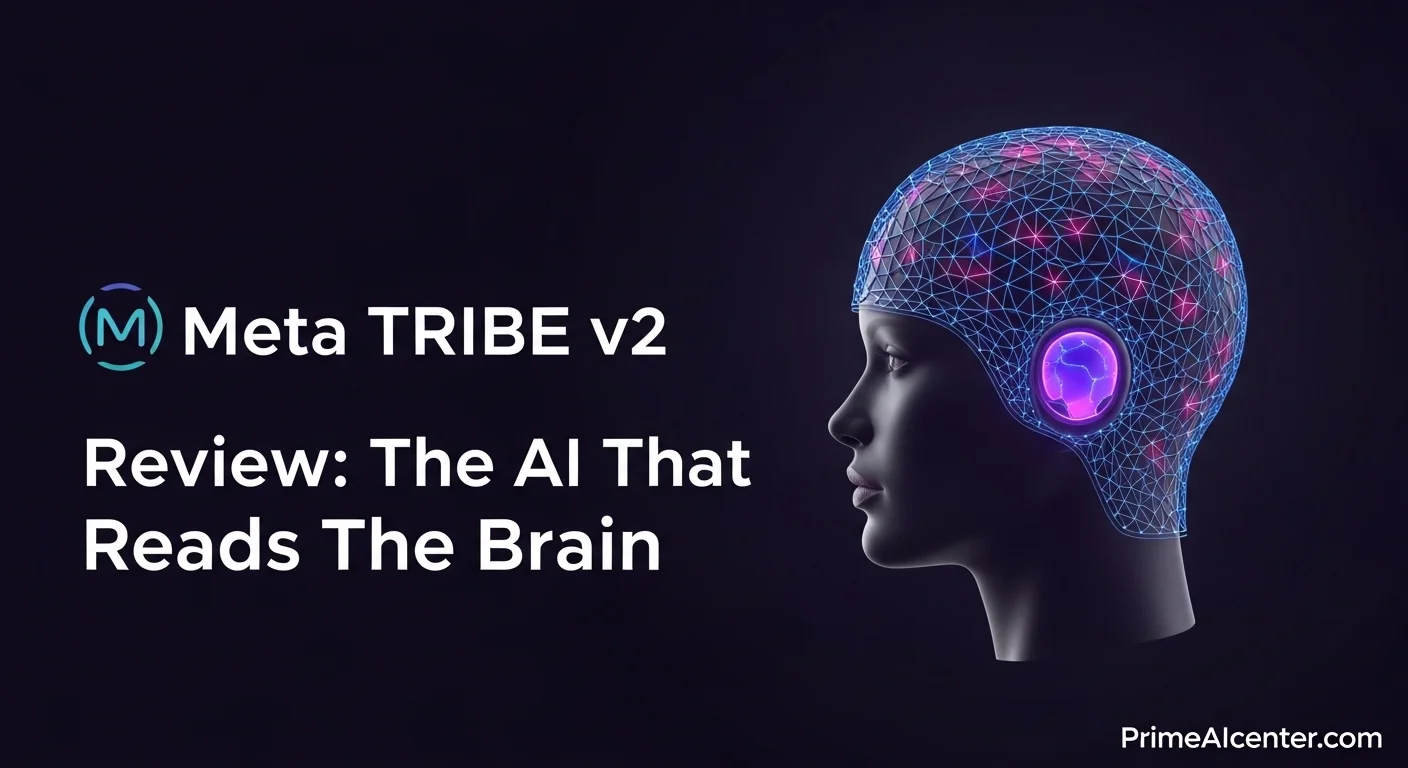

On March 26, 2026, Meta’s Fundamental AI Research (FAIR) team released something that would have sounded like science fiction five years ago: an AI model that creates a digital twin of your brain.
TRIBE v2 — short for TRImodal Brain Encoder version 2 — predicts exactly how your brain responds to anything you see, hear, or read. Feed it a video clip, a podcast, or a piece of text, and it outputs a high-resolution map of which neurons fire, where, and in what pattern. Trained on 500+ hours of fMRI recordings from 700+ people, it achieves a 70-fold increase in spatial resolution over previous systems and can predict the brain activity of someone it has never seen before — without any retraining.
Meta released the model, codebase, research paper, and a live demo to the global scientific community the same day. This is not a proprietary product. It is open research — and it is significant enough that it trended on X within hours of release, with the thread from Meta’s official AI account reaching 16,900 views in its first hour.
This Meta TRIBE v2 Review explains what TRIBE v2 actually does, how the architecture works in plain language, what the numbers mean, and — most importantly — why this research matters well beyond the neuroscience community.
What Is TRIBE v2 and What Problem Does It Solve
To understand TRIBE v2, you need to understand the problem it solves.
Neuroscience has historically studied the brain in fragments. Researchers would map one cognitive function — motion perception, face recognition, language processing — to a specific brain region using a model trained specifically for that narrow task. The results were deep but disconnected. There was no unified framework for how the brain integrates what you see, what you hear, and what you read simultaneously.
Neuroscience has long been a field of divide and conquer. Researchers typically map specific cognitive functions to isolated brain regions using models tailored to narrow experimental paradigms. While this has provided deep insights, the resulting landscape is fragmented. (MarkTechPost, March 26, 2026)
TRIBE v2 is the first foundation model to treat all three sensory modalities — vision, audition, and language — as a unified system. It processes video, audio, and text simultaneously and maps the combined response across the entire cortex, not just one region. The result is a model that reflects how the brain actually works in the real world: processing everything at once, continuously, across an enormous network of interconnected regions.
Meta has introduced TRIBE v2, a next-generation multimodal AI system designed to predict human brain responses to real-world inputs like video, audio, and language. One of the key goals of TRIBE v2 is to move beyond traditional neuroscience models that focus on isolated sensory processing. (The Tech Portal, March 26, 2026)
TRIBE v2 Architecture: How It Actually Works
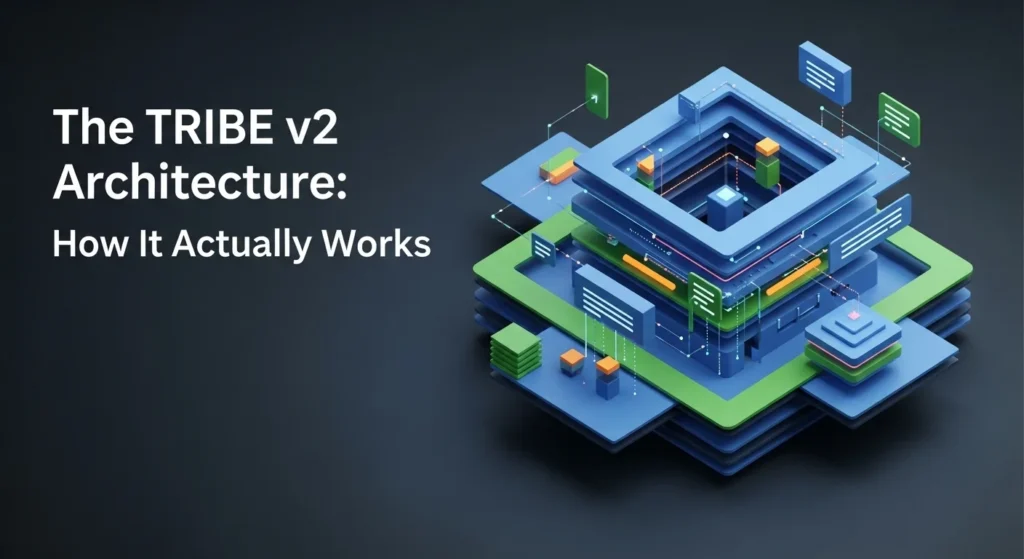
The architecture is a three-stage pipeline. Each stage has a specific job, and understanding them makes the capabilities clear.
Stage 1 — Feature Extraction: Seeing, Hearing, and Reading
TRIBE v2 does not build its own visual, audio, or language understanding from scratch. Instead, it leverages three of the most powerful existing AI models as dedicated sensory processors:
| Modality | Model Used | What It Does |
|---|---|---|
| Text / Language | LLaMA 3.2-3B | Extracts contextualized word embeddings with 1,024-word temporal context, mapped to a 2Hz grid |
| Video / Vision | V-JEPA2-Giant | Processes 64-frame segments (4 seconds each) per time-bin |
| Audio / Sound | Wav2Vec-BERT 2.0 | Processes sound, resampled to 2Hz to match stimulus frequency |
These three models produce embeddings — numerical representations of what they perceive. Each is compressed into a shared dimension (D=384) and then concatenated into a combined multi-modal time series with a model dimension of 1,152. This is the unified sensory representation that the next stage works with.
Stage 2 — Temporal Integration: Making Sense of It All Together
The combined time series is fed into a Transformer encoder — 8 layers, 8 attention heads — that processes a 100-second window of experience. This is where the integration happens: the model learns how visual, auditory, and linguistic information relate to each other over time and how the combination produces the neural response.
The Transformer architecture here is the same fundamental design as GPT, Claude, and Gemini — but instead of predicting the next word, it is learning to predict the next brain state given a sequence of sensory input.
Stage 3 — Subject-Specific Brain Mapping
The Transformer outputs are passed through a Subject Block that projects the latent representations onto a precise anatomical brain map: 20,484 cortical vertices on the surface of the brain and 8,802 subcortical voxels. This produces a high-resolution prediction of neural activity across virtually the entire brain — not just one region, but the whole cortex simultaneously.
The Subject Block is where individual variation is handled. Each person’s brain responds slightly differently to the same stimulus. The subject-specific layer learns to account for this, allowing the model to predict the neural response of a specific individual when their data is available, and to generalize to a new individual when it is not.
The Numbers: What TRIBE v2 Actually Achieved
| Metric | TRIBE v2 | Previous Best |
|---|---|---|
| Spatial resolution increase | 70x higher | Baseline |
| Brain voxels predicted | ~70,000 | ~1,000 in earlier versions |
| Training subjects | 700+ people | 4 people (original TRIBE) |
| fMRI training hours | 451.6 hours | Much smaller datasets |
| Evaluation dataset | 1,117.7 hours / 720 subjects | — |
| Zero-shot improvement | 2-3x better than previous methods | Baseline |
| Fine-tuning improvement | 2-4x better with just 1 hour of new data | Baseline |
| Group correlation (HCP 7T) | ~0.4 Rgroup — 2x median subject | — |
| Open source | Yes — model, codebase, paper, demo all released | Mostly proprietary |
Without any retraining, TRIBE v2 can reliably predict the brain responses of individuals it has never seen before, achieving a nearly 2-3x improvement over previous methods for both movies and audiobooks. (Meta AI, official X post, March 26, 2026)
The 70,000 voxel figure deserves specific attention. Earlier systems predicted brain activity in roughly 1,000 voxels — small regions of the brain. TRIBE v2 maps 70,000. This is not an incremental improvement. It is the difference between a low-resolution thumbnail and a full 4K image of the brain’s response. The spatial resolution upgrade alone makes a category of research possible that was previously impossible.
Zero-Shot Capability: The Most Commercially Significant Feature
The capability that attracted the most attention in the research and technology communities is TRIBE v2’s zero-shot generalization. The model can predict how a brain it has never scanned will respond to a stimulus it has never tested — without any retraining on that person’s data.
This is achieved through an “unseen subject” layer that learns the statistical structure of how brains vary across people, rather than memorizing the specific response patterns of the training subjects. The result: TRIBE v2 can predict the group-averaged response of a new cohort more accurately than the actual recording of many individual subjects within that cohort. (MarkTechPost)
Why does this matter beyond the lab? Because it eliminates the most expensive step in neuroscience research: collecting fMRI data from new participants. A researcher studying how a new drug affects visual processing, or how a specific type of content affects emotional response, can now run virtual experiments — “in-silico neuroscience” — using TRIBE v2 to generate predictions before investing in costly scanning sessions.
The model can be used to run virtual experiments, pre-screening neuroimaging studies. By running virtual experiments on the Individual Brain Charting dataset, the model recovered classic functional landmarks. (MarkTechPost)
Open Source: What Meta Released and Where to Find It
Meta’s decision to release TRIBE v2 as open science distinguishes it from most frontier AI research. The full release package includes four components:
| Component | Link | What It Contains |
|---|---|---|
| Research Paper | Meta AI Research | Full technical methodology, results, and analysis |
| Model Weights | HuggingFace | Pre-trained model for researchers to use and fine-tune |
| Codebase | GitHub | Full training and inference code |
| Interactive Demo | Meta AI Demo | Live visualization of brain response predictions |
Meta has released the model, codebase, paper, and demo to help researchers advance neuroscience, apply brain insights to build better AI, and use computational simulation to speed up breakthroughs in neurological disease diagnosis and treatment. (Meta AI, official X, March 26, 2026)
The open-source commitment is not just transparency — it is a strategic investment in the research ecosystem. Every lab that uses TRIBE v2, publishes results, and contributes back to the field validates and extends Meta’s underlying research. The company gets a global research community running experiments on its architecture without paying for them.
TRIBE v2 vs TRIBE v1: What Changed
| Feature | TRIBE v1 | TRIBE v2 |
|---|---|---|
| Training subjects | 4 individuals | 700+ individuals |
| Brain voxels | ~1,000 | ~70,000 |
| Modalities | Video + Audio | Video + Audio + Language (text) |
| Zero-shot capability | Limited | 2-3x improvement over prior methods |
| Resolution | Low-resolution fMRI | 70x higher spatial resolution |
| Training competition | Algonauts 2025 winner | Scales on that winning architecture |
| Dataset scope | Small (movies + audio) | 451h training / 1,117h evaluation |
| Generalization | Stimulus and subject-specific | Cross-subject, cross-task |
While the original version trained on low-resolution fMRI recordings from just four individuals, TRIBE v2 incorporates data from more than 700 healthy volunteers exposed to diverse media inputs including podcasts, videos, images, and written content. (Blockchain.news)
The jump from 4 subjects to 700+ is the defining difference. TRIBE v1 was a proof of concept — a demonstration that the approach was viable on a very small dataset. TRIBE v2 is a foundation model — trained at the scale required to learn generalizable patterns of human brain response rather than memorizing four specific individuals.
Real-World Applications: What TRIBE v2 Actually Enables
1. Neurological Disease Research and Treatment
The most immediate and significant application is in medical research. TRIBE v2 can simulate the brain responses of patients with specific neurological conditions — mapping how a stroke, a tumor, or a neurodegenerative disease changes the pattern of neural responses to stimuli. Researchers can test hypotheses about intervention effects virtually before designing clinical trials, dramatically reducing the time and cost of early-stage research.
It is designed to help researchers create digital copies of neural activity, which could lead to better treatments for neurological disorders. (NewsBytesApp)
2. Brain-Computer Interface Development
Meta Reality Labs has invested heavily in brain-computer interface research. TRIBE v2’s ability to predict neural responses to audiovisual stimuli maps directly to challenges in BCI design: understanding what perceptual experiences correspond to what neural states, and how to engineer interfaces that interact reliably with those states. For AR and VR applications, predicting how users will perceptually respond to different stimuli has obvious product implications.
The release fits within Meta’s broader push into brain-computer interface research. While TRIBE v2 focuses on understanding brain responses rather than direct neural interfaces, the underlying research could inform future products in the AR/VR space where predicting user perception matters. (Blockchain.news)
3. In-Silico Neuroscience Experiments
TRIBE v2 recovered classic functional landmarks in virtual experiments on the Individual Brain Charting dataset — visual cortex, auditory cortex, and language regions responded to the appropriate stimuli in the model’s predictions, matching established neuroscience findings. This validates the model’s use as a platform for pre-screening real experiments: researchers can run hundreds of virtual stimulus conditions in days rather than months of actual scanning.
4. AI Architecture Development
The model encodes biological neural network behavior at unprecedented resolution. For the AI research community, this is a dataset of how the most capable general-purpose intelligence ever studied — the human brain — processes multimodal information. The insights could feed directly back into artificial neural network design: new attention mechanisms, new multimodal integration strategies, new architectures for combining sensory modalities.
For the AI research community, the open release of a model trained on such extensive neuroimaging data provides a new tool for studying how biological neural networks process multimodal information — insights that could eventually feed back into artificial neural network design. (Blockchain.news)
5. Content Experience Design
Understanding how the brain responds to content — videos, audio, text — has direct applications in media, advertising, and content creation. TRIBE v2’s ability to predict neural response across simultaneous modalities gives researchers and eventually practitioners a framework for understanding which content combinations produce the strongest cognitive engagement. This remains primarily a research application in March 2026, but the commercial trajectory is clear.
Limitations: What TRIBE v2 Cannot Do Yet
The honest assessment of any new model requires understanding its current boundaries.
It is not mind reading. TRIBE v2 predicts neural responses to controlled stimuli — it does not decode thoughts, memories, intentions, or emotional states. The model maps how the brain responds to specific sensory inputs, not the internal cognitive landscape of a person’s experience.
fMRI temporal resolution is low. fMRI measures brain activity through blood oxygen levels — an indirect proxy that lags actual neural firing by seconds. The model inherits this limitation. It produces spatially high-resolution predictions but temporally coarse ones.
Individual variability creates noise. Individual variability in cognition, attention, and emotional state can introduce noise that is difficult to fully capture. These factors mean that even advanced models like TRIBE v2 provide approximations rather than precise reconstructions of brain function. (The Tech Portal)
Not available for public consumer use. TRIBE v2 is released for the research community. It requires neuroimaging expertise to use meaningfully and is not configured for consumer or enterprise applications in its current form.
Training was on healthy adults. The 700+ subjects in the training dataset were healthy volunteers. Generalizing predictions to clinical populations — people with neurological disorders, children, elderly subjects — requires additional validation work.
The Strategic Picture: Why Meta Released This Now
Meta’s FAIR team could have kept TRIBE v2 proprietary. The decision to release it openly to the research community tells you something important about Meta’s strategy.
First, the open release positions Meta as the foundational infrastructure provider for computational neuroscience research — the same way PyTorch positioned them as foundational infrastructure for AI research broadly. Labs worldwide will build on TRIBE v2, cite the work, and extend Meta’s research agenda without Meta funding the experiments.
Second, TRIBE v2 directly supports Meta’s Reality Labs investment. Understanding how users perceive audiovisual experiences at a neural level is core infrastructure for the next generation of AR and VR products. The model provides a research foundation that could inform product decisions for Meta’s hardware roadmap years down the line.
Third, the zero-shot capability — predicting the brain response of individuals the model has never seen — is the long-term capability that matters most for any commercial application. A model that requires individual fMRI data to be useful is a research tool. A model that generalizes to new individuals without retraining is a product foundation.
For more context on how Meta AI is reshaping the technology landscape in 2026, see our Best AI Tools 2026 guide and our AI Statistics 2026 report on market trends and investment data.
What This Means for AI in 2026
TRIBE v2 is significant in a way that most AI model releases are not, because it crosses a domain boundary. Every frontier model release in the past three years — GPT-5.4, Claude Opus 4.6, Gemini 3.1 Pro — has been a different point on the same trajectory: more reasoning capability, lower hallucination rate, better coding, broader ecosystem. TRIBE v2 is doing something structurally different: it is encoding the structure of biological intelligence itself.
The log-linear scaling result is the most technically important finding in the paper. The researchers found that prediction accuracy increased log-linearly with training data volume — and they found no evidence of a performance plateau. This means that as neuroimaging datasets grow (and they will grow, as fMRI technology improves and data-sharing initiatives expand), models like TRIBE v2 will become proportionally more accurate. The ceiling has not been found yet.
The implications for AI architecture research are speculative but significant. If you can model with high fidelity how the human brain integrates visual, auditory, and linguistic information simultaneously, you have a blueprint for building artificial systems that do the same thing more efficiently. TRIBE v2 may ultimately contribute more to the next generation of AI architectures than to neuroscience clinical applications.
For content creators, marketers, and businesses following AI developments, TRIBE v2 represents a reminder of what “foundation model” means in its fullest sense. The same architectural principles — transformer-based, trained at scale, generalized rather than specialized — that power ChatGPT and Claude are now being applied to decode the biological system those models were modeled on. The feedback loop between AI architecture and neuroscience research is accelerating.
For AI search and discoverability in 2026 — including how to ensure your content appears in AI-generated answers — see our GEO Optimization guide and our GEO Ranking Techniques article. For enterprise AI deployment, see our Enterprise AI Agent Deployment guide.
FAQS: Meta TRIBE v2 Review
What is Meta TRIBE v2?
TRIBE v2 (TRImodal Brain Encoder version 2) is a foundation AI model released by Meta’s FAIR team on March 26, 2026. It predicts human brain responses to video, audio, and text inputs simultaneously. Trained on 500+ hours of fMRI data from 700+ people, it creates a digital twin of neural activity with 70x higher spatial resolution than previous systems. Meta released the model, codebase, paper, and demo openly to the research community.
How does TRIBE v2 work?
TRIBE v2 uses a three-stage pipeline. First, it extracts features from video (using V-JEPA2-Giant), audio (using Wav2Vec-BERT 2.0), and text (using LLaMA 3.2-3B). Second, a Transformer encoder with 8 layers integrates the three modalities over a 100-second window. Third, a subject-specific block maps the integrated representations onto 70,000 brain voxels — predicting which regions of the brain activate in response to the input.
Can TRIBE v2 read minds?
No. TRIBE v2 predicts neural responses to specific sensory inputs — not thoughts, memories, intentions, or emotional states. It maps how the brain responds to videos, sounds, and text, not the internal cognitive content of a person’s experience. Meta has been explicit that the technology is designed for neuroscience research, not consumer applications.
What is the zero-shot capability of TRIBE v2?
TRIBE v2 can predict the brain responses of individuals it has never scanned — without any retraining on their specific data. It achieves a 2-3x improvement over previous methods on this zero-shot task. In the Human Connectome Project 7T dataset, it predicted group-averaged responses more accurately than many individual subjects’ actual recordings. This capability is central to its research utility: it allows virtual experiments without new fMRI data collection.
Is TRIBE v2 open source?
Yes. Meta released the model weights (on HuggingFace), the full codebase (on GitHub), the research paper (on Meta AI Research), and an interactive demo on the same day as the announcement — March 26, 2026. The release is intended to accelerate global neuroscience research and allow the wider scientific community to build on the work.
What are the main applications of TRIBE v2?
The primary applications are: (1) neurological disease research — simulating brain responses for new treatments without costly scanning, (2) brain-computer interface development for AR/VR, (3) in-silico neuroscience — running virtual experiments before real trials, (4) AI architecture research — using biological neural network insights to improve artificial neural networks, and (5) content experience design — understanding neural engagement with audiovisual media.
How does TRIBE v2 compare to TRIBE v1?
TRIBE v2 represents a dramatic scale-up. v1 was trained on low-resolution fMRI from 4 individuals and predicted ~1,000 brain voxels. v2 was trained on 700+ subjects across 451+ hours of fMRI and predicts ~70,000 voxels — a 70x spatial resolution increase. v2 also adds language/text as a third modality (v1 handled only video and audio) and achieves 2-3x better zero-shot generalization.
What are the limitations of TRIBE v2?
Current limitations include: low temporal resolution (fMRI measures brain activity indirectly through blood oxygen, lagging actual neural firing by seconds); individual variability introducing prediction noise; training only on healthy adult subjects (not clinically validated yet); and it is not available for public consumer use — it requires neuroimaging expertise to use meaningfully.
How does TRIBE v2 relate to Meta’s AR/VR products?
TRIBE v2 fits within Meta’s Reality Labs investment in brain-computer interface research. Understanding how users perceptually respond to audiovisual stimuli at a neural level is relevant to next-generation AR and VR product design — where predicting user perception and cognitive engagement matters for experience design. The model does not directly interface with hardware but provides a research foundation for future product development.
Who can use TRIBE v2?
Currently, TRIBE v2 is released for the scientific research community. Neuroscientists, AI researchers, clinical researchers, and computational biologists can access the model and codebase through HuggingFace and GitHub. Commercial or consumer applications are not available in the current release. The interactive demo on Meta AI is accessible to anyone wanting to explore the model’s capabilities visually.