
Updated April 4, 2026. DeepSeek V4 has not officially launched yet — and that makes this the most important AI article you can read right now. The model has been delayed three times. The release window is April 2026. Every major benchmark suggests it will be the most disruptive open-source AI release since DeepSeek V3 sent Nvidia’s stock down 17% in a single day. When it drops, it will change the cost calculus for every developer and enterprise currently paying frontier prices for closed-source models.
This DeepSeek V4 Review compiles everything confirmed, credibly reported, and technically substantiated about DeepSeek V4: its 1-trillion-parameter architecture, Engram memory system, native multimodal capabilities, projected pricing at $0.10–$0.30 per million input tokens, and what it means for teams building with Claude Opus 4.6, GPT-5.4, and Gemini 3.1 Pro. We will update this article the moment the official release drops.
Note: DeepSeek has not released V4 publicly as of April 4, 2026. Specifications in this article are based on official press releases, verified third-party reporting from Reuters and FT, technical papers published by DeepSeek, and confirmed community benchmark data from closed testing. All figures marked with (projected) are estimates based on available evidence.
DeepSeek V4 Review – Quick Reference
| Specification | Value | Source |
|---|---|---|
| Total parameters | ~1 trillion | Official press release, Reuters |
| Active parameters per token | ~37 billion (MoE) | NxCode analysis, DeepSeek architecture papers |
| Context window | 1 million tokens | Official Alibaba announcement, FT reporting |
| Architecture | MoE + Engram conditional memory + DeepSeek Sparse Attention | Published January 2026 technical papers |
| Input modalities | Text + Image + Video (natively) | Official preview documentation |
| Output modalities | Text + Image + Video generation | Community testing of V4 Lite (March 9) |
| License | Apache 2.0 (open weights) — expected | DeepSeek’s established pattern |
| Hardware optimization | Huawei Ascend 910B/C (primary), also NVIDIA-compatible | Reuters, FT, Huawei partnership disclosure |
| Input pricing (projected) | $0.10–$0.30 per million tokens | DeepSeek pricing history + analyst estimates |
| SWE-bench target | 80%+ Verified (projected) | Community leaks, NxCode analysis |
| Release status | NOT YET RELEASED — April 2026 window | Official stance as of April 4, 2026 |
| V4 Lite status | Released March 9 (community name — ~200B params) | Chinese tech media, user reports |
Why DeepSeek V4 Matters More Than Any Model This Year
To understand why developers worldwide are watching DeepSeek V4 more closely than GPT-5.5 or Gemma 4, you need to understand what DeepSeek V3 did to the AI industry when it launched in December 2025. In a single day, the announcement that a Chinese lab had matched GPT-4o and Claude 3.5 Sonnet performance at a fraction of the cost triggered a $1 trillion selloff in US tech stocks — including $600 billion from Nvidia alone. President Trump called it “a wake-up call.” Cloud providers scrambled. Every assumption about the economics of frontier AI was proven wrong overnight.
DeepSeek V4 is the sequel. Where V3 proved that a Chinese lab could compete on cost-efficiency at the 671B parameter scale, V4 targets the trillion-parameter tier — previously the exclusive domain of closed-source models from OpenAI and Google. If V4 delivers on its projected $0.10–$0.30/M token pricing at 1 trillion parameter quality, it would undercut Claude Opus 4.6 ($5/$25 per million tokens) by 17–50× on input costs and GPT-5.4 Pro ($30/$180) by 100–300×.
This is not incremental. It is a pricing disruption of the magnitude that makes enterprise AI adoption decisions radically different. For context on where current pricing stands across the full competitive landscape, our best AI tools 2026 guide tracks every major model’s cost and capability.
The Three Delays: Why DeepSeek V4 Is Still Unreleased
DeepSeek V4 has missed three consecutive release windows. Understanding why is important for setting expectations about the April 2026 window currently in play.
Window 1 — Chinese New Year (late January 2026): The original target, widely reported by Reuters and industry analysts. Missed without official explanation. Community speculation: training instability at trillion-parameter scale.
Window 2 — Late February 2026: A second window that passed without release. DeepSeek GitHub showed updates during this period, but no official V4 announcement. A “V4 Lite” (~200B parameters) reportedly appeared internally.
Window 3 — Early March 2026: Chinese tech media reported the “V4 Lite” appeared on DeepSeek’s website on March 9, 2026, with improved SVG generation and expanded context. DeepSeek did not officially confirm this as V4. The community-nicknamed “Hunter Alpha” that appeared on OpenRouter on March 11 and burned through 500 billion tokens in a week turned out to be Xiaomi’s MiMo V2 Pro — not DeepSeek V4.
Each delay has the same root cause: training frontier models at trillion-parameter scale on non-Nvidia hardware (Huawei Ascend 910B) is genuinely unprecedented. According to reporting from Reuters and the Financial Times, DeepSeek withheld V4 from US chip manufacturers including Nvidia and AMD during testing — giving exclusive early access to Chinese chip suppliers Huawei and Cambricon. This is a deliberate geopolitical statement as much as a technical decision.
The current April 2026 window is considered the most reliable yet. Multiple signals converge: the V4 Lite validated the core architecture, GitHub updates continue at pace, and according to APIYI’s DeepSeek V4 preview analysis, “a ‘V4 Lite’ (~200B parameters) released on March 9th has already validated the core architecture, making a full version release highly likely” in April.
Architecture Deep Dive: What Makes DeepSeek V4 Different
The Trillion-Parameter MoE Paradox
DeepSeek V4’s headline number is 1 trillion parameters — but raw parameter count does not equal inference cost. The Mixture-of-Experts architecture activates only approximately 37 billion parameters per token. This means every inference call loads the knowledge capacity of a 1T model while spending compute equivalent to a ~37B dense model. For comparison, DeepSeek V3 had 671B total with ~37B active — V4 nearly doubles the knowledge base while keeping inference costs essentially flat.
IBM Principal Research Scientist Kaoutar El Maghraoui described DeepSeek’s approach as “scaling AI more intelligently rather than just making it bigger.” The practical implication: the inference cost per million tokens should be similar to V3, not 1.5× higher despite 1.5× more parameters.
Engram Conditional Memory — The 1M Context Breakthrough
This is DeepSeek’s most technically significant innovation in V4. Standard attention mechanisms face two problems at million-token scale: they are computationally expensive and they degrade in quality on long-distance retrieval. Engram solves both.
Engram is a conditional memory module that achieves constant-time O(1) knowledge retrieval by decoupling static pattern storage from dynamic reasoning. It uses multi-head hashing to map compressed contexts to embedding tables via deterministic functions — effectively creating a “memory” that does not require re-reading the entire context window for each query. The system targets 97% Needle-in-a-Haystack accuracy at 1M token scale — the same benchmark where most models degrade significantly beyond 128K tokens.
For enterprise use cases, this is transformative. A 1M context window that actually works — rather than technically existing but degrading in quality — enables processing entire software repositories, legal document archives, or multi-year project histories in a single API call.
Manifold-Constrained Hyper-Connections (mHC)
DeepSeek published this architecture in a January 13, 2026 technical paper. It addresses the core challenge of training trillion-parameter MoE models: gradient explosion and expert load imbalance. At 1 trillion parameters, the gradient signals that propagate through the network can become unstable, causing training runs to fail or produce inconsistent results. mHC constrains hyper-connections within the manifold space, providing a mathematical guarantee against gradient explosion during training. This is the technical foundation that makes V4’s training run at trillion-parameter scale possible.
Native Multimodal Architecture — Not a Bolt-On
DeepSeek V3 was text-only. V4 integrates text, image, and video understanding during pre-training — the same architectural approach Google used for Gemini and OpenAI for GPT-5. The difference between native multimodal and added-on vision is significant in production: native multimodal models show better cross-modal reasoning, more coherent outputs when mixing modalities, and higher reliability on tasks that require understanding relationships between visual and textual elements.
Community testing of the V4 Lite variant showed notably strong performance on SVG vector graphic generation — a task that requires understanding visual structure, layout, and spatial relationships simultaneously. According to Introl’s analysis of the V4 Lite community reports, “early test feedback shows that V4 performs impressively on high-difficulty tasks such as generating complex SVG vector graphics, with performance significantly better than current online models.”
DeepSeek V4 Benchmark Projections
No official benchmarks have been published for V4. The following projections are based on the V4 Lite community data, the V2→V3 improvement trajectory, and the architectural claims from technical papers. Independent verification will be published at official release — this table will be updated immediately.
| Benchmark | DeepSeek V3 (current) | DeepSeek V4 (projected) | Claude Opus 4.6 | GPT-5.4 | Gemini 3.1 Pro |
|---|---|---|---|---|---|
| SWE-bench Verified | ~71% | 80%+ (projected) | 80.8% ⭐ | ~74% | 80.6% |
| AIME 2026 (math) | ~79% | ~88% (projected) | ~85% | ~84% | ~86% |
| GPQA Diamond (PhD) | ~85% | ~90% (projected) | ~88% | ~92% | 94.3% ⭐ |
| Needle 1M (retrieval) | ~80% at 128K | 97% at 1M (Engram claim) | ~85% at 200K | ~82% at 1M | ~88% at 1M |
| Human eval (SVG/visual) | Strong (text) | “Significantly better” (V4 Lite) | Strong | Strong | Leading multimodal |
| Context window | 128K | 1M tokens | 200K | 1M | 1M |
| Input cost/M tokens | $0.27 | $0.10–$0.30 (projected) | $5.00 | $2.50 ($30 Pro) | $2.00 |
All V4 figures marked as projected. Table will be updated with official benchmarks at release.
DeepSeek V4 Pricing: The Economics That Will Reshape Enterprise AI
If DeepSeek’s established pricing philosophy holds — and every V2-to-V3 data point suggests it will — V4 will be the most competitively priced trillion-parameter model ever released. Here is what the comparison looks like:
| Model | Input (per M tokens) | Output (per M tokens) | Multiplier vs V4 (est.) |
|---|---|---|---|
| DeepSeek V4 (projected) | $0.10–$0.30 | $0.30–$0.60 | 1× (baseline) |
| DeepSeek V3 (current) | $0.27 | $1.10 | ~1× input, 2× output |
| Qwen 3.6 Plus (free preview) | Free (preview period) | Free (preview period) | Temporary only |
| GLM-5V-Turbo | $1.20 | $4.00 | 4–12× more expensive |
| Gemini 3.1 Pro | $2.00 | $12.00 | 7–20× more expensive |
| GPT-5.4 | $2.50 | $15.00 | 8–25× more expensive |
| Claude Opus 4.6 | $5.00 | $25.00 | 17–50× more expensive |
| GPT-5.4 Pro | $30.00 | $180.00 | 100–300× more expensive |
The practical impact: a workflow that costs $5,000/month on Claude Opus 4.6 could theoretically run for $100–$300/month on DeepSeek V4 at comparable quality. That is not a cost optimization — it is a fundamental change to the business case for AI adoption. Teams that were previously priced out of frontier AI could access trillion-parameter quality for the cost of a basic SaaS subscription.
For context on the current pricing landscape across all major models, our AI statistics 2026 guide tracks the full cost comparison data.
The Geopolitical Dimension: Huawei Chips and US-China AI Rivalry
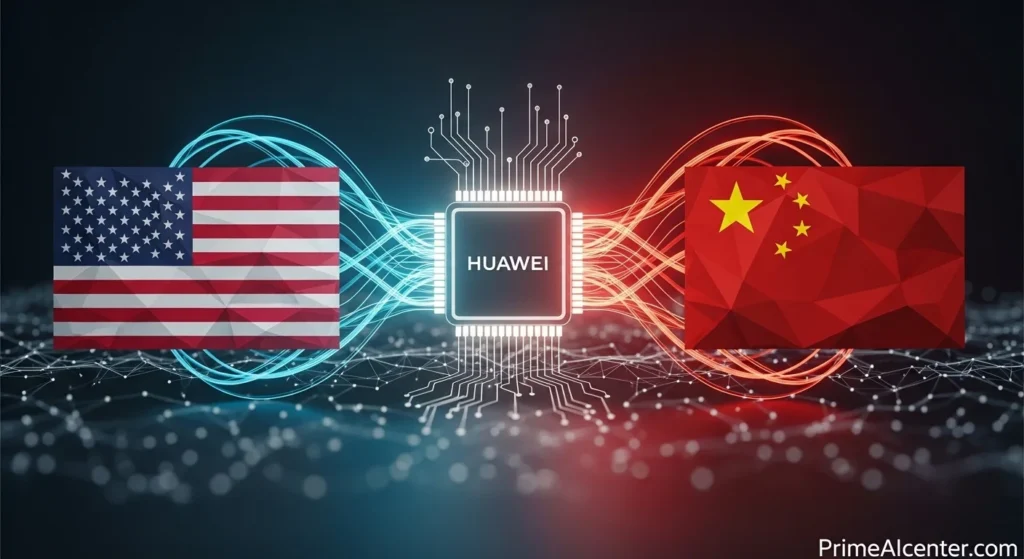
DeepSeek V4 is more than a model release. It is a proof-of-concept for a parallel AI infrastructure stack that is deliberately independent of US semiconductor technology.
According to Reuters reporting confirmed on February 27, 2026, DeepSeek gave domestic chip suppliers including Huawei early access to V4 while explicitly excluding Nvidia and AMD. This is a reversal of the typical dynamic in AI development, where new models are optimized first for Nvidia hardware. DeepSeek’s decision signals that V4 is not just Ascend-compatible — it is Ascend-optimized. The training run happened on Huawei Ascend 910B chips. The inference serving will be optimized for Ascend. This is the first frontier-tier model trained entirely outside the Nvidia ecosystem.
Meanwhile, Nvidia halted China-bound H200 production in early March 2026 and shifted capacity to its next-generation Vera Rubin architecture. The message from both sides is clear: the US-China AI supply chain split is real, accelerating, and consequential for every enterprise making infrastructure decisions in 2026.
For teams evaluating DeepSeek V4, the Huawei chip story matters for two practical reasons. First, if your compliance requirements prohibit use of models from US entity-listed Chinese companies, DeepSeek faces the same constraints as GLM-5V-Turbo — review your applicable requirements. Second, if you are building on open weights, V4’s optimization for Huawei hardware means self-hosting on Ascend accelerators will deliver the best inference performance, while Nvidia GPU hosting will still work but may run at lower efficiency.
DeepSeek V4 vs Current Frontier Models: Head-to-Head
DeepSeek V4 vs Claude Opus 4.6
Claude Opus 4.6 is the current coding benchmark leader at 80.8% SWE-bench Verified. Projected DeepSeek V4 at 80%+ would essentially tie on this metric — while costing 17–50× less on input tokens. The advantage for Claude: mature enterprise tooling, Claude Code integration, MCP protocol support, and Anthropic’s safety record. The advantage for V4: price, open weights, 1M context with Engram memory, and native multimodal generation that Claude does not support. Our best AI coding assistant 2026 guide covers this competition in full.
DeepSeek V4 vs GPT-5.5
GPT-5.4 leads on computer use (75% OSWorld, exceeding human expert baseline of 72.4%) and general knowledge work (83% GDPval). DeepSeek V4 is not targeting computer use — it is targeting coding, long-context reasoning, and document understanding. These are different use cases with limited overlap. Teams doing GUI automation should prefer GPT-5.4. Teams processing large codebases or documents at high volume should strongly evaluate V4 at its projected price point.
DeepSeek V4 vs Gemma 4 (Open Source)
Gemma 4 31B is the current open-weight champion — #3 globally on Arena AI, Apache 2.0, deployable on a single H100. At 31B parameters, it cannot match V4’s knowledge capacity. But it runs on significantly less hardware (20GB vs hundreds of GB for V4), supports audio input on edge models, and has better multimodal-to-code translation (Gemma 4 vs V4’s text/image/video generation). V4 will lead on reasoning depth; Gemma 4 will lead on accessibility and edge deployment. See our complete Gemma 4 guide for the full open-weight comparison.
DeepSeek V4 vs Qwen 3.6 Plus
Qwen 3.6 Plus (released April 2, 2026) and DeepSeek V4 are China’s two flagship model releases of Q2 2026. Both target 1M context, agentic coding, and competitive pricing. The key differences: Qwen 3.6 Plus is already available (free preview), multimodal (text + image + video input), and integrates with OpenClaw and Claude Code. V4 adds native multimodal generation (not just understanding), Engram memory for true 1M retrieval quality, and the trillion-parameter knowledge capacity that Qwen 3.6 Plus does not match in scale. During V4’s absence, Qwen 3.6 Plus is the best alternative for teams that need frontier-quality long-context reasoning today. See our upcoming Qwen 3.6 Plus review for the full breakdown.
How to Access DeepSeek V4 When It Releases
Based on DeepSeek’s established release pattern, here is what to expect:
Day One Access Options
- DeepSeek website (chat.deepseek.com) — Free interactive access, rate limited. Available immediately at launch.
- DeepSeek API (platform.deepseek.com) — Pay-per-use at projected $0.10–$0.30/M input tokens. Usually available within hours of web launch.
- OpenRouter — Third-party API access, typically available within 24–48 hours of official launch. Model string will be
deepseek/deepseek-v4. - HuggingFace (open weights) — Based on DeepSeek’s Apache 2.0 pattern, expect model weights to be available within 24–72 hours. Prepare your HuggingFace account and storage in advance.
Self-Hosting Requirements (Projected)
| Quantization | RAM/VRAM Required | Hardware |
|---|---|---|
| 4-bit (Q4_K_M) | ~500 GB | 8× H100 80GB or equivalent |
| 8-bit (Q8) | ~1 TB | 16+ H100 or A100 cluster |
| BF16 (full precision) | ~2 TB | Enterprise data center |
Self-hosting V4 is not consumer territory — unlike Gemma 4 which runs on a gaming laptop, V4’s scale requires enterprise infrastructure. The value proposition for most teams is the API, not self-hosting. For the developer-friendly local AI story, Gemma 4 E4B on Ollama remains the recommended path. For frontier-quality at minimal cost via API, V4 is the target.
Framework Support (Expected Day One)
Based on V3’s release: vLLM, SGLang, and llama.cpp are expected to add V4 support within 24–72 hours of weight release. The DeepSeek team has historically collaborated closely with these frameworks for day-one compatibility. For agent frameworks: OpenClaw, Claude Code, and Cline have already integrated V3 — V4 support should follow the same API format.
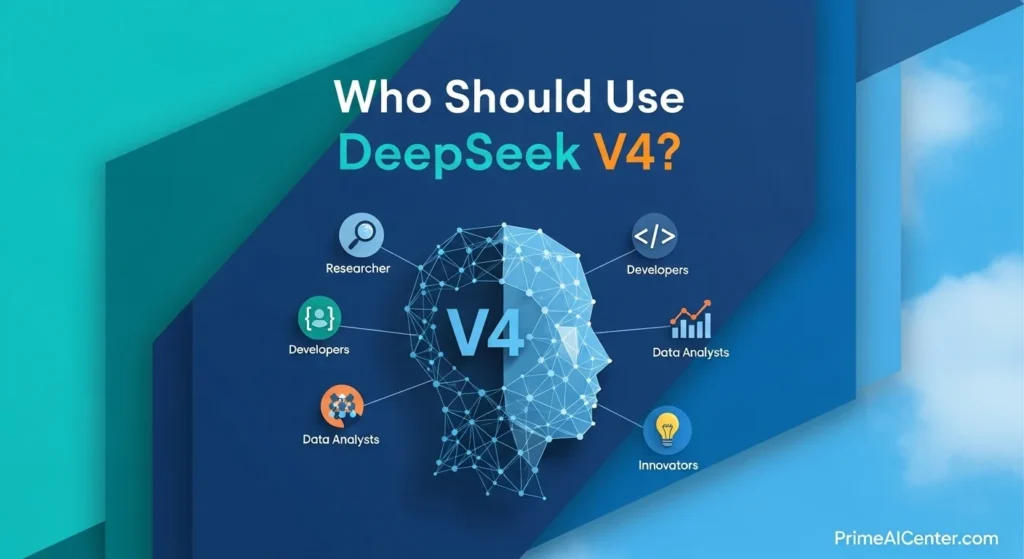
Who Should Use DeepSeek V4?
Best fit for DeepSeek V4:
- Development teams processing large codebases who are currently paying Claude Opus 4.6 or GPT-5.4 Pro rates
- Enterprises running high-volume document analysis, legal review, or compliance workflows at 1M token scale
- Startups building AI products who need frontier-quality reasoning without frontier pricing
- Researchers requiring open weights and Apache 2.0 licensing for derivative model development
- Organizations in regions where data sovereignty requires on-premises deployment
- Teams building multimodal generation workflows (text + image + video output)
Better alternatives for specific use cases:
- Computer use / GUI automation: GPT-5.4 (75% OSWorld, best-in-class)
- Cybersecurity / offensive research: Claude Mythos when available (Anthropic: “far ahead of any other model”)
- On-device / edge deployment: Gemma 4 E4B (runs on 8GB laptop)
- Audio-visual content: Gemma 4 E2B/E4B (native audio input)
- Multilingual CJK: Qwen 3.5/3.6 (250K vocabulary, 201 languages)
The April 2026 Open-Source AI Landscape
DeepSeek V4 is arriving into the strongest open-weight ecosystem in AI history. In the first four days of April 2026 alone, the following major releases have occurred:
| Model | Released | Highlight | Status |
|---|---|---|---|
| Gemma 4 31B | April 2, 2026 | #3 open model globally, Apache 2.0, phone-to-server scale | ✅ Available now |
| Qwen 3.6 Plus | April 2, 2026 | 1M context, 3× faster than Claude, free preview | ✅ Available now (free) |
| GLM-5V-Turbo | April 1, 2026 | 94.8 Design2Code, vision coding, $1.20/M | ✅ Available now |
| DeepSeek V4 | April 2026 (pending) | 1T params, Engram 1M context, $0.10–$0.30/M | ⏳ Imminent |
| GPT-5.5 (Spud) | April 2026 (pending) | “Two years research,” contextual breakthrough | ⏳ Weeks away |
| Claude Mythos | Q3 2026 (limited) | “Step change,” cybersecurity frontier | ⏳ Q3 2026 estimate |
| Grok 5 | Q2 2026 (delayed) | 6T parameters, SpaceX/xAI merge | ⏳ Polymarket 12% by June |
The breadth of this landscape means V4 enters a market where developers have real choices at every tier. For teams currently using DeepSeek V3, V4 is a direct upgrade path. For teams on Western proprietary models, V4 represents the strongest cost-efficiency argument yet for switching or routing high-volume tasks to open-source alternatives. For a complete map of where every model fits, our best AI chatbots 2026 guide is updated monthly.
FAQS: DeepSeek V4 Review
When will DeepSeek V4 be released?
As of April 4, 2026, DeepSeek has not announced an official date. The model has missed three previous windows (January, February, March). April 2026 is the current consensus target based on API.yi analysis, community signals, and the successful V4 Lite validation in March. We will update this article immediately upon official release.
How many parameters does DeepSeek V4 have?
Approximately 1 trillion total parameters in a Mixture-of-Experts architecture, with ~37 billion active per inference token. This is verified through DeepSeek’s official press materials and Reuters reporting, though final specifications may vary slightly at launch.
Is DeepSeek V4 open source?
Expected to be released under Apache 2.0 based on DeepSeek’s established pattern. DeepSeek V3 (671B) was released under MIT license on HuggingFace. V4 is expected to follow the same open-weight approach, though terms have not been officially confirmed.
Can I run DeepSeek V4 locally?
Not on consumer hardware. Self-hosting V4 requires approximately 500GB RAM/VRAM for 4-bit quantization — equivalent to 8× H100 80GB GPUs. The practical access path for most developers is the API at projected $0.10–$0.30/M input tokens. For local AI that actually runs on consumer hardware, Gemma 4 E4B (8GB VRAM) is the current recommendation. See our Gemma 4 local setup guide.
How does DeepSeek V4 compare to Claude Opus 4.6?
Both target ~80% SWE-bench Verified performance. Claude Opus 4.6 costs $5/$25 per million tokens. DeepSeek V4 is projected at $0.10–$0.30/$0.30–$0.60. If V4’s benchmarks hold, the quality-per-dollar advantage would be 17–50× in V4’s favor on input costs. Claude leads on enterprise tooling maturity, safety evaluation, and Claude Code integration.
Will DeepSeek V4 beat GPT-5.5?
GPT-5.5 (Spud) is also unreleased with no confirmed benchmarks. Based on available signals: GPT-5.5 will likely lead on general knowledge work and contextual understanding (Brockman: “contextual breakthrough”). DeepSeek V4 will likely lead on price, open-weight availability, and long-context coding. They may be competitive on raw reasoning. See our GPT-5.5 complete guide for GPT-5.5 specifics.
How does the Engram memory system work?
Engram is a conditional memory module published in a January 2026 DeepSeek technical paper. It achieves constant-time O(1) knowledge retrieval at million-token scale by separating static pattern storage from dynamic reasoning. Multi-head hashing maps compressed contexts to embedding tables, enabling retrieval without re-reading the full context window. Target performance: 97% Needle-in-a-Haystack accuracy at 1M tokens versus the typical 60–80% degradation seen at long ranges in standard attention models.
Final Assessment: Should You Wait for DeepSeek V4?
No. Build and deploy with what is available today. Gemma 4 31B, Qwen 3.6 Plus, and GLM-5V-Turbo are all excellent models available right now. DeepSeek V3 is available via API for $0.27/M input tokens — competitive pricing for today’s workflows. Claude Opus 4.6 and GPT-5.4 remain the best options for specific high-value use cases like complex coding and computer use respectively.
What you should do: bookmark this page, subscribe to DeepSeek’s official channels, and prepare your evaluation infrastructure. When V4 drops, you want to be able to run your benchmarks within hours of availability — not weeks. The teams that adopt quickly will gain the cost advantage, the capability advantage, and the institutional knowledge of the model before competitors.
The disruption potential of DeepSeek V4 is real. A trillion-parameter model with 1M context, multimodal generation, and $0.30/M pricing under Apache 2.0 would be the most economically significant AI release since DeepSeek V3. The delays have been frustrating, but each week of additional training on Huawei Ascend chips is a week of optimization that could compound the quality advantage.
April 2026 is the window. The release could come any day. We will update this article immediately — with full benchmarks, download links, pricing confirmation, and practical deployment guide — the moment it lands.
For the complete picture of what is already available in April 2026, explore our best AI tools 2026, our zero-day reviews of Gemma 4 and GLM-5V-Turbo, and our comparison of the upcoming GPT-5.5 (Spud) and Claude Mythos.
Sources: NxCode DeepSeek V4 analysis, APIYI preview guide, Digital Applied technical analysis, Q2 2026 model preview, Introl architecture analysis, Abhishek Gautam Huawei analysis, AI2Work pricing analysis, Evolink release tracker, Geeky Gadgets leak analysis, Updated April 4, 2026.