
On April 1, 2026, Z.ai (formerly Zhipu AI) released GLM-5V-Turbo — the company’s first native multimodal coding foundation model, and arguably the most specialized AI release of the year. While every other lab is racing to build the most powerful general-purpose model, Z.ai built something deliberately different: a model that looks at a design mockup, understands its layout, color palette, component hierarchy, and interaction logic, and generates a complete, runnable frontend project — in one pass.
The benchmark claim is striking: 94.8 on Design2Code against Claude Opus 4.6’s 77.3. That is a 17-point gap on a task that directly maps to one of developers’ most time-consuming workflows. It also leads on AndroidWorld and WebVoyager — the two most rigorous benchmarks for real GUI agent behavior.
This GLM-5V-Turbo Review covers everything: what GLM-5V-Turbo actually does, how it works architecturally, what the benchmarks mean in practice, how it integrates with Claude Code and OpenClaw, how it prices against every major alternative, and — critically — where it still falls short. We draw on the official Z.ai documentation, independent developer testing, VentureBeat’s analysis, MarkTechPost’s technical breakdown, and the OpenRouter pricing data updated April 2, 2026.
GLM-5V-Turbo at a Glance
| Detail | Specification |
|---|---|
| Developer | Z.ai (Zhipu AI / Tsinghua University spinoff) |
| Release Date | April 1, 2026 |
| Model Type | Native multimodal vision coding foundation model |
| Architecture | Builds on GLM-5 (744B total params, 40B active MoE) + CogViT + MTP |
| Context Window | 200K tokens (202,752 on OpenRouter) |
| Max Output | 131,072 tokens |
| Input Modalities | Text, images, video, design drafts, document layouts |
| Output | Text and code |
| Reasoning Mode | Yes — extended thinking / chain-of-thought |
| API Pricing | $1.20/M input tokens, $4.00/M output tokens |
| Coding Plan | From $3/month (promotional) — $10/month standard |
| Open Source | Proprietary (weights release planned — date unconfirmed) |
| Key Integrations | OpenClaw, Claude Code, Cline, ClawHub |
| Intelligence Index | 43 (Artificial Analysis) — well above average for price tier |
What Is GLM-5V-Turbo?
The vision-language model space has long had a dirty secret: the see-saw effect. When you improve a model’s visual recognition capabilities, its programming logic often degrades — and vice versa. Models that can describe a screenshot beautifully frequently fail to translate that visual understanding into the rigorous, executable syntax that software engineering requires. The result is a generation of multimodal models that are impressive in demos but unreliable in production code generation from visual inputs.
GLM-5V-Turbo is Z.ai’s direct answer to that problem. According to MarkTechPost’s technical analysis of the launch, the model was built from the ground up to bridge visual perception and code execution through three architectural innovations that work together.
The result is a model that completes the full loop of: understand the environment → plan actions → execute tasks — without breaking that chain when the input is visual rather than textual.
Architecture Deep Dive: How GLM-5V-Turbo Actually Works

1. Native Multimodal Fusion — Not a Two-Stage Pipeline
Most previous-generation vision-language models used a two-stage approach: a vision encoder converts an image into a textual description, and a language model then processes that description as if it were written text. This pipeline introduces a lossy compression step — spatial relationships, pixel-level details, and visual hierarchy information are necessarily degraded when translated into text.
GLM-5V-Turbo uses a native fusion approach. Visual inputs — images, videos, design drafts, document layouts — are treated as primary data throughout both pretraining and post-training stages. The model learns to reason across text and visual tokens simultaneously, rather than converting one into the other. According to the official Z.ai documentation for GLM-5V-Turbo, this continuous visual-text alignment across training stages is the foundational reason the model can preserve fine-grained visual details — like the exact spacing between UI components or the specific color values in a design system — when generating code.
2. CogViT Vision Encoder
The CogViT vision encoder is responsible for preserving spatial hierarchies and fine-grained visual details from input images and video. Unlike standard vision transformers that treat images as flat grids of patches, CogViT maintains awareness of structural relationships — understanding that a navigation bar sits above content, that a button hierarchy implies interaction priority, and that color relationships signal branding intent.
In practical terms, this means when you feed GLM-5V-Turbo a high-fidelity Figma export, it does not just identify “button, text, image.” It understands “primary CTA with branded color, supporting secondary action, hero image with overlay text, responsive grid with 16px gutter.” That semantic depth is what allows pixel-level visual consistency in the generated code.
3. MTP (Multi-Token Prediction) Architecture
The MTP architecture improves inference efficiency and reasoning quality for long output sequences. This matters specifically for code generation — a complete, runnable frontend project may involve thousands of lines of HTML, CSS, and JavaScript across multiple files. MTP allows the model to plan and output these sequences more coherently, with fewer inconsistencies between the visual intent and the implementation.
The MTP choice also enables the model’s 200K context window to be practically useful for code generation at scale — processing extensive technical documentation, lengthy video recordings of software interactions, or full design system files as context while still producing high-quality output.
4. 30+ Task Joint Reinforcement Learning
This is the training methodology Z.ai uses to directly address the see-saw effect. Rather than optimizing sequentially — first vision, then coding, then reasoning — GLM-5V-Turbo was trained across more than 30 distinct task types simultaneously. These include:
- STEM reasoning — maintaining mathematical and logical foundations required for programming
- Visual grounding — precisely identifying coordinates and properties of GUI elements
- Video analysis — interpreting temporal changes for debugging animations or user flows
- Tool use — interacting with external software tools and APIs
- GUI agent tasks — operating within real application interfaces autonomously
- Coding agent tasks — completing software development workflows end-to-end
By jointly optimizing across all these task types, the model learns that visual understanding and programming capability are not in tension — they are complementary skills for the same underlying task. According to MarkTechPost’s analysis, this approach resulted in “more robust gains in perception, reasoning, and agentic execution” than sequential or modular training would allow.
GLM-5V-Turbo Benchmark Results: The Numbers in Context
Z.ai published benchmark results across four primary categories. These are company-supplied measurements — independent verification is pending and historical precedent suggests treating internal benchmarks with appropriate skepticism. That said, the Design2Code score in particular is striking enough to deserve detailed examination.
Multimodal Coding and Agentic Tasks
| Benchmark | GLM-5V-Turbo | Claude Opus 4.6 | Qwen 2.5 VL | GPT-4o |
|---|---|---|---|---|
| Design2Code | 94.8 ⭐ | 77.3 | ~70 | ~68 |
| AndroidWorld | Leading ⭐ | Trailing | Competitive | Below |
| WebVoyager | Leading ⭐ | Trailing | Competitive | Below |
| BrowseComp | Above Claude Opus 4.6 | Below GLM-5V-Turbo | — | — |
| Visual code generation | Leading | Below | Below | Below |
| Multimodal retrieval QA | Leading | Below | Below | Below |
The Design2Code gap is the headline number: 94.8 versus 77.3 for Claude Opus 4.6. According to independent analysis of the GLM-5V-Turbo launch, “that’s a striking gap” — though the same source immediately notes the important caveat: these are company measurements, and “in pure text coding — backend tasks, repository exploration — Claude still leads across all categories.” The model is narrowly specialized: it excels specifically when visual input needs to be translated into frontend code.
Pure-Text Coding (CC-Bench-V2)
| Benchmark | GLM-5V-Turbo | Notes |
|---|---|---|
| Backend coding | Strong | Maintained despite vision additions |
| Frontend coding | Strong | Expected given architecture focus |
| Repo exploration | Strong | 200K context enables large-codebase work |
According to the official documentation, GLM-5V-Turbo “maintained solid performance across the three core benchmarks in CC-Bench-V2 — Backend, Frontend, and Repo Exploration — showing that the addition of visual capabilities did not come at the expense of text coding performance.” This is the anti-see-saw evidence Z.ai points to most directly.
Artificial Analysis Intelligence Index
On the Artificial Analysis Intelligence Index — a composite benchmark evaluating reasoning, knowledge, mathematics, and coding — GLM-5V-Turbo scores 43, compared to an average of 13 for comparable models in its price tier. That places it “well above average among comparable models” at similar pricing, according to Artificial Analysis’s model page for GLM-5V-Turbo.
What GLM-5V-Turbo Actually Does: Four Core Use Cases
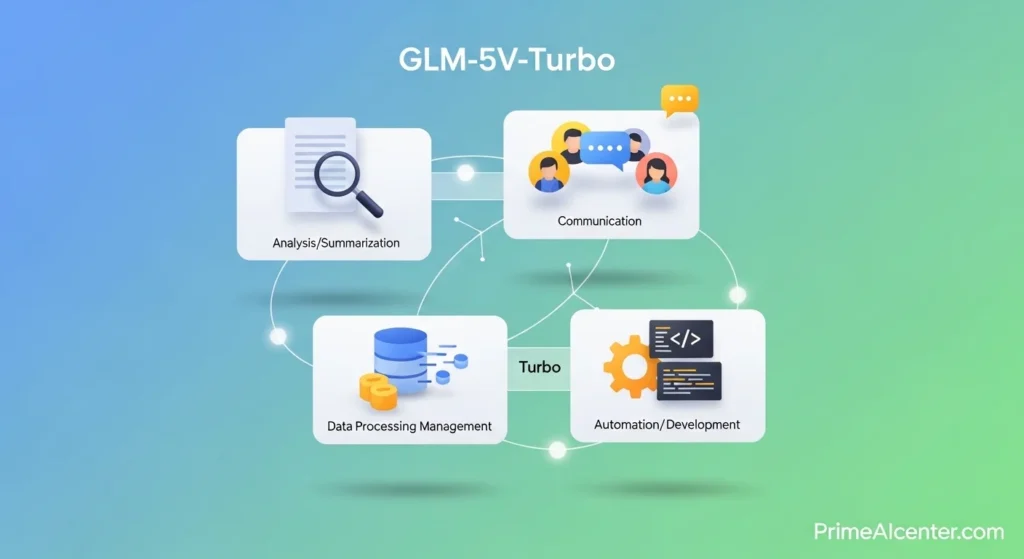
Use Case 1: Design Mockup → Running Frontend App
This is the model’s signature capability and the one that generated the most developer interest on launch day. Send GLM-5V-Turbo a design mockup — a Figma export, a screenshot, a hand-drawn wireframe, even a photograph of a whiteboard sketch — and it generates a complete, runnable frontend project.
For high-fidelity designs, the model aims for pixel-level visual consistency: matching the exact color palette, spacing, typography, and component hierarchy. For wireframes, it reconstructs structure and functionality even when visual details are sparse. According to developer testing of GLM-5V-Turbo with OpenClaw, the model “shows strong reasoning and corrective behavior on multi-pass UI builds” — when asked to fix missing elements, it rebuilds cleanly rather than patching inconsistently.
The recommended workflow from the documentation and independent testers: request single-file outputs during UI builds, keeping CSS and JavaScript embedded. This prevents style drift across files and makes the output immediately runnable. A prompt like: “Recreate the mobile pages based on the design mockups in the images. The left shows the welcome page, center shows the homepage.” — generates complete, deployable code in one pass.
Use Case 2: Video → Website
One of GLM-5V-Turbo’s more unusual capabilities is video-to-code generation. Provide a short video — a product demo, a user session recording, a screen capture of an existing application — and ask the model to analyze mood, color temperature, layout patterns, and interaction flows, then generate corresponding frontend code.
A practical prompt from the documentation: “Analyze the attached video for mood, color temperature, and pacing. Generate a single HTML file for a portfolio landing page that reflects those aesthetics.” This is useful for brand-consistent web development when you have video references but no explicit design files.
Use Case 3: GUI Agent Tasks (AndroidWorld / WebVoyager)
GLM-5V-Turbo’s performance on AndroidWorld and WebVoyager benchmarks demonstrates something more than design-to-code capability: the model can operate within actual graphical user interfaces as an autonomous agent. It can browse target websites, map page transitions, collect visual assets and interaction details, and generate code based on what it observes — without human direction at each step.
In OpenClaw workflows, this means the model can autonomously: navigate to a target URL, identify UI elements and their properties, understand the site’s information architecture, and generate scraping or replication code grounded in what it actually observed. This is the “Claw scenario” the model was specifically optimized for — a category of task that most other models handle through text descriptions of pages rather than direct visual perception.
Use Case 4: Agentic Engineering with OpenClaw and Claude Code
Perhaps the most strategically interesting aspect of GLM-5V-Turbo is its explicit optimization for agent orchestration frameworks. The model is designed to work in “deep synergy” with two specific agentic harnesses:
OpenClaw — the open-source agentic harness framework that coordinates AI agent behavior by decomposing goals into subtasks, created by Austrian programmer Peter Steinberger. GLM-5V-Turbo is integrated as a first-class option in OpenClaw and has been specifically optimized for OpenClaw’s visual task categories: environment setup, software development, information retrieval, data analysis, and content creation.
Claude Code — Anthropic’s terminal-first coding agent. GLM-5V-Turbo works within Claude Code for visually grounded coding workflows. In “Claw scenarios” where a developer provides a screenshot of a bug or a mockup of a new feature, GLM-5V-Turbo handles the visual perception and code generation while Claude Code handles the agentic execution layer.
This is a genuinely unusual product positioning: a model that explicitly markets its ability to work alongside a competitor’s product (Claude Code), turning visual understanding into a complement to Claude’s text-based reasoning rather than a replacement for it. For more on how Claude Code works and the agentic architecture it supports, see our best AI coding assistant 2026 comparison. For the underlying agent protocol, our WebMCP and MCP protocol guide covers how these integrations work.
GLM-5V-Turbo Pricing: The Economic Case
This is where GLM-5V-Turbo becomes genuinely compelling for high-volume workflows. The model is priced at a fraction of the comparable multimodal offerings from Western frontier labs.
| Model | Input (per M tokens) | Output (per M tokens) | Notes |
|---|---|---|---|
| GLM-5V-Turbo | $1.20 | $4.00 | Vision + text + video input |
| Claude Opus 4.6 | $5.00 | $25.00 | Text + vision (no native video) |
| GPT-5.4 | ~$10.00 | ~$30.00 | 1M context, computer use |
| GPT-5.2 | $1.75 | $14.00 | Strong reasoning, no video input |
| Gemini 3.1 Pro | $2.00 | $12.00 | 1M context, leads most benchmarks |
| Gemini 3.1 Flash-Lite | $0.075 | $0.30 | Cheapest capable option |
| GLM-5-Turbo (text only) | $0.96 | $3.20 | Text + agentic, no vision |
At $1.20/$4.00, GLM-5V-Turbo costs less than a quarter of Claude Opus 4.6 on input tokens and less than a fifth on output — while claiming superior performance on the specific task of design-to-code generation. For frontend development teams doing high-volume UI work, this price differential is significant. A workflow that costs $500/month on Claude Opus 4.6 for the same output volume would cost approximately $100/month on GLM-5V-Turbo.
The GLM Coding Plan subscription is even cheaper: starting at $3/month (promotional) or $10/month standard, it includes access to GLM-5V-Turbo, GLM-5, GLM-5.1, GLM-5-Turbo, and GLM-4.7, plus features like vision understanding, web search, and web reader. The plan is compatible with Claude Code, Cline, and other popular coding tools. According to VentureBeat’s coverage of Z.ai’s pricing strategy, this positions the coding subscription as “about $0.04 cheaper per total input and output cost (at 1 million tokens)” than its predecessor — while adding multimodal vision capabilities that predecessors lacked.
GLM-5V-Turbo vs Claude Opus 4.6: Honest Comparison
This is the comparison most developers will actually care about, since Claude Opus 4.6 is the current production standard for serious coding workflows.
| Dimension | GLM-5V-Turbo | Claude Opus 4.6 | Winner |
|---|---|---|---|
| Design-to-code (Design2Code) | 94.8 | 77.3 | GLM-5V-Turbo 🟢 |
| GUI agents (AndroidWorld) | Leading | Trailing | GLM-5V-Turbo 🟢 |
| Web navigation (WebVoyager) | Leading | Trailing | GLM-5V-Turbo 🟢 |
| Agentic browsing (BrowseComp) | Above | Below | GLM-5V-Turbo 🟢 |
| Backend/repo coding (SWE-bench) | GLM-5: 77.8%; GLM-5V-Turbo: competitive | 80.8% ⭐ | Claude Opus 4.6 🔵 |
| Complex reasoning (GPQA Diamond) | GLM-5 family: ~88% | ~88% | Roughly equal 🟡 |
| Video input | ✅ Native support | ❌ No | GLM-5V-Turbo 🟢 |
| Context window | 200K tokens | 200K tokens | Equal 🟡 |
| Pricing (input) | $1.20/M ⭐ | $5.00/M | GLM-5V-Turbo 🟢 |
| Open weights | Planned (not yet released) | Proprietary | GLM-5V-Turbo (pending) 🟡 |
| Enterprise support maturity | Growing (12,000+ enterprise customers) | Mature | Claude Opus 4.6 🔵 |
| Multi-agent orchestration | OpenClaw native | Claude Code native | Depends on your stack 🟡 |
Summary: GLM-5V-Turbo wins clearly on visual tasks — design-to-code, GUI agents, web navigation — and wins decisively on pricing. Claude Opus 4.6 wins on general text-based coding benchmarks and enterprise support maturity. The optimal strategy for many teams is to use both: GLM-5V-Turbo for frontend/visual workflows, Claude Opus 4.6 for complex backend architecture and reasoning-heavy tasks.
The Z.ai Company Context: Why This Launch Matters Beyond the Benchmarks
Understanding GLM-5V-Turbo requires understanding Z.ai’s strategic position — because the model’s significance extends well beyond its benchmark scores.
Z.ai (Zhipu AI) was founded in 2019 as a Tsinghua University spinoff in Beijing. In January 2026, it became the world’s first publicly traded foundation model company after its Hong Kong Stock Exchange IPO, raising substantial funds at a valuation of approximately $31–34.5 billion (figures vary by reporting source and timing). CEO Zhang Peng articulated the company’s open strategy explicitly: “Unlike OpenAI’s closed system, we adopt an open strategy to advance science and technology.”
GLM-5, released February 2026, was the base model: 744 billion total parameters, 40 billion active per token in a Mixture-of-Experts architecture, trained on 28.5 trillion tokens — entirely on Huawei Ascend chips with no Nvidia hardware. This is geopolitically significant. Despite Z.ai being placed on the U.S. Commerce Department Entity List in January 2025 citing national security concerns, the model was developed entirely on domestic Chinese hardware and released under an MIT license on HuggingFace, accumulating over 217,000 downloads. According to WinBuzzer’s analysis of the GLM-5V-Turbo launch, “the Entity List designation has not blocked the Hong Kong IPO or this open-source distribution.”
GLM-5-Turbo (March 15, 2026) — the text-only predecessor to GLM-5V-Turbo — was the first commercial offshoot: proprietary (not open-source), priced at $1.20/$4.00 per million tokens, and optimized specifically for OpenClaw agentic workflows. According to Trending Topics EU’s coverage of GLM-5-Turbo, it costs “five times less than Claude Opus 4.6” and outperforms several leading models in OpenClaw-specific task categories.
GLM-5V-Turbo is the multimodal evolution of that strategy: the same price advantage, now extended to visual inputs. This three-release sequence in two months — GLM-5 (February), GLM-5-Turbo (March), GLM-5V-Turbo (April) — reflects both competitive pressure and a clear product thesis: build openly at the foundation layer, commercialize efficiently at the application layer, and price aggressively to capture developer adoption before Western labs can close the cost gap.
For the broader context of Chinese AI models in 2026, including how GLM-5V-Turbo fits into the ecosystem alongside Qwen 3.5 and Kimi K2.5, our best AI chatbots 2026 guide covers the full competitive landscape. The AI statistics that define this market are covered in detail in our AI statistics 2026 guide.
OpenClaw Integration: The Technical Details
OpenClaw is the agentic harness framework that Z.ai has most explicitly optimized GLM-5V-Turbo for. Created by Peter Steinberger and released on GitHub in November 2025, OpenClaw lets users create personal AI agents accessible via WhatsApp, Telegram, and Discord. After GLM-5V-Turbo’s integration, OpenClaw can now understand webpage layouts, GUI elements, and chart information — enabling agents to handle complex real-world tasks that combine perception, planning, and execution in ways that text-only models cannot.
The integration adds five official Skills to ClawHub — the OpenClaw skill marketplace — powered by GLM-5V-Turbo:
- Visual description — automatic image content analysis with relationship and scene understanding
- Visual grounding — precise object location using bounding boxes from natural-language descriptions
- Prompt generation — automatic structured prompt creation from reference images and videos
- GLM-OCR — text extraction from images, documents, and screenshots
- GLM-Image — broader image analysis for non-coding visual tasks
For developers using Claude Code within OpenClaw, GLM-5V-Turbo adds a visual perception layer that Claude Code does not natively provide. According to the official documentation, “this is especially useful in Claw Scenarios, where a developer might need to provide a screenshot of a bug or a mockup of a new feature” — letting Claude Code handle the execution while GLM-5V-Turbo handles the seeing. This complements the broader agent ecosystem covered in our guide on WhatsApp AI agents and our deep dive into what AI agents are and how they work.
How to Access GLM-5V-Turbo: Four Options
Option 1: Z.ai API Direct
Available at docs.z.ai with the model ID glm-5v-turbo. Pricing: $1.20/M input, $4.00/M output. Supports Python (via zai SDK), Java, and standard OpenAI-compatible interfaces.
Option 2: OpenRouter
Available at openrouter.ai/z-ai/glm-5v-turbo with a 202,752-token context window and 131K max output. OpenRouter enables model switching and fallback configurations within OpenClaw and other agent frameworks. Pricing matches direct API.
Option 3: GLM Coding Plan Subscription
Starting at $3/month (promotional), $10/month standard. Includes GLM-5V-Turbo alongside GLM-5, GLM-5.1, GLM-5-Turbo, and GLM-4.7. Compatible with Claude Code, Cline, and other popular coding tools. Best value for individual developers doing regular frontend work. Apply via the Z.ai Coding Plan trial application form.
Option 4: Z.ai Chat Interface
Available at chat.z.ai for direct interactive use without API setup. Good for evaluating the model before committing to API integration or subscription.
Honest Limitations: Where GLM-5V-Turbo Falls Short
No honest review omits the limitations. Here is what the evidence shows:
Specialized, not general. GLM-5V-Turbo is excellent specifically at visual-to-code workflows. In pure text-based backend coding, repository exploration, and complex architectural reasoning, Claude Opus 4.6 maintains a measurable edge. This model is not a general-purpose Claude replacement; it is a specialist tool for a specific category of work.
Internal benchmarks only. Every benchmark cited in this review is company-supplied data. Independent third-party validation of the 94.8 Design2Code score and the GUI agent claims is pending. Z.ai has been accurate in previous benchmark claims for GLM-5 (SWE-bench Verified 77.8% has been externally validated), but the multimodal-specific claims for GLM-5V-Turbo await independent confirmation.
No open weights yet. Unlike GLM-5, which carries an MIT license and is available on HuggingFace, GLM-5V-Turbo is proprietary. Z.ai has indicated plans to release weights, but no date is confirmed. Organizations that require self-hosted deployment for compliance or data sovereignty reasons cannot use this model in its current form.
Entity List considerations. Z.ai is on the U.S. Commerce Department Entity List. While this has not blocked HuggingFace access, open-source distribution, or the Hong Kong IPO, U.S. government contractors and defense-adjacent firms should review applicable restrictions before deploying GLM-5V-Turbo in sensitive environments.
Self-hosting is non-trivial. The GLM-5 base model requires approximately 1.49TB in BF16 format. While cloud deployment via partners like GMI Cloud is available on day one, on-premises deployment of the base architecture is not accessible to smaller teams.
Who Should Use GLM-5V-Turbo?
Frontend developers and UI engineers doing high-volume design implementation will find the most direct value. The Design2Code capability alone could eliminate hours of manual work per sprint. At $1.20/M input tokens, the economics are compelling versus any alternative.
Full-stack development teams working in OpenClaw-based agentic workflows gain a visual perception layer they previously lacked. Rather than replacing Claude Code or Codex, GLM-5V-Turbo extends what those agents can perceive and act on.
No-code and low-code builders working with design tools like Figma can now generate production-ready code directly from their design files without intermediate steps. The pixel-level visual consistency claim, if it holds under independent testing, makes this a significant workflow accelerator. For more on no-code AI tools for builders, our best AI tools for solopreneurs guide covers the broader toolkit.
Budget-conscious development teams looking for Claude Opus 4.6 alternatives for specific tasks. At $1.20/$4.00 versus $5.00/$25.00, teams can route visual and frontend tasks to GLM-5V-Turbo and reserve Claude Opus for complex backend work — cutting API costs substantially without sacrificing quality on visual tasks.
Enterprise teams adopting the OpenClaw ecosystem. With Tencent’s WorkBuddy, Nvidia’s NemoClaw, and major Chinese cloud providers (Alibaba, ByteDance, Baidu) all releasing OpenClaw variants, the ecosystem is growing faster than most Western developers realize. GLM-5V-Turbo is positioned as the premier vision model within that ecosystem.
For the full enterprise deployment framework, our enterprise AI agent deployment guide covers governance, security, and rollout patterns that apply directly to GLM-5V-Turbo deployments.
FAQS: GLM-5V-Turbo Review
What is GLM-5V-Turbo?
GLM-5V-Turbo is Z.ai’s first native multimodal coding foundation model, released April 1, 2026. It natively processes images, video, design drafts, and text to generate code — specifically optimized for design-to-code generation, GUI agent tasks, and agentic workflows within OpenClaw and Claude Code.
How is GLM-5V-Turbo different from GLM-5-Turbo?
GLM-5-Turbo (released March 15, 2026) is a text-only agentic model. GLM-5V-Turbo (released April 1, 2026) adds native vision capabilities — image, video, and design document input — making it a multimodal model. GLM-5V-Turbo builds on the same GLM-5 base architecture but extends it with the CogViT vision encoder and MTP architecture for visual reasoning.
What is the Design2Code benchmark?
Design2Code evaluates how accurately a model can reproduce UI mockups in runnable HTML/CSS/JavaScript code. GLM-5V-Turbo scored 94.8, compared to Claude Opus 4.6’s 77.3. These are Z.ai-supplied scores; independent verification is pending. The 17-point gap is significant if it holds under external testing.
How much does GLM-5V-Turbo cost?
API: $1.20 per million input tokens, $4.00 per million output tokens (via OpenRouter and Z.ai direct). GLM Coding Plan subscription: from $3/month (promotional) to $10/month standard, including GLM-5V-Turbo and other Z.ai models.
Does GLM-5V-Turbo work with Claude Code?
Yes. GLM-5V-Turbo is explicitly optimized for use alongside Claude Code. In the recommended workflow, GLM-5V-Turbo handles visual perception and code generation from images/designs, while Claude Code handles agentic task execution. The model is also compatible with Cline and other coding tools via the GLM Coding Plan.
Is GLM-5V-Turbo open source?
Not currently. Unlike GLM-5 (MIT license, available on HuggingFace), GLM-5V-Turbo is proprietary. Z.ai has indicated plans to release the weights but has not confirmed a date. The API is available through Z.ai’s platform and OpenRouter.
Is GLM-5V-Turbo affected by U.S. export restrictions?
Z.ai is on the U.S. Commerce Department Entity List. This has not blocked API access, open-source distribution, or the Hong Kong IPO. However, U.S. government contractors and defense-adjacent organizations should review applicable compliance requirements before deploying this model in sensitive environments.
Final Verdict: GLM-5V-Turbo Review
| Category | Score | Notes |
|---|---|---|
| Design-to-code capability | ⭐⭐⭐⭐⭐ | Category-leading at 94.8 Design2Code (pending independent verification) |
| GUI agent performance | ⭐⭐⭐⭐⭐ | Leads AndroidWorld and WebVoyager over Claude Opus 4.6 |
| Pricing | ⭐⭐⭐⭐⭐ | 4× cheaper than Claude Opus on input, 6× on output |
| General coding | ⭐⭐⭐⭐ | Strong, but Claude Opus 4.6 still leads SWE-bench |
| Integration ecosystem | ⭐⭐⭐⭐ | Deep OpenClaw and Claude Code support; Claude Code ecosystem more mature |
| Open source / self-hosting | ⭐⭐ | Proprietary for now — weights release planned but unconfirmed |
| Enterprise maturity | ⭐⭐⭐ | 12,000+ enterprise customers, Hong Kong IPO, but newer to international market |
| Benchmark credibility | ⭐⭐⭐ | Company-supplied scores — independent validation pending for V-Turbo specifically |
Bottom line: GLM-5V-Turbo is the most capable and cost-efficient visual-to-code model available in April 2026. The Design2Code score gap over Claude Opus 4.6 is significant enough that it deserves serious evaluation by any team doing frontend development from design files. The OpenClaw and Claude Code integrations mean it adds visual capability to existing agentic workflows without replacing them. The pricing makes it an obvious choice for high-volume visual tasks versus any Western frontier alternative.
The caveats are real: these benchmarks are self-reported, the model is narrowly specialized, and open weights are still coming. But on the evidence available on April 2, 2026, this is a model that developers doing design-to-code work should test immediately.
For the broader AI model landscape heading into Q2 2026 — including the upcoming GPT-5.5 (Spud) release and the Claude Mythos Capybara tier — our best AI chatbots 2026 guide is updated regularly. For making money with AI tools, our guide to monetizing AI covers practical frameworks for freelancers, agencies, and solopreneurs.
Sources: MarkTechPost, Z.ai official documentation, WinBuzzer, VentureBeat, Artificial Analysis, OpenRouter, abit.ee analysis, Sonu Sahani developer testing, WaveSpeed AI, Serenities AI, Trending Topics EU, Puter Developer docs, LogRocket power rankings, TLDL pricing guide. Updated April 2, 2026.