
Something extraordinary happened in the first four months of 2026. The performance gap between open-source AI models and the best proprietary models — GPT-5.4 at $2.50/M tokens, Claude Opus 4.6 at $5.00/M — narrowed to single-digit percentages on most benchmarks. A year ago, that gap was 15–20 points. Today, a model you can download, run locally, and customize freely — at zero ongoing API cost — competes directly with the most expensive AI systems in history.
Six major labs now ship frontier-competitive open-weight models: Google (Gemma 4), Meta (Llama 4), Alibaba (Qwen 3.5/3.6), Zhipu AI (GLM-5), Moonshot AI (Kimi K2.5), and even OpenAI (gpt-oss-120b) — which crossed a historic threshold by releasing open weights for the first time. Chinese models now process over 45% of all tokens on OpenRouter, the leading AI API marketplace, up from less than 2% a year ago.
This guide covers the 12 best open-source AI models available in April 2026. For each model, you get: exact download links, real benchmark scores, hardware requirements, license terms (the most important detail most guides skip), and an honest assessment of who should use it and why. No sponsored rankings. No marketing claims. Just data and decisions.
Open Source vs Open Weight vs Source-Available: The Critical Distinction
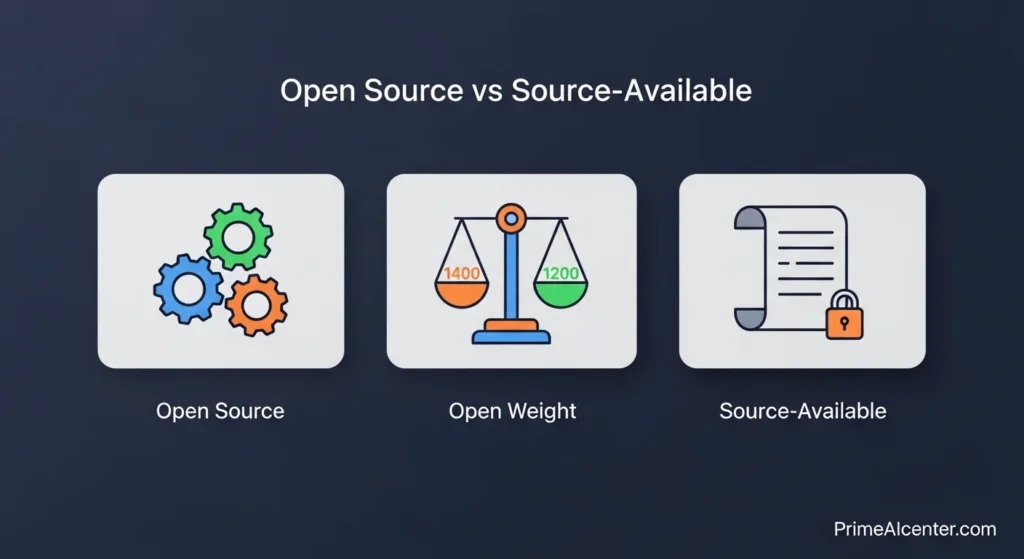
Before the model rankings, understand the terminology — because getting it wrong is expensive. Three categories get conflated constantly in AI coverage, and they have completely different implications for what you can actually do with the model.
| Category | What You Get | Commercial Use | Examples |
|---|---|---|---|
| Open Source | Weights + training code + data documentation + permissive license | ✅ Unrestricted | DeepSeek V3.2, Mistral Small 4 |
| Open Weight (Apache 2.0) | Weights only — no training code or data pipeline | ✅ Unrestricted (Apache 2.0) | Gemma 4, Qwen 3.5, GLM-5, gpt-oss-120b |
| Open Weight (Custom License) | Weights with usage restrictions baked in | ⚠️ Conditional — always check | Llama 4 (700M MAU cap), Kimi K2.5 |
| Proprietary API | API access only — no weights | Terms of service apply | GPT-5.4, Claude Opus 4.6, Gemini 3.1 Pro |
The short rule: Apache 2.0 is the gold standard. It means no monthly active user limits, no acceptable-use policy enforcement, no geographic restrictions, and full freedom to build derivative models. Llama 4’s community license has a 700M MAU threshold clause — fine for most companies, but add compliance overhead for fast-growing products. Always read the license before building on any model. For the full competitive picture including proprietary models, see our best AI chatbots 2026 comparison.
The 12 Best Open Source AI Models of 2026 — Ranked
🥇 1. GLM-5 — Best Overall Open-Weight Model
| Spec | Value |
|---|---|
| Developer | Zhipu AI (Z.ai) |
| Parameters | 744B total / 40B active (MoE) |
| License | MIT ✅ (most permissive available) |
| Context Window | 128K tokens |
| Release | February 2026 |
| Arena AI Rank | #1 among open models (ELO 1451) |
| SWE-bench Verified | 77.8% |
| GPQA Diamond | 86.0% |
| Training data | 28.5 trillion tokens |
| Hardware | Trained on Huawei Ascend — requires significant GPU cluster |
GLM-5 is the highest-ranked open-weight model on the Chatbot Arena leaderboard with an ELO of 1451. It scales from 355B parameters (GLM-4.5, 32B active) to 744B (GLM-5, 40B active), trained on 28.5 trillion tokens — more than any other open-weight model. The MIT license is the most permissive available: no restrictions, no clauses, no geographic limits. GLM-5 integrates DeepSeek Sparse Attention (DSA) to reduce deployment cost while preserving long-context capacity.
The geopolitical angle matters: GLM-5 was trained entirely on Huawei Ascend chips — zero dependency on Nvidia hardware. This makes it the first frontier-tier model that demonstrates Chinese domestic AI compute can produce globally competitive results. According to AIMojo’s State of Open-Source AI 2026, GLM-5 “currently leads reasoning benchmarks” among open models.
Best for: Complex systems engineering, long-horizon agentic tasks, coding at scale, enterprise deployments where MIT licensing removes all legal friction. For the GLM vision coding model built on this architecture, see our GLM-5V-Turbo review.
📥 Download links:
→ HuggingFace: zai-org/GLM-5
→ HuggingFace: ACTiVEX/GLM-5 (community mirror)
→ Deep Infra hosted API: zai-org/GLM-5
🥈 2. Kimi K2.5 — Best Overall Performance (All Tasks)
| Spec | Value |
|---|---|
| Developer | Moonshot AI |
| Parameters | ~1 trillion (MoE) |
| License | MIT ✅ |
| Context Window | 256K tokens |
| Release | January 27, 2026 |
| BrowseComp | 78.4% (best of any model) |
| GPQA Diamond | Strong (competing with Claude Opus 4.5) |
| Modalities | Text + Vision (native multimodal) |
| Unique Feature | Agent Swarm: up to 100 parallel sub-agents |
Kimi K2.5 set a new open-weight performance ceiling when it launched in late January 2026. Its headline feature is Agent Swarm — the ability to split complex tasks into up to 100 specialized sub-agents running in parallel, coordinated by a master agent. On BrowseComp (the benchmark measuring web navigation and multi-source research), Kimi K2.5 scored 78.4% — the best result of any model tested, including GPT-5.2. In Swarm mode, complex analytical tasks that take 10 minutes complete in 2–3 minutes.
The tradeoff: standard Thinking mode is slower than competitors (29.2 seconds median vs 4.6 for Claude Sonnet 4.6). And the ~1 trillion parameter count makes self-hosting unrealistic for most teams. Use the API for most cases.
Best for: Deep research workflows, multi-source analysis, complex agentic tasks, web research automation. For how agentic AI like this works architecturally, see our complete AI agent guide.
📥 Download links:
→ HuggingFace: moonshotai/Kimi-K2.5
→ Chat interface: kimi.ai (free access globally)
→ API: platform.moonshot.cn
🥉 3. Gemma 4 31B — Best Open Model for Deployment Range
| Spec | Value |
|---|---|
| Developer | Google DeepMind |
| Sizes | E2B / E4B / 26B MoE (4B active) / 31B Dense |
| License | Apache 2.0 ✅ (first time for Gemma) |
| Context Window | 128K (E2B/E4B) / 256K (26B/31B) |
| Release | April 2, 2026 |
| Arena AI Rank | #3 open model globally (ELO ~1452) |
| AIME 2026 | 89.2% |
| MMLU Pro | 85.2% |
| Codeforces ELO | 2150 (vs 110 for Gemma 3) |
| Modalities | Text + Images + Video (all) + Audio (E2B/E4B) |
Gemma 4 is Google’s most important open-weight release, landing April 2, 2026 with a genuinely disruptive feature: four model variants spanning smartphone (E2B) to server (31B Dense), all under the same Apache 2.0 license, all natively multimodal, and all showing benchmark scores that would have been unthinkable from a 31B model a year ago. The 31B Dense outperforms models 20× its size on the Arena AI leaderboard. The 26B MoE achieves 97% of the 31B’s quality while activating only 3.8B parameters per inference — the most compute-efficient frontier-quality model available.
The AIME 2026 improvement from Gemma 3’s 20.8% to Gemma 4’s 89.2% — a 4× jump — demonstrates a training recipe transformation that is qualitatively significant. For a complete setup guide including hardware requirements, Ollama commands, and fine-tuning instructions, see our Gemma 4 complete guide with download links.
Best for: Any team needing one model family from phone to data center, Android development, on-device AI, privacy-sensitive deployments.
📥 Download links:
→ HuggingFace: google/gemma-4-31B-it
→ HuggingFace: google/gemma-4-26B-A4B-it (MoE)
→ HuggingFace: google/gemma-4-E4B-it (Edge)
→ Ollama: ollama run gemma4
→ Kaggle Models (no HuggingFace account needed)
→ Google AI Studio (hosted, no download)
4. DeepSeek V3.2 — Best Value: 90% of GPT-5.4 at 1/50th the Cost
| Spec | Value |
|---|---|
| Developer | DeepSeek |
| Parameters | ~685B total / 37B active (MoE) |
| License | MIT ✅ |
| Context Window | 128K tokens |
| API Pricing | $0.27–$0.28 per million input tokens |
| Notable | Gold-medal results on 2025 IMO and IOI |
| Architecture | DeepSeek Sparse Attention (DSA) |
DeepSeek V3.2 delivers roughly 90% of GPT-5.4’s quality at approximately 1/50th the cost — $0.28 per million input tokens versus $2.50 for GPT-5.4. The model introduced DeepSeek Sparse Attention (DSA), a fine-grained sparse attention mechanism that reduces training and inference cost while preserving quality in long-context scenarios. It reported gold-medal results on both the 2025 International Mathematical Olympiad (IMO) and International Olympiad in Informatics (IOI) — a landmark achievement for an open-weight model.
For high-volume internal workflows — data labeling, content summarization, document classification — DeepSeek V3.2 is the most cost-effective frontier-adjacent model available. According to OpenRouter’s April 2026 rankings, DeepSeek V3.2 is the “reasoning specialist” in the Chinese model category, consistently in the top 10 by token volume across the platform.
Best for: Bulk processing, cost-sensitive production workloads, mathematical reasoning, coding, teams migrating from expensive proprietary APIs.
📥 Download links:
→ HuggingFace: deepseek-ai/DeepSeek-V3.2-Exp
→ Chat interface: chat.deepseek.com (free)
→ API: platform.deepseek.com ($0.27/M input)
→ OpenRouter: deepseek/deepseek-v3-2
5. Llama 4 Maverick + Scout — Best for Ultra-Long Context
| Spec | Scout | Maverick |
|---|---|---|
| Parameters (total/active) | 109B / 17B (16 experts) | 400B / 17B (128 experts) |
| Context Window | 10M tokens ⭐ | 1M tokens |
| License | Llama 4 Community License (700M MAU clause) | |
| Release | April 5, 2025 (still current best) | |
| Training Tokens | ~40 trillion | ~22 trillion |
| Modalities | Text + Images (native) | |
| Minimum Hardware | Single H100 (INT4) | 8× H100 (FP8) |
| API Cost Estimate | $0.19/Mtok (distributed inference) | |
Llama 4 Scout has one defining competitive advantage that no other model in the world can match: a 10 million token context window — 10× longer than any competitor. This is not theoretical. For teams processing entire software repositories, book-length documents, multi-year conversation histories, or full legal case archives in a single prompt, Scout is the only option. Maverick, with 1M context and 128 experts, offers the best quality-per-active-parameter ratio in the family.
The honest limitation: Self-hosting Llama 4 requires enterprise-grade hardware. Scout (INT4) needs ~55GB — not available on any consumer GPU. Maverick (FP8) requires 8× H100. The 700M MAU license clause is not a problem for most companies but requires legal review for fast-growing consumer products. Also note: the Llama 4 Community License includes geographic restrictions for certain countries — review carefully before production deployment in the EU.
Best for: Large document processing, legal tech, codebase analysis, enterprise use cases requiring the longest context available anywhere. Meta AI is built with Llama 4 in WhatsApp, Messenger, and Instagram.
📥 Download links:
→ HuggingFace: Llama-4-Scout-17B-16E-Instruct
→ HuggingFace: Llama-4-Maverick-17B-128E-Instruct
→ Official: llama.com/models/llama-4
→ Ollama: ollama run llama4
⚠️ Requires HuggingFace account + license acceptance before download.
6. Qwen 3.5 / 3.6 Plus — Best for Coding and CJK Languages
| Spec | Value |
|---|---|
| Developer | Alibaba (Qwen Team) |
| Size Range | 0.8B to 397B (dense + MoE variants) |
| License | Apache 2.0 ✅ |
| Context Window | Qwen 3.6 Plus: 1M tokens |
| Languages | 201 languages, 250K vocabulary |
| Qwen 3.5 flagship | 397B-A17B (MoE) |
| Qwen 3.6 Plus | Released March 31, 2026 — free preview |
| Benchmark | Wins/ties 5 of 8 benchmark categories |
Qwen 3.5 is the most downloaded open-weight model family globally by commercial deployment, driven by three factors: Apache 2.0 licensing, the widest model size range (0.8B to 397B) of any lab, and competitive performance on coding benchmarks. The 201-language, 250K vocabulary advantage makes Qwen the unmatched choice for CJK (Chinese, Japanese, Korean) script applications — and the best multilingual option in the entire open-source ecosystem.
Qwen 3.6 Plus, released March 31, 2026, adds a 1M token context window and runs at approximately 3× the inference speed of Claude Opus 4.6 in community benchmarks. It is currently in free preview on OpenRouter. The always-on chain-of-thought reasoning (no toggle required) and native function calling make it production-ready for agentic coding workflows.
Best for: Coding agents, CJK language applications, multilingual content, teams wanting the widest model size range under one license. For agentic WhatsApp integration, see our WhatsApp AI agents guide.
📥 Download links:
→ HuggingFace: Qwen/Qwen3.5-397B-A17B
→ HuggingFace: Qwen/Qwen3.5-27B (recommended single-GPU)
→ OpenRouter: qwen/qwen3.6-plus-preview:free (free now)
→ Ollama: ollama run qwen3.5
→ Qwen Chat: chat.qwen.ai
7. Mistral Small 4 — Best Single-Model Architecture
| Spec | Value |
|---|---|
| Developer | Mistral AI (France) |
| Parameters | 119B total / 6.5B active (MoE) |
| License | Apache 2.0 ✅ |
| Context Window | 256K tokens |
| Release | March 2026 |
| Unique Feature | Adjustable reasoning_effort (none/low/medium/high) |
Mistral Small 4 takes a unique architectural approach: instead of shipping separate models for instruction following, reasoning, and coding, it unifies all three into a single 119B MoE model with adjustable reasoning effort at inference time. Set reasoning_effort="none" for fast instruction responses. Set reasoning_effort="high" for deliberate step-by-step reasoning comparable to dedicated reasoning models. One deployment, one API, all capability levels.
As Europe’s strongest open-weight entry, Mistral Small 4 is particularly important for EU organizations facing AI Act compliance requirements. Apache 2.0 license, EU-headquartered company, sovereignty-friendly architecture. At 6.5B active parameters per inference, it runs efficiently on a single H100 or equivalent hardware.
Best for: EU organizations needing sovereignty, teams that want to minimize model management overhead, production systems requiring tunable inference cost-quality tradeoffs.
📥 Download links:
→ HuggingFace: mistralai/Mistral-Small-4
→ Ollama: ollama run mistral-small4
→ Mistral AI Platform API
8. gpt-oss-120b — OpenAI’s First Open-Weight Model
| Spec | Value |
|---|---|
| Developer | OpenAI |
| Parameters | 117B total / 5.1B active (MoE) |
| License | Apache 2.0 ✅ (historic first for OpenAI) |
| Context Window | 128K tokens |
| Release | Early 2026 |
| Reasoning | Configurable low/medium/high effort |
| Limitation | Text-only (no vision/audio) |
gpt-oss-120b is historically significant: it is the first time OpenAI has ever released model weights publicly — under Apache 2.0, no less. This model was downloaded far more than any other American open-weight model since Llama 3.1 was released, according to Interconnects AI’s tracking of open-weight adoption. OpenAI releasing open weights under Apache 2.0 confirms that even the most commercially oriented AI lab now considers open-weight models a competitive necessity.
The model comes in two sizes (20B and 120B), uses the familiar GPT tokenizer (o200k_harmony), and follows OpenAI API conventions — making migration from GPT-4o or GPT-5.4 straightforward for existing OpenAI users. The key limitation: text-only. No image, audio, or video input. For multimodal needs, use Gemma 4, Llama 4, or Qwen 3.5.
Best for: OpenAI ecosystem teams transitioning to self-hosted deployment, organizations needing the OpenAI API interface without ongoing API costs.
📥 Download links:
→ HuggingFace: openai/gpt-oss-120b
→ LM Studio model catalog (search “gpt-oss”)
9. MiniMax M2.5 — Best for Creative and Multimodal Tasks
| Spec | Value |
|---|---|
| Developer | MiniMax AI |
| License | MIT ✅ |
| Notable | Top-4 globally on key evals |
| Strength | Creative tasks, multimodal reasoning |
| Rivalry | Competes directly with GLM-5 and Kimi K2.5 |
MiniMax M2.5 is one of the community’s most downloaded models from early 2026 — despite being less well-known in Western markets than Llama or Qwen. It achieves top-4 performance across evaluations including multimodal understanding and creative content generation, carving out a strong position specifically for tasks where models like GLM-5 (agentic) or DeepSeek V3.2 (reasoning) show relative weaknesses. MIT license, available on HuggingFace, and actively maintained.
Best for: Creative content workflows, image-text reasoning, marketing automation, storytelling applications. For a full content creation AI stack, see our best AI tools for content creators guide.
📥 Download links:
→ HuggingFace: MiniMaxAI/MiniMax-M2.5
→ Deep Infra hosted API
10. Xiaomi MiMo-V2-Pro — Best Budget/Volume Option
| Spec | Value |
|---|---|
| Developer | Xiaomi |
| Parameters | 1T+ total / 42B active (MoE) |
| API Pricing | $1/$3 per million tokens |
| OpenRouter Rank | #8 worldwide by token volume |
| Notable | Was “Hunter Alpha” — most mysterious AI model release of 2026 |
Xiaomi’s MiMo-V2-Pro briefly appeared on OpenRouter in March 2026 under the anonymous name “Hunter Alpha” — and within days was burning through 500 billion tokens per week, with performance rivaling GPT-5.2. When its identity was confirmed via Reuters, it became the most-discussed AI model reveal of the year. With 1T+ parameters and 42B active per inference, it operates at trillion-parameter quality for $1/$3 per million tokens. See our full deep dive in our Xiaomi MiMo-V2-Pro review.
Best for: High-volume inference at competitive prices, teams that need large parameter scale without the GLM-5 or Kimi K2.5 price premium.
📥 Access:
→ OpenRouter: xiaomi/mimo-v2-pro ($1/M input)
→ API access via Xiaomi AI Platform
11. NVIDIA Nemotron-3 Super 120B — Best for Enterprise/Edge
| Spec | Value |
|---|---|
| Developer | NVIDIA |
| Parameters | 120B |
| License | Apache 2.0 ✅ |
| Optimization | Nvidia GPU natively optimized (CUDA, TensorRT) |
| Performance vs Llama 4 Maverick | Comparable quality at roughly half the weight |
NVIDIA’s Nemotron-3 Super 120B is the Western alternative for teams that want NVIDIA GPU optimization without the Llama 4 licensing complexity. Apache 2.0 licensed, achieves performance comparable to Llama 4 Maverick at approximately half the parameter weight, and benefits from NVIDIA’s native CUDA and TensorRT optimization. According to RunPod’s Llama 4 analysis, NVIDIA Nemotron Ultra 235B is “performing comparably to Maverick at about half of the weight” — making it a compelling alternative for teams without multi-H100 infrastructure.
Best for: NVIDIA infrastructure-heavy teams, enterprise deployments prioritizing CUDA compatibility, teams wanting a Llama 4 alternative with simpler licensing.
📥 Download links:
→ HuggingFace: nvidia/Nemotron-3-Super-120B
→ NVIDIA AI (hosted): build.nvidia.com
12. Phi-4 — Best for Constrained Hardware and Edge AI
| Spec | Value |
|---|---|
| Developer | Microsoft Research |
| Parameters | 14B dense |
| License | MIT ✅ |
| Context Window | 16K tokens |
| VRAM Required | ~8 GB (4-bit quantized) |
| Specialty | Outperforms models 5× its size on reasoning |
Microsoft Phi-4 is the definitive answer to “I have limited GPU budget but need real reasoning capability.” At 14B parameters, it outperforms models 5× its size on specific reasoning benchmarks — achieved through Microsoft’s high-quality synthetic data training approach. Runs on 8GB VRAM with 4-bit quantization, making it accessible to RTX 4070 and M2 Pro machines. MIT licensed. For teams building AI apps on laptops, IoT devices, or budget-conscious infrastructure, Phi-4 is the correct choice.
Best for: Consumer GPU deployment, edge AI, IoT, hobbyist development, developers learning to build AI applications locally. For monetization strategies using models like this, see our guide to making money with AI.
📥 Download links:
→ HuggingFace: microsoft/phi-4
→ Ollama: ollama run phi4
→ LM Studio (search “phi-4”)
Master Comparison Table: 12 Models Head-to-Head
| Model | License | Params (Active) | Context | Modality | Best Benchmark | Consumer GPU? | API Cost |
|---|---|---|---|---|---|---|---|
| GLM-5 | MIT ✅ | 744B (40B) | 128K | Text | #1 Arena open | ❌ Cluster | $1/$3.2/M |
| Kimi K2.5 | MIT ✅ | ~1T (MoE) | 256K | Text+Vision | BrowseComp 78.4% | ❌ Cluster | API + Free chat |
| Gemma 4 31B | Apache 2.0 ✅ | 31B Dense | 256K | Text+Vision+Video+Audio* | AIME 89.2% | ✅ RTX 4090 | Free weights |
| DeepSeek V3.2 | MIT ✅ | 685B (37B) | 128K | Text | IMO/IOI gold | ❌ Cluster | $0.27/M |
| Llama 4 Scout | Community ⚠️ | 109B (17B) | 10M ⭐ | Text+Vision | 10M context | ❌ H100 only | $0.19/M est. |
| Llama 4 Maverick | Community ⚠️ | 400B (17B) | 1M | Text+Vision | Arena ELO 1417 | ❌ 8× H100 | $0.19/M est. |
| Qwen 3.6 Plus | Apache 2.0 ✅ | TBD (hybrid) | 1M | Text | 3× Claude speed | TBD | Free preview |
| Qwen 3.5 397B | Apache 2.0 ✅ | 397B (17B) | 262K→1M | Text+Vision | Coding leader | ❌ Cluster | Low cost API |
| Mistral Small 4 | Apache 2.0 ✅ | 119B (6.5B) | 256K | Text+Vision | EU sovereignty | ✅ 24GB GPU | Mistral API |
| gpt-oss-120b | Apache 2.0 ✅ | 120B (5.1B) | 128K | Text only | Most DL’d US model | ✅ 24GB GPU | Free weights |
| MiniMax M2.5 | MIT ✅ | Large MoE | Long | Text+Multimodal | Creative top-4 | ❌ Cluster | MiniMax API |
| Phi-4 | MIT ✅ | 14B Dense | 16K | Text | Best tiny reasoner | ✅ RTX 4070 | Free weights |
* Gemma 4 audio only on E2B and E4B edge models
Which Model Should You Use? Decision Framework
By Primary Use Case
| Use Case | Best Pick | Runner-Up | Why |
|---|---|---|---|
| Coding agents / DevOps | GLM-5 | Qwen 3.5 | GLM-5 #1 Arena; Qwen leads SWE-bench |
| Ultra-long context (10M+) | Llama 4 Scout | — | Only option globally; 10× any competitor |
| Budget / high-volume API | DeepSeek V3.2 | Qwen 3.6 Plus (free) | $0.27/M vs $2.50 for GPT-5.4 |
| On-device / phone / laptop | Gemma 4 E4B | Phi-4 | Gemma 4 runs on 8GB RAM; audio support |
| Multi-source research / agentic | Kimi K2.5 | GLM-5 | Agent Swarm; BrowseComp #1 |
| CJK / multilingual | Qwen 3.5/3.6 | GLM-5 | 201 languages, 250K vocabulary |
| EU / sovereignty | Mistral Small 4 | Gemma 4 | EU-headquartered; Apache 2.0 |
| Creative content | MiniMax M2.5 | Kimi K2.5 | Top-4 multimodal creative benchmarks |
| Android development | Gemma 4 E4B | Gemma 4 E2B | Foundation for Gemini Nano 4 |
| OpenAI migration | gpt-oss-120b | Qwen 3.6 Plus | Same tokenizer/API format; Apache 2.0 |
By Hardware Budget
| Hardware Budget | Best Model | What You Get |
|---|---|---|
| Phone / Raspberry Pi | Gemma 4 E2B | On-device AI with audio + vision |
| Laptop (8–16GB RAM) | Gemma 4 E4B or Phi-4 | Fast reasoning, strong coding |
| Gaming PC (16–24GB VRAM) | Gemma 4 31B (Q4) or gpt-oss-120b | Frontier-adjacent quality |
| Single H100 (80GB) | Gemma 4 31B (BF16) or Mistral Small 4 | Unquantized frontier quality |
| Multi-H100 cluster | GLM-5, Kimi K2.5, Llama 4 Maverick | True frontier performance |
| No GPU (API only) | DeepSeek V3.2 API or Qwen 3.6 Plus (free) | Best cost/performance on the market |
The Open-Source AI Revolution: Why 2026 is Different
The open-source AI landscape in April 2026 is unrecognizable from a year ago. Four seismic shifts explain why:
1. Chinese models dominate the open-source leaderboard. Four Chinese labs — Zhipu AI (GLM-5), DeepSeek, Moonshot AI (Kimi K2.5), and Alibaba (Qwen) — hold the top positions on open-weight benchmarks. They are shipping new top-performing models every 4–6 weeks. Chinese models now account for 45%+ of all OpenRouter token volume, up from less than 2% a year ago. This is not a trend. It is a structural market shift. According to the State of Open-Source AI 2026 analysis, “US startups are now quietly fine-tuning Chinese open-weight models for production.”
2. OpenAI released open weights under Apache 2.0. This is the clearest possible signal that proprietary-only AI is no longer viable as a complete strategy. Even the most commercially oriented AI lab in the world now considers open weights a competitive necessity. For organizations that have historically been OpenAI-only, gpt-oss provides a familiar entry point into self-hosted deployment. The full model landscape with proprietary comparisons is covered in our best AI tools 2026 guide.
3. The deployment case for open models is now stronger than the cost case. Through most of 2024, the argument for open models was cost: proprietary APIs were expensive. In 2026, cost is still relevant, but the primary enterprise driver has shifted to deployment advantages: data privacy, vendor lock-in avoidance, latency control, compliance, and customization. Over 75% of enterprises now use two or more LLM families, running open models for internal workloads and proprietary APIs only for high-stakes external-facing tasks (Databricks, 2026). Our enterprise AI agent deployment guide covers the governance framework for mixed deployments.
4. The performance gap has closed to near-parity. GLM-5 at #1 on Arena AI open leaderboard. Kimi K2.5 at #1 on BrowseComp (beating all proprietary models). Gemma 4 31B at #3 globally, outperforming models 20× its size. Qwen 3.5 winning 5 of 8 benchmark categories. The gap between open and proprietary is now about use-case fit, deployment requirements, and licensing — not raw quality. For the proprietary models that still lead on specific benchmarks, see our upcoming GPT-5.5 (Spud) review, Claude Mythos review, and our existing Gemini 3.1 Pro guide.
FAQS: Best Open Source AI Models
What is the best open-source AI model in 2026?
GLM-5 (Zhipu AI) ranks #1 among open models on the Arena AI leaderboard with MIT licensing. For broader deployment range, Gemma 4 31B is the best Apache 2.0 option. For the best cost-performance ratio via API, DeepSeek V3.2 at $0.27/M input tokens delivers ~90% of GPT-5.4 quality at 1/50th the price. For ultra-long context (10M tokens), Llama 4 Scout is the only option.
What is the difference between open source and open weight AI?
Open source means weights + training code + data documentation + a permissive license (Apache 2.0 or MIT). Open weight means weights only, often with usage restrictions. Open source is strictly more permissive. DeepSeek (MIT), Mistral (Apache 2.0), and Gemma 4 (Apache 2.0) are the most permissive options. Llama 4 carries a custom community license with a 700M MAU threshold clause.
Can I run these models on my laptop?
Yes — some of them. Gemma 4 E4B runs on 8GB RAM. Phi-4 runs on 8GB VRAM. gpt-oss-120b runs on a 24GB GPU. Gemma 4 31B runs on a single RTX 4090 with 4-bit quantization. For larger models like GLM-5, Kimi K2.5, or Llama 4 Maverick, you need enterprise GPU clusters. The fastest path to getting any model running locally is Ollama — see our Gemma 4 Ollama setup guide for step-by-step instructions.
Which open-source model is best for coding in 2026?
GLM-5 is #1 on the Chatbot Arena coding category. Qwen 3.5 leads LiveCodeBench and SWE-bench Verified. DeepSeek V3.2 scored gold-medal results on the 2025 IMO and IOI. For coding agent workflows specifically, see our best AI coding assistant guide and our Kilo Code review.
Which open-source model supports the most languages?
Qwen 3.5 leads with 201 languages and a 250K vocabulary. Gemma 4 supports 140+ languages natively. Llama 4 was trained on 200 languages with fine-tuned support for 12. For multilingual applications, Qwen’s CJK (Chinese-Japanese-Korean) advantage is particularly significant.
How do I run an open-source AI model locally for free?
The easiest path: install Ollama (ollama.com) and run ollama run gemma4 for Gemma 4 E4B (8GB RAM required) or ollama run phi4 for Phi-4 (less RAM). For a GUI interface with no terminal required, use LM Studio (lmstudio.ai). Both are free. For GEO optimization of content you create with these models, see our GEO optimization guide.
Final Verdict: The Open-Source AI Stack for April 2026
The open-source AI landscape in April 2026 has surpassed what most analysts thought possible a year ago. The correct question is no longer “can open models compete?” — they clearly can, on most benchmarks that matter for production use cases. The question is now: which open model fits your specific deployment requirements?
For most teams, the optimal 2026 open-source AI stack looks like this: Gemma 4 E4B for on-device and mobile deployment (Apache 2.0, phone-scale hardware, zero ongoing cost). DeepSeek V3.2 via API for bulk processing ($0.27/M, MIT license, 90% of proprietary quality at 1/50th the cost). GLM-5 or Kimi K2.5 for the highest-quality complex reasoning (where frontier performance is genuinely required). And a careful eye on DeepSeek V4 — expected any day — which could reset the economics again at the trillion-parameter scale.
The teams that will have a structural advantage in 2026 are not those choosing between proprietary and open. They are those that have built infrastructure to route tasks intelligently between both, extracting the best quality-per-dollar from a model landscape that is advancing faster than any team can track alone.
For the next step — building AI workflows on top of these models — our AI agent guide and WebMCP protocol guide cover the infrastructure layer. For solopreneurs building products on open models, see our best AI tools for solopreneurs guide. For tracking all AI statistics, adoption rates, and market context, see our AI statistics 2026 guide.
Sources: Digital Applied open-source AI landscape, AIMojo State of Open-Source AI 2026, OpenRouter April 2026 rankings, HuggingFace Llama 4 release, GLM-5 model card, Kimi K2.5 model card, Vertu LLM leaderboard, MySummit Kimi K2.5 review, Interconnects AI open artifacts, Sebastian Raschka architecture analysis, Prem AI Llama 4 deployment guide, Analytics Vidhya Llama 4. Updated April 5, 2026.