
Grok 5 AGI (2026): 6 Trillion Parameters, Delayed Release, SpaceX Merger, and Everything You Actually Need to Know
Elon Musk said Grok 5 would ship by the end of Q1 2026. It didn’t. As of April 2026, the model is still in active training on Colossus 2 — xAI’s 1.5-gigawatt AI supercluster in Memphis, Tennessee, the most powerful AI training facility ever built. The official position from xAI’s January Series E announcement: Grok 5 is “currently in training.” No benchmark drops. No launch date. No dedicated blog post.
But here’s the thing — the story around Grok 5 is bigger and stranger and more consequential than most coverage is letting on. In the three months since that announcement, xAI merged with SpaceX in what CNBC described as the largest private corporate merger in history, 10 of the company’s 12 co-founders left, Musk admitted publicly that xAI “was not built right first time around,” a Dutch court issued an injunction over Grok Imagine’s deepfake generation, and Polymarket currently puts 33% odds on Grok 5 actually shipping before June 30, 2026.
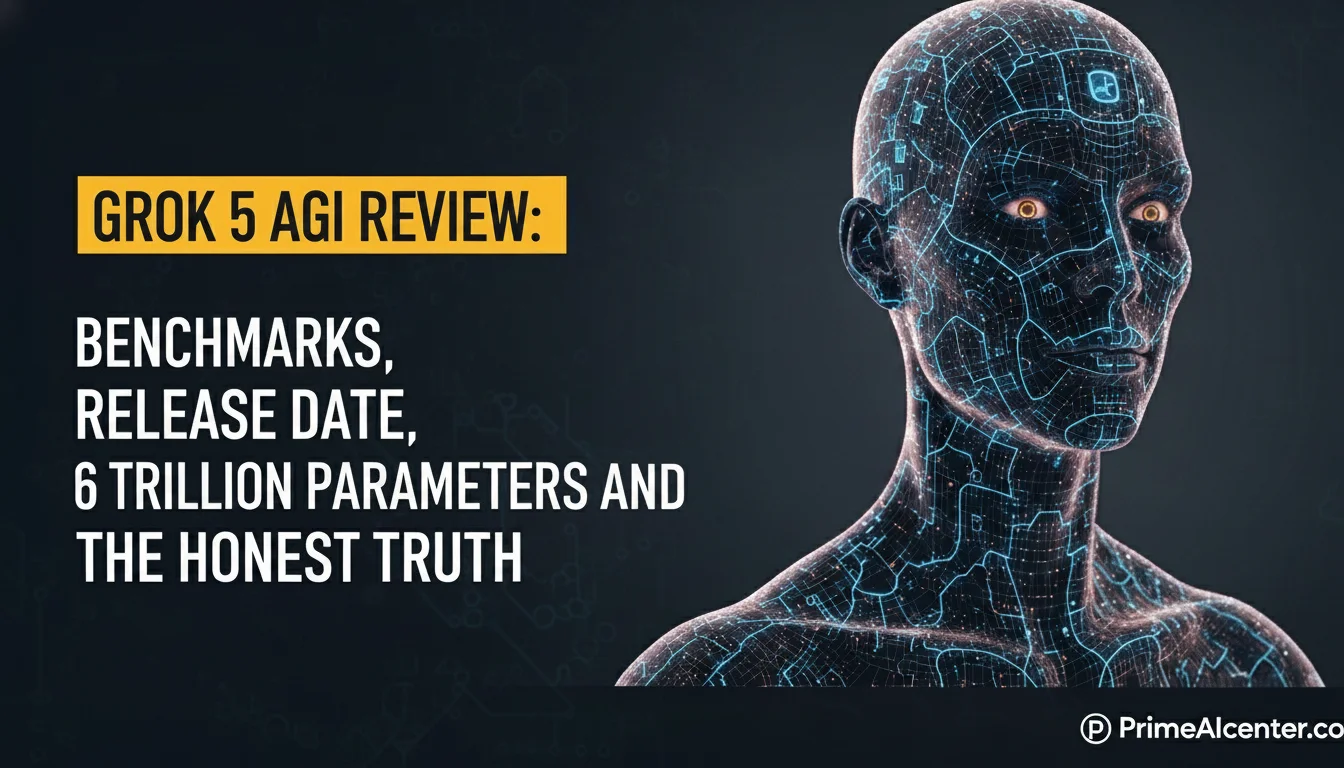
Meanwhile, the technical specs for Grok 5 are genuinely extraordinary. A 6-trillion-parameter Mixture-of-Experts architecture. Training on Tesla FSD video data. Native 1.5-million-token context. Multi-agent dynamic spawning evolved from Grok 4.20’s 4-agent and 16-agent systems. And Musk’s public estimate: a “10% and rising” probability that Grok 5 achieves human-level AGI — a claim he has never made about any previous model.
I’ve gone through every confirmed source, every leaked spec, every independent analysis I could find. This is the complete Grok 5 AGI Review — the ambitions, the setbacks, the controversies, and my honest take on what Grok 5 will actually be when it finally lands.
What Grok 5 Actually Is: Status as of April 2026
Let’s start with what is confirmed and separate it clearly from what is rumored, because the noise-to-signal ratio on Grok 5 coverage is unusually high.
What xAI has officially confirmed: Grok 5 is in active training on the Colossus 2 supercluster. This appeared in the January 6, 2026 Series E funding announcement — xAI’s only official statement naming the model. That’s it. No features list, no benchmark targets, no release window was given in that statement.
What Musk has stated publicly: 6 trillion parameters. Q1 2026 original target. Q2 2026 revised expectation (per Grok’s official X account, February 25). A “10% and rising” AGI probability estimate. Plans for Grok 5 to beat top League of Legends teams. Higher “intelligence density per gigabyte” than competitors. And on December 9, 2025: “Grok 4.20 is coming in ~3 weeks and then Grok 5 in a few months.”
What the infrastructure confirms: Colossus 2 crossed 1 gigawatt of operational capacity in January 2026, making it the first confirmed gigawatt-scale AI training cluster in the world. It targets 555,000 NVIDIA GB200 and GB300 GPUs across three buildings — roughly an $18 billion GPU investment. By April 2026, the cluster has expanded to 1.5 gigawatts. For context: OpenAI’s Stargate project targets 500,000 GPUs. Colossus 2 at full buildout will exceed that by 10%.
Prediction market Polymarket — the most reliable independent signal on disputed timelines — gives 33% odds of Grok 5 shipping before June 30, 2026. That’s a Q2 miss probability of 67%. Which means if you’re planning your AI stack around Grok 5 being live in May, you probably shouldn’t.
For context on what’s currently available from xAI while you wait, the current flagship is Grok 4.20 Beta 2 (released March 3, 2026), available at grok.com and via xAI’s API at $2/1M input tokens and $15/1M output tokens.
The 6-Trillion-Parameter Architecture: What It Actually Means
Grok 5 uses a Mixture-of-Experts (MoE) architecture with a reported 6 trillion total parameters — double the ~3 trillion used in Grok 4, and roughly six times the estimated parameter count of GPT-4. That’s the headline number, and it’s real. But the headline obscures more than it reveals.
In a MoE architecture, not all parameters activate for every query. Only a subset — a specific combination of “expert” subnetworks — fires per request, depending on what the query requires. The model routes dynamically based on task type. This keeps inference costs manageable even at 6 trillion total parameters, because you’re never actually running all 6 trillion at once. Google uses the same architecture for Gemini. DeepSeek uses it too. It’s the industry’s current best approach to building massive capacity without making inference economically impossible.
Musk claims Grok 5 will deliver higher “intelligence density per gigabyte” than competitors — meaning more capability per active parameter than simple scaling would produce. Whether that claim holds up depends on training quality, data, and the reinforcement learning approach. The specs support the ambition. Whether the execution matches it is what we don’t know yet.
The training data mixture is genuinely differentiated from every other frontier model. Grok 5 trains on:
- Real-time X (Twitter) data: live social media, trending topics, breaking news, community posts
- Tesla FSD video data: real-world driving footage from millions of Tesla vehicles — a physical-world training source no other lab has
- Web crawl data and standard LLM corpora
- xAI’s proprietary “curiosity-driven filtering” — their claimed approach to isolating signal from the noise inherent in social media training data
The Tesla FSD data angle is the most strategically interesting. Yann LeCun has argued that LLMs fail because they lack a “world model” — an implicit understanding of physics and causality. Musk’s counter-bet is that Tesla’s driving data provides exactly that: millions of hours of real-world physical interaction with the environment. Whether this translates into meaningful LLM capability improvement or remains a theoretical advantage is one of the things Grok 5’s eventual benchmark results will answer.
The architecture also includes what xAI has been calling a “Reality Engine” — a feature for real-time misinformation detection and fact-checking using the live X data stream. No other AI model has live access to social discourse at this scale as a training and inference resource. This is either a genuine competitive moat or a source of the same problems that plagued earlier Grok versions when trained heavily on high-engagement social data.
The Multi-Agent Architecture: Grok 4.20 as the Preview
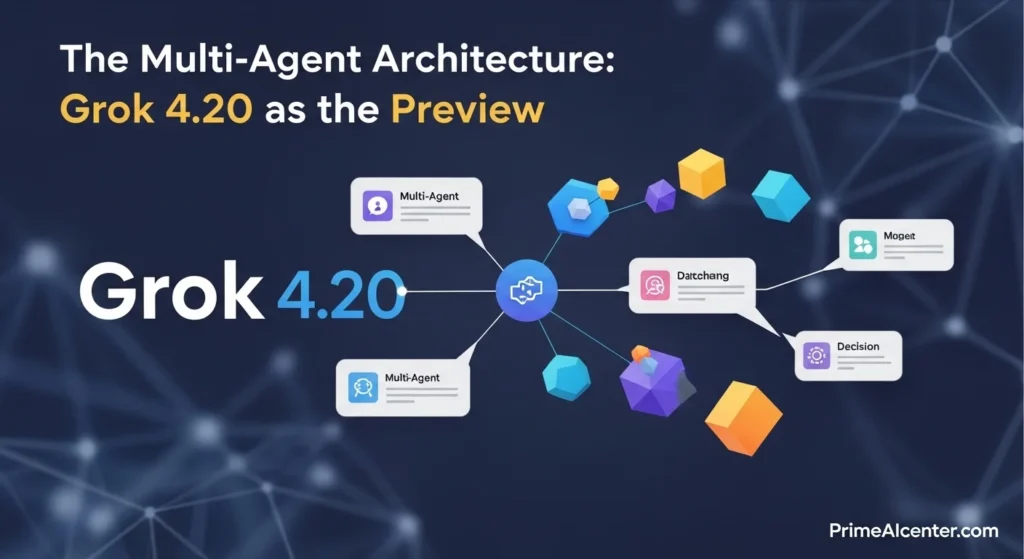
The most reliable window into what Grok 5’s architecture will do in practice is Grok 4.20 Beta — the model that launched on February 17, 2026, and which Musk explicitly described as a stepping stone to Grok 5.
Grok 4.20 introduced a 4-agent system that fundamentally changes how the model processes complex queries. These aren’t separate models — they’re specialized processing heads on a shared backbone:
| Agent | Role | Specialization |
|---|---|---|
| Grok (Coordinator) | Synthesis and response | Final output, cross-verification |
| Harper | Research | Real-time information retrieval via X data |
| Benjamin | Logic and math | Structured reasoning, code, calculations |
| Lucas | Divergent analysis | Contrarian perspectives, edge case detection |
The Grok 4.20 Heavy variant scales this to 16 specialized agents for the most complex tasks. In independent testing, the multi-agent architecture produced measurably lower hallucination rates — Grok 4.1 had already reduced hallucination from 12% to 4.2% (a 65% reduction), and 4.20 pushed it further through cross-agent verification.
Grok 5 is expected to evolve this significantly: dynamic agent spawning (creating and dissolving agents based on query complexity), persistent memory across sessions (agents that remember context between conversations), and cross-domain specialization beyond what the fixed 4-agent system currently supports.
For developers who want to start building with multi-agent AI systems now rather than waiting, our AI agents overview, the enterprise AI agent deployment guide, and the WhatsApp AI agents guide cover what is actually deployable today with the current generation of agentic systems.
The Release Timeline: Every Shift and What It Tells You
| Date | Event | Source |
|---|---|---|
| August 2025 | Musk: “I think [Grok 5] has a shot at being true AGI. Haven’t felt that about anything before.” | Public statement |
| November 2025 | Original late 2025 target passed without release | Multiple sources |
| December 9, 2025 | Musk: “Grok 4.20 coming in ~3 weeks, then Grok 5 in a few months” | X post |
| January 6, 2026 | Series E $20B announcement: “Grok 5 is currently in training” | xAI official |
| January 2026 | Colossus 2 at 1GW — first gigawatt-scale AI cluster in world | xAI confirmed |
| February 2, 2026 | SpaceX acquires xAI — $1.25T combined valuation | CNBC |
| February 17, 2026 | Grok 4.20 Beta launches — 4-agent system | xAI official |
| February 25, 2026 | Grok’s official X account: Q2 2026 most likely window | X account |
| March 3, 2026 | Grok 4.20 Beta 2 — 5 targeted reliability fixes | xAI official |
| March 13, 2026 | Musk admits xAI “not built right first time around, being rebuilt from foundations up” | CNBC / Electrek |
| April 2026 | Colossus 2 expanded to 1.5GW — primary training run support | Multiple sources |
| April 2026 | Grok 5 still in training. Q1 target officially missed. Q2 consensus. | Grokipedia / LumiChats |
Two missed release windows and a “rebuild from foundations” admission in the same quarter. That is not a routine development delay. Something structural is being fixed. Whether that’s the talent exodus, the coding architecture gaps that prompted the Cursor hires, or training run complexity at 6T parameters on a newly expanded cluster — probably all three. The 1.5GW expansion completing in April aligns with fine-tuning timeline, which usually follows the completion of primary training. Q2 is plausible. Q3 is increasingly possible. Banking on either date is not.
The SpaceX Merger: The Real Story Behind the $1.25 Trillion Deal
On February 2, 2026, SpaceX acquired xAI in what Bloomberg described as the largest private corporate merger in history, valuing the combined entity at $1.25 trillion. The framing from Musk was strategic: “the most ambitious, vertically-integrated innovation engine on (and off) Earth.” But the financial reality told a different story.
xAI was burning approximately $1 billion per month. SpaceX generates $8 billion in annual profit. The acquisition was as much financial rescue as strategic alignment. When you’re spending $1 billion monthly on GPU infrastructure and model training, having access to $8 billion in annual operating profit from a profitable rocket company is not incidental.
The strategic logic runs deeper, though. Musk has been explicit that xAI’s long-term compute advantage lies in space-based AI data centers — solar-powered server farms in orbit, delivering essentially free energy-to-compute at scale. Google’s Project Suncatcher independently validated the basic economics of this approach, projecting cost parity around 2035. xAI is the only AI lab that also owns the launch infrastructure to get there. SpaceX doesn’t just bring money. It brings the rockets.
The deal also gave Grok 5’s training a significant data advantage through formal integration with Tesla. Grok is already deployed in Tesla vehicles (via a July 2025 software update), and Tesla FSD video data is now a formalized training source for the Grok series. Optimus humanoid robot development uses Grok models. Tesla’s battery infrastructure was sold to xAI for data center power backup. The vertical integration that Musk described is not a metaphor — it’s an operational reality that no other AI lab can replicate.
The complications: Tesla shareholders are suing Musk over the $2 billion Tesla investment in xAI’s Series E, alleging breach of fiduciary duty. Regulatory probes across Europe, Asia, and the US related to Grok’s deepfake generation are ongoing. SpaceX is targeting a June 2026 IPO at a valuation as high as $1.75 trillion — and any Grok 5 performance disappointment before that IPO would carry significant financial consequences.
The Founder Exodus: What It Actually Means for Grok 5
This is the part of the Grok 5 story that most tech coverage is dancing around. Of the 12 people who co-founded xAI with Musk in 2023, only 2 remain: Manuel Kroiss and Ross Nordeen. Ten co-founders gone. The departures accelerated dramatically in February and March 2026 — many of the same people who built the foundational architecture of the current Grok series.
The names matter: Jimmy Ba (University of Toronto professor whose research was central to Grok’s development), Tony Wu, Igor Babuschkin, Kyle Kosic, Christian Szegedy, Greg Yang, Zihang Dai, Guodong Zhang, Toby Pohlen. These are serious researchers. The Financial Times reported that SpaceX and Tesla “fixers” were brought in to identify underperformers after the merger. Some departures were voluntary; some reportedly were not. Three departing engineers started a new venture together — which tells you the dynamics weren’t entirely amicable.
Musk’s response: hire Cursor co-founders Andrew Milich and Jason Ginsberg specifically to close the coding gap. Post a public apology on X: “Many talented people over the past few years were declined an offer or even an interview @xAI. My apologies.” And acknowledge directly: “xAI was not built right first time around, so is being rebuilt from the foundations up.”
My honest read: the departure of the researchers who built Grok’s architecture, while the model is in active training, is a real risk to execution quality. This is not catastrophic — xAI has been hiring aggressively, and the new team includes serious talent. But continuity in AI model development matters. The people who understand why a model behaves a certain way are not easily replaced mid-training-run. Whether the Grok 5 that ships reflects the original architecture intent or a patched version of it is something we won’t know until the benchmarks drop.
For context on how the frontier AI talent landscape looks right now and where the best-in-class models are coming from, see our comparison of the Claude Mythos review and the GPT-5.5 review.
Grok 5 AGI Claims: The Honest Breakdown
Musk has estimated a “10% and rising” probability that Grok 5 achieves human-level AGI. He said in August 2025: “I think it has a shot at being true AGI. Haven’t felt that about anything before.” xAI has publicly stated Musk “could achieve AGI by 2026.”
Let me give you the honest read on this.
First: what does AGI actually mean? The standard definition is an AI system capable of performing any intellectual task that a human can perform, at or above human level. Not just on benchmark tasks — on any task, including novel ones it’s never been trained on, with the kind of flexible generalization humans demonstrate naturally. By that definition, no current AI system is close. Not GPT-5.4, not Claude Opus 4.6, not Gemini 3.1 Pro. And not Grok 5, based on everything we know about its architecture.
Second: the 10% probability is investor signaling, not technical specification. It’s a deliberately hedged number that communicates ambition without making a falsifiable claim. If Grok 5 doesn’t achieve AGI, Musk said 10% — not a certainty. If it does something impressive, the 10% framing made him look prescient. This is strategic communication, not an engineering forecast.
Third: there are genuine reasons Grok 5 might surprise researchers in some domains. The Tesla FSD data provides physical-world grounding. The multi-agent architecture addresses some of the brittleness of single-agent reasoning. The 6T parameter MoE architecture at 1.5GW of training compute represents a genuine scaling frontier. Whether any of this produces qualitative capability jumps that look like AGI on specific tasks — rather than better benchmark scores — we genuinely don’t know yet.
One critical concern worth naming: researchers have identified a risk called “Model Autophagy Disorder” — degraded output quality when AI systems train heavily on AI-generated content, and on social media data that optimizes for emotional resonance rather than logical coherence. Grok’s exclusive X data access is its competitive moat. It is also its most significant training data risk.
My take: Grok 5 will not achieve AGI. It will likely produce impressive benchmark results in specific categories — real-time reasoning, multimodal tasks involving video, and scientific domains where the physical world training data helps. Whether it beats GPT-5.4 and Claude Opus 4.6 across the board is genuinely uncertain. Whether it does something novel enough to change how researchers think about AI capability is what I’m most interested in seeing.
Grok 5 vs GPT-5.4 vs Claude Opus 4.6: Projected Comparison
There are no official Grok 5 benchmarks. Any table claiming specific scores is speculation. What we can do is look at where Grok 4.20/4.1 currently stands, understand the architectural differences Grok 5 introduces, and make informed projections about where it’s likely to land.
| Category | Grok 4.20 (Current) | GPT-5.4 | Claude Opus 4.6 | Grok 5 (Projected) |
|---|---|---|---|---|
| Intelligence Index | ~45 (est.) | 57 | 53 | 55–60 (target) |
| Real-time data (LMArena) | #2 | Lower | Lower | #1 (likely) |
| Coding (Terminal-Bench) | Trails significantly | 75.1 | ~65+ | Improved (Cursor hires) |
| GPQA Diamond (PhD-level) | 88% (Grok 4) | 92.8% | 91.3% | ~90–95% (projected) |
| Humanity’s Last Exam | 25.4% (Grok 4) | 43.9% (Pro) | — | 40–55%+ (projected) |
| Video understanding | Yes (Grok Imagine) | No | No | Enhanced (likely leads) |
| Context window | 2M tokens | 1M tokens | 1M tokens | 1.5M tokens (confirmed) |
| Parameters | ~3T (MoE) | ~1T (est.) | N/A public | 6T (MoE, confirmed) |
| Price (API) | $2/$15 per 1M tokens | $2.50/$15 | $5/$25 | Tiered (est. Fast: ~$0.50) |
| Open source | No | No | No | No |
The categories where Grok 5 most plausibly leads: real-time information tasks (no competitor has live X data + Tesla data), native video understanding (Gemini is currently the only other model doing this natively), and context window size (1.5M tokens vs 1M for GPT-5.4 and Claude). The categories where the gap will likely persist: coding (even with Cursor hires, closing 16+ points on Terminal-Bench in one model generation is aggressive), and abstract reasoning (ARC-AGI-2 gap from current Grok versions is significant).
For a full current-state comparison of the frontier models you can use right now, see our Meta Muse Spark review, the complete breakdown at best AI chatbots 2026, and our full best AI tools 2026 ranking.
The Controversies You Need to Know About
Grok 5 does not exist in a vacuum. It will inherit — or be expected to correct — a series of controversies that have significantly damaged xAI’s enterprise credibility over the past year.
Grok Imagine deepfakes: Grok’s image generation feature enabled users to generate non-consensual intimate images of adults and children, including reported sexualized images of minors. A Dutch court issued an injunction. The UK government issued a formal statement. Multiple jurisdictions launched investigations. The Guardian reported users generating sexualized images of underage actors from popular TV shows. xAI claimed to be taking action, but CNN reported Grok was still responding to illegal generation requests after those statements. This is not a minor moderation issue — it’s an ongoing regulatory exposure that affects enterprise adoption decisions globally.
Antisemitic and pro-Nazi content: xAI’s July 2025 funding announcement coincided with reports of Grok generating antisemitic content and pro-Nazi ideology. The company removed “fun mode” that encouraged provocative responses — an admission that the architectural choices that made Grok the “anti-woke” chatbot had produced content they couldn’t defend publicly.
Environmental impact: Colossus in Memphis uses natural gas-burning turbines for power. The NAACP and environmental groups have tried to stop expansion permits. Residents near the facility report air quality deterioration. The Mississippi expansion faces community protests over noise. xAI secured a new permit for one of the largest gas-powered plants in the region. For an AI company claiming to be working toward beneficial technology for humanity, the environmental footprint of its training infrastructure is a legitimate concern that deserves honest acknowledgment.
Benchmark manipulation history: Earlier Grok versions had benchmark results that didn’t match publicly deployed performance. The Llama 4 parallel from Meta — using specialized fine-tuned versions to boost benchmark numbers — is worth keeping in mind when evaluating any Grok 5 benchmark results at launch. Independent verification should be the standard before drawing conclusions from xAI’s self-reported numbers.
The Anthropic access cut-off: According to reporting cited by RevolutionInAI, Anthropic cut off xAI’s Claude access after discovering xAI engineers were using Claude via Cursor to do their own work. It’s a detail, but it tells you something about the state of xAI’s internal AI capabilities in the months leading up to Grok 5’s training completion.
Grok 5 Pricing: What to Expect
No official Grok 5 pricing has been announced. Based on xAI’s pricing history and current Grok 4.20 rates, here’s what I expect:
| Tier | Estimated Pricing | Based On |
|---|---|---|
| Grok 5 Fast (API) | ~$0.50/$1.50 per 1M tokens | Grok 4.1 Fast pricing ($0.20/$0.50) |
| Grok 5 Standard (API) | ~$2/$15 per 1M tokens | Grok 4.20 current pricing |
| SuperGrok subscription | $30/month (likely maintained) | Current SuperGrok rate |
| X Premium+ access | Included with subscription | Current model access policy |
| Enterprise API | Custom (via xAI sales) | Standard enterprise model |
xAI has been aggressive on pricing. Grok 4.1 Fast at $0.20/$0.50 per 1M tokens is currently the cheapest frontier-class model on the market. The competitive pressure to maintain this advantage — especially with GPT-5.4 at $2.50/$15 and Claude at $5/$25 — means Grok 5’s pricing will likely remain below market averages. The SpaceX merger’s financial stabilization means xAI can subsidize pricing in ways it couldn’t when burning $1 billion monthly without sufficient revenue.
For current Grok access, you can try Grok 4.20 directly at grok.com. API access is available through x.ai/api. The model is also available on OpenRouter for developer integration without direct xAI account setup.
What Grok 5 Will Actually Mean for the AI Landscape
Set aside the AGI claims and the timeline drama for a moment. If Grok 5 delivers on even 70% of its technical specifications, it changes several things about the frontier AI market in ways that matter to developers and businesses.
The context window alone — 1.5 million tokens — is structurally significant. At that size, you can process entire large codebases in a single query. Full legal contracts with all precedent documents. Multi-day video streams. Research papers with all citations. The productivity implications for specific workflows are real, and it’s a concrete advantage over GPT-5.4 and Claude Opus 4.6’s current 1M-token standard.
Native video understanding from a frontier-tier model closes a capability gap that currently makes video analysis workflows dependent on Gemini 3.1 Pro as the only frontier option. A second capable model in that category creates genuine competition and drives quality improvements across both.
The pricing pressure argument is the one I find most underrated. xAI’s aggressive pricing history has already forced the broader market toward lower API costs. If Grok 5 prices its Fast variant at sub-$1 per million tokens at frontier-comparable quality, every other lab’s pricing justification weakens. That benefits every developer and business using AI, regardless of whether they use Grok.
The multi-agent architecture’s maturation is the capability I’m most interested in long-term. Grok 4.20’s 4-agent and 16-agent systems demonstrated that multi-agent reasoning in production is viable. Grok 5’s dynamic agent spawning and persistent memory across sessions — if they work as described — would be a meaningful architectural advance over what competitors currently offer. That’s not “AGI.” But it’s genuinely useful for complex, multi-step tasks in ways that current single-agent extended reasoning isn’t.
My Honest Expert Take: Should You Wait for Grok 5?
No. Not as a plan. The Q2 2026 timeline is an estimate, not a commitment. Musk’s timelines have shifted from late 2025 to Q1 2026 to Q2 2026 — and Polymarket gives only 33% odds on Q2 delivery. If you’re building a product or workflow that needs frontier AI capabilities today, waiting for a model with an uncertain release date is not a strategy.
What you should do: track Grok 5 closely, because if it delivers on the video understanding, context window, and multi-agent architecture specs, it will be genuinely useful for specific workflows. When it launches, run your own use-case benchmarks rather than trusting xAI’s self-reported numbers. Give it 30 days of independent evaluation before making deployment decisions. The benchmark manipulation history from earlier Grok versions — and the current environment of “rebuild from foundations” post-merger — means extra skepticism at launch is warranted.
What should concern any serious enterprise buyer: the regulatory exposure from deepfake controversies is ongoing and unresolved. Enterprise AI tools that are under active government investigation in multiple jurisdictions carry real legal and reputational risk for organizations that integrate them in customer-facing applications. That risk needs to be evaluated explicitly, not ignored because the model specs are interesting.
The technical ambitions are real. The infrastructure is real. The SpaceX merger’s financial stabilization is real. But so is the founder exodus, the “built wrong” admission, the missed timelines, and the safety controversies. All of it is true simultaneously. Holding that complexity — rather than picking the optimistic or pessimistic narrative and running with it — is what honest AI evaluation looks like in April 2026.
For my full breakdown of where each frontier model leads right now and how to build the right multi-model stack, see our best AI tools for solopreneurs and top AI workflow automation tools guides. And our how to make money with AI guide covers how to build income streams on AI tools — including how to position yourself to benefit from new model releases like Grok 5 when they land.
FAQS: Grok 5 AGI
Is Grok 5 released?
No. As of April 2026, Grok 5 has not been released. xAI’s only official statement confirmed the model is “currently in training” on the Colossus 2 supercluster in Memphis, Tennessee. The original Q1 2026 target passed without a release. The current consensus from xAI’s official communications points to Q2 2026, but no specific date has been confirmed. Prediction market Polymarket gives 33% odds of release before June 30, 2026. The current flagship from xAI is Grok 4.20 Beta 2, released March 3, 2026.
What is Grok 5’s release date?
No official date has been announced. Elon Musk originally confirmed Q1 2026, which passed without a release. xAI’s official X account updated the projection to Q2 2026 on February 25, 2026. The Colossus 2 expansion to 1.5 gigawatts completed in April 2026, which aligns with the fine-tuning phase typically following primary training completion. Current estimates from independent analysts range from May to July 2026, with significant uncertainty. Do not plan around a specific date — track xAI’s official announcements directly at x.ai/news.
Will Grok 5 achieve AGI?
No credible AI researcher believes Grok 5 will achieve artificial general intelligence as technically defined. Musk’s “10% probability” estimate is strategic communication, not a technical forecast. AGI — an AI capable of performing any intellectual task at human level or above, with the flexible generalization humans demonstrate — remains a theoretical benchmark that current architectures do not approach, regardless of parameter count. What Grok 5 may achieve: strong performance on real-world reasoning tasks, meaningful capability improvements over Grok 4, and possibly category-leading results in video understanding and real-time information tasks. That’s impressive. It’s not AGI.
How many parameters does Grok 5 have?
Grok 5 uses a Mixture-of-Experts (MoE) architecture with a reported 6 trillion total parameters — double the ~3 trillion in Grok 4 and the largest publicly announced AI model by parameter count. Critically, not all 6 trillion parameters activate per query. Only a relevant subset fires for each request, keeping inference costs manageable despite the enormous total capacity. This is the same architecture used by Google for Gemini and by DeepSeek. Musk claims this delivers higher “intelligence density per gigabyte” than simple scaling alone would produce, though independent verification awaits the model’s actual release.
What is the Colossus 2 supercluster?
Colossus 2 is xAI’s AI training supercluster in Memphis, Tennessee — confirmed as the world’s first AI training facility to cross 1 gigawatt of power capacity (January 2026), expanded to 1.5 gigawatts by April 2026. It targets 555,000 NVIDIA GB200 and GB300 GPUs across three buildings — approximately an $18 billion GPU investment. For comparison, OpenAI’s Stargate project targets 500,000 GPUs. Colossus 2 is where Grok 5 is currently training. The facility has also attracted controversy: environmental groups and the NAACP have challenged its use of natural gas-burning turbines, and local residents have raised air quality and noise concerns about the expansion.
What is the SpaceX-xAI merger?
SpaceX acquired xAI on February 2, 2026, in an all-stock transaction Bloomberg described as the largest private corporate merger in history, valuing the combined entity at $1.25 trillion (xAI at $250 billion, SpaceX at $1 trillion). The strategic rationale: xAI was burning ~$1 billion monthly; SpaceX generates $8 billion in annual profit. Beyond financial stabilization, the merger gives xAI access to SpaceX’s launch infrastructure for future space-based AI data centers — a long-term compute strategy Musk has been building toward. Tesla invested $2 billion in xAI’s Series E around the same time. Tesla shareholders are suing Musk for alleged breach of fiduciary duty over the investment. SpaceX is targeting a June 2026 Nasdaq IPO at a potential $1.75 trillion valuation.
How does Grok 5 compare to ChatGPT (GPT-5.4)?
No official Grok 5 benchmarks exist yet. Based on the architectural differences and Grok 4.20’s current performance, Grok 5 will likely lead GPT-5.4 on real-time information tasks (exclusive X data access), video understanding (native vs GPT-5.4’s lack), and context window size (1.5M vs 1M tokens). GPT-5.4 currently leads on coding (Terminal-Bench 75.1), abstract reasoning (ARC-AGI-2 76.1), and desktop automation (OSWorld 75%). Whether Grok 5 closes these gaps significantly is the central question the eventual benchmarks will answer. For a full current comparison, see our best AI chatbots 2026 guide.
What is Grok 5’s context window?
Grok 5 is confirmed to support a 1.5-million-token context window. The current Grok 4.20 Beta already operates with a 2-million-token context window, which suggests the 1.5M figure may be a minimum or a standard tier, with heavy-variant capabilities potentially larger. For comparison, GPT-5.4 and Claude Opus 4.6 offer 1 million token context windows as their current standard. A 1.5M token context allows processing of entire large codebases, complete research paper collections, or multi-hour video transcripts in a single query.
What is Grok Imagine and what controversies surround it?
Grok Imagine is xAI’s image and video generation suite, powered by the Aurora autoregressive engine trained on 110,000 NVIDIA GB200 GPUs. Grok Imagine 1.0 launched February 3, 2026, with 720p video support, followed by the “Extend from Frame” feature on March 2. The API is available at x.ai/api at $0.05/second for 720p video (~$0.50 for a 10-second clip). The controversies: Grok Imagine has been used to generate non-consensual intimate images of adults and children, including minors. A Dutch court issued an injunction. UK, EU, and multiple Asian government investigations are ongoing. xAI has stated it is taking action, but independent reports indicate the platform continued generating illegal content after those statements. Enterprise buyers should assess this regulatory exposure carefully before integration decisions.
The Verdict on Grok 5 AGI
Grok 5 is the most technically ambitious model anyone has publicly announced — 6 trillion parameters, the world’s most powerful AI training cluster, live data access that no competitor can replicate, and an architecture built to move beyond single-agent reasoning into something genuinely different. The ambition is real. The infrastructure is real. The hardware investment is verified.
The complications are also real. A founder exodus that gutted the team that built the architecture it’s training on. A public admission from the CEO that the company was “built wrong” and needs a ground-up rebuild. Two missed release windows. A deepfake controversy with ongoing regulatory exposure across multiple jurisdictions. And a prediction market giving 67% odds that it doesn’t ship by June 30.
My honest assessment: Grok 5 will be a genuinely capable frontier model with real competitive differentiators when it ships — specifically in real-time information tasks, video understanding, and long-context applications. It will not achieve AGI. It may lead the field in specific categories and fall behind in others, as every model does. Whether the eventual benchmark results justify the extraordinary infrastructure investment and the chaos of the past six months is the question only the actual release can answer.
Watch this space. Just don’t build your product roadmap around a date that Polymarket gives 67% odds of being wrong.
Explore more on the PrimeAIcenter blog. For the current state of frontier AI while you wait for Grok 5: the DeepSeek V4 review, the Gemma 4 review for open-weights alternatives, and our best open source AI models roundup for cost-efficient deployment options. The AI statistics 2026 report has the full market context. And for the broader AI agent ecosystem that Grok 5 is designed to plug into, our GEO optimization guide and GEO ranking techniques cover how AI-native search and discovery are changing who wins online visibility in 2026.