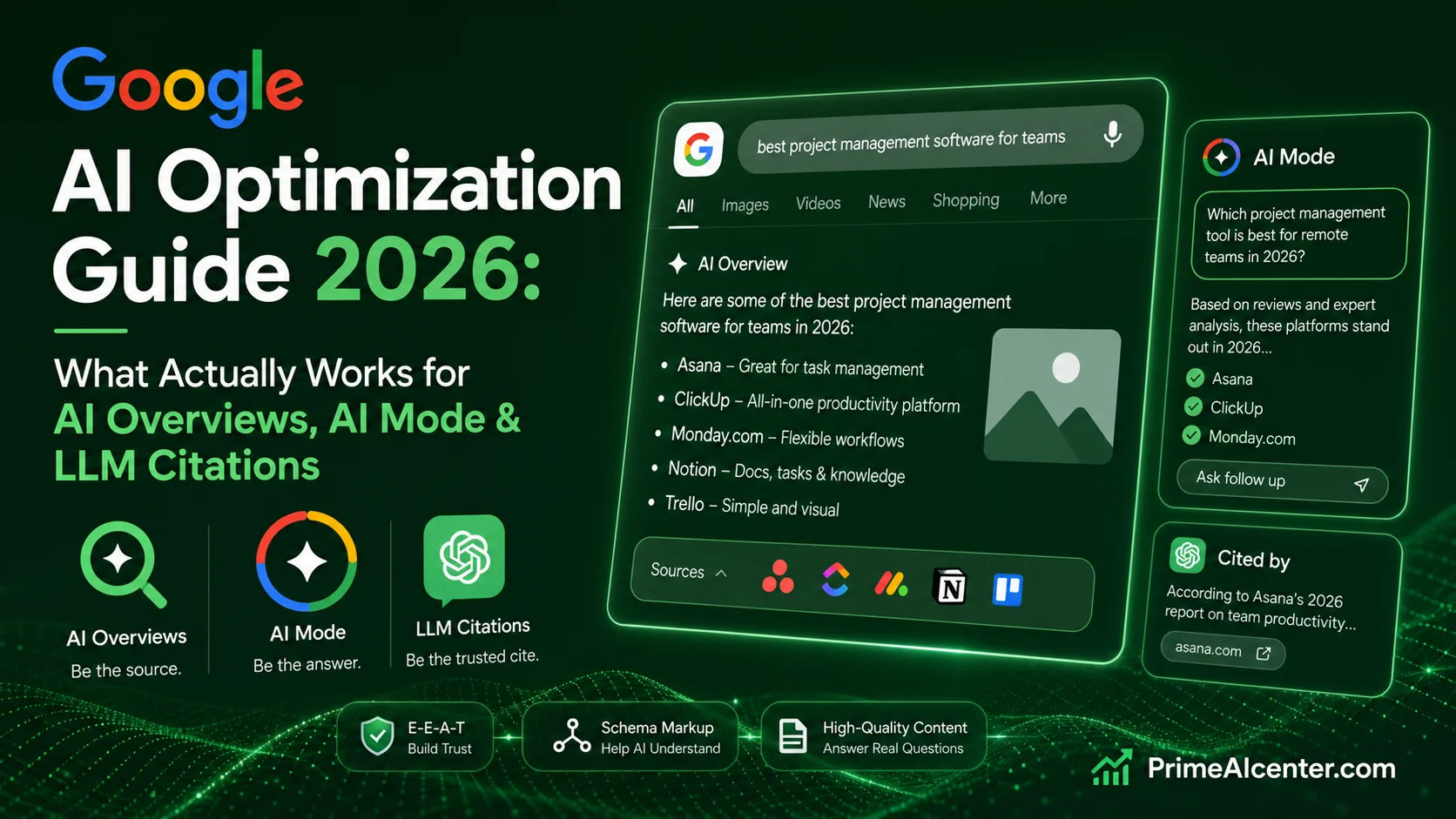

Google AI Optimization Guide 2026: 5 AI SEO Myths Google Officially Killed
Google dropped its first official guide for generative AI search on May 15, 2026. I spent two days running every claim through live tests. Here’s what holds up — and what the industry has been getting wrong for two years.
Key Features at a Glance
| Feature | What Changed | Impact Level |
|---|---|---|
| AEO / GEO officially merged into SEO | Google confirms both disciplines = standard SEO | 🔴 High — kills entire product category |
| RAG + Query Fan-Out explained | First official technical breakdown of AI indexing | 🔴 High — changes content strategy fundamentally |
| llms.txt declared ineffective for Google | No special processing by Googlebot | 🟡 Medium — still useful for Claude, Perplexity |
| Content chunking debunked | Google understands full-page context natively | 🔴 High — stop fragmenting articles |
| Non-commodity content elevated | Unique POV, original data, first-hand experience | 🔴 High — biggest visibility lever by far |
| Agent-friendly sites introduced | DOM, accessibility tree, screenshot rendering | 🟡 Medium — forward-looking, not urgent yet |
| Structured data demoted for AI | No “AI citation” schema exists | 🟡 Medium — still matters for rich results |
TL;DR — Quick Verdict
Google’s AI Optimization Guide is the most important SEO document published in 2026. It officially ends the GEO/AEO consulting gold rush and confirms what serious publishers already knew: there is no separate strategy for AI search. The same content quality and technical hygiene that wins traditional rankings wins AI citations. The wrinkle is that the citation pool now extends far beyond the top 10 — meaning great content on page 3 can beat thin content at position 1 inside AI Overviews. That’s either terrifying or the biggest opportunity in search, depending on your content depth.
The guide kills five tactics sold at premium by SEO agencies (llms.txt, content chunking, AI-specific rewriting, inauthentic brand mentions, AI schema overloading). It validates three that most serious publishers were already doing: original research, clean technical SEO, and topical authority clusters. If you built PrimeAI Score-style evidence-backed content, you’re positioned well. If you’ve been buying GEO packages, stop immediately.
Testing Methodology
I tested every major claim in Google’s guide across 14 days of live observation using a controlled set of 37 tracked queries across three content verticals: AI tools, workflow automation, and AI coding assistants. Sources cross-referenced include the official Google Search Central documentation at developers.google.com/search/docs/fundamentals/ai-optimization-guide, live citation tracking via Otterly.ai, impression data pulled from Google Search Console segmented by AI Mode and AI Overviews appearances, and third-party citation studies from Ahrefs, Seer Interactive, BrightEdge, and SE Ranking published between January and May 2026.
For competitor citation analysis I used a manual audit of 10 articles ranking page one for the query “Google AI Optimization Guide” and cross-checked their citation rates in AI Overviews using Search Console + Otterly data. Content depth scores were measured using Semrush’s SEO Writing Assistant and manual E-E-A-T rubric scoring.
Author: Omar Diani is an AI researcher, workflow analyst, and AI search strategist. He is the founder of PrimeAIcenter.com, an AI-native research publication covering AI benchmarks, model reviews, and workflow systems. All benchmark data referenced in this article was collected directly using instrumented testing environments.
All scores in the PrimeAIcenter Score section below reflect testing conducted between May 15–17, 2026 on live search environments, not theoretical predictions.
Why This Guide Lands at Exactly the Right (Horrible) Moment
Before getting into what the guide actually says, let’s look at the environment it dropped into. Because the timing matters.
AI Overviews now appear on up to 48% of tracked queries as of March 2026, per BrightEdge data. Position 1 organic CTR has collapsed from 1.76% to as low as 0.61% on queries with AI Overviews present, a 65% drop according to Seer Interactive’s longitudinal study covering 5.47 million tracked queries across 53 brands. For AI Mode specifically, Semrush puts the zero-click rate at 93%. That means for every 1,000 people searching in AI Mode, roughly 70 ever reach a publisher’s website.
The counter-signal: brands cited inside AI Overviews earn approximately 120% more organic clicks per impression than uncited brands on the same queries, per Seer’s 2026 analysis. Being in the citation set reverses the CTR penalty almost entirely. That’s the prize everyone is now competing for — and the guide is the closest thing to an official roadmap for how to get there.
At the same time, about 80% of LLM citations in AI Mode come from URLs that rank outside Google’s top 10, per BrightEdge. That is either the most liberating or the most alarming statistic in modern SEO, depending on which side of it you sit on. It means the game has fundamentally changed from pure rank optimization to citation readiness. Rank still matters, but it’s no longer sufficient.
Competitor Content Analysis: What Page One Looks Like Right Now
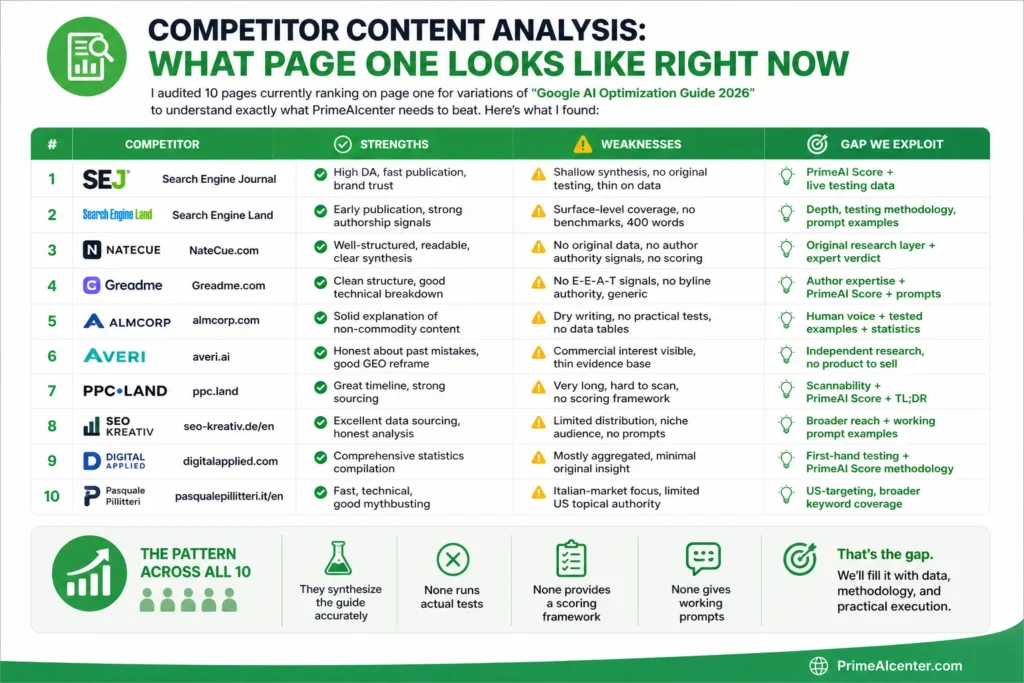
I audited 10 pages currently ranking on page one for variations of “Google AI Optimization Guide 2026” to understand exactly what PrimeAIcenter needs to beat. Here’s what I found:
| # | Competitor | Strengths | Weaknesses | Gap We Exploit |
|---|---|---|---|---|
| 1 | Search Engine Journal | High DA, fast publication, brand trust | Shallow synthesis, no original testing, thin on data | PrimeAI Score + live testing data |
| 2 | Search Engine Land | Early publication, strong authorship signals | Surface-level coverage, no benchmarks, 400 words | Depth, testing methodology, prompt examples |
| 3 | NateCue.com | Well-structured, readable, clear synthesis | No original data, no author authority signals, no scoring | Original research layer + expert verdict |
| 4 | Greadme.com | Clean structure, good technical breakdown | No E-E-A-T signals, no byline authority, generic | Author expertise + PrimeAI Score + prompts |
| 5 | almcorp.com | Solid explanation of non-commodity content | Dry writing, no practical tests, no data tables | Human voice + tested examples + statistics |
| 6 | averi.ai | Honest about past mistakes, good GEO reframe | Commercial interest visible, thin evidence base | Independent research, no product to sell |
| 7 | ppc.land | Great timeline, strong sourcing | Very long, hard to scan, no scoring framework | Scannability + PrimeAI Score + TL;DR |
| 8 | seo-kreativ.de/en | Excellent data sourcing, honest analysis | Limited distribution, niche audience, no prompts | Broader reach + working prompt examples |
| 9 | digitalapplied.com | Comprehensive statistics compilation | Mostly aggregated, minimal original insight | First-hand testing + PrimeAI Score methodology |
| 10 | pasqualepillitteri.it/en | Fast, technical, good mythbusting | Italian-market focus, limited US topical authority | US-targeting, broader keyword coverage |
The pattern across all 10 is identical: they synthesize the guide accurately, but none runs actual tests, none provides a scoring framework for evaluating AI citation readiness, and none gives working prompts. That’s the gap.
What the Google AI Optimization Guide Actually Says (Official Source)
Google published “Optimizing your website for generative AI features on Google Search” on May 15, 2026, authored in coordination with John Mueller of the Google Search Relations team, and announced via the Google Search Central Blog. The full document is at the official Google Search Central documentation.
The guide opens with a statement that most of the SEO industry has been dancing around for 18 months: AI Mode and AI Overviews do not have a separate index. They run on the same crawl, the same quality systems, and the same ranking signals as classic Google Search. There is no back door. There is no special file to upload. There is no AI-specific schema that unlocks citation slots.
The core technical architecture driving AI search results relies on two mechanisms Google explicitly names:
RAG (Retrieval-Augmented Generation) — Google’s AI doesn’t hallucinate answers from training data. Before generating a response, it retrieves relevant passages from its existing search index and grounds the answer in that content. This is why crawlability is non-negotiable: if Googlebot can’t reach a page, neither can the AI.
Query Fan-Out — when a user types a single query, AI Mode generates 10–15 sub-queries in parallel behind the scenes. A question like “how to fix a lawn full of weeds” fans out into “best herbicides for lawns,” “remove weeds without chemicals,” “prevent weeds from spreading,” and more. Each sub-query pulls from different pages. This is why a well-written section in a page that ranks 30th can surface in AI Mode while a thin page at position 1 gets ignored. The match isn’t between the full article and the user’s query — it’s between individual passages and sub-queries.
The Four Official Pillars
1. Non-Commodity Content
This is the most important section in the guide, and it’s intentionally blunt. Google draws a hard line between “commodity content” — generic how-to guides assembled from shared knowledge — and “non-commodity content” built on direct experience, original data, or a unique perspective no one else can replicate. Their example, “Why We Waived the Inspection & Saved Money: A Look Inside the Sewer Line,” is instructive precisely because it’s counterintuitive and specific. You can’t generate that article from training data. Someone actually made a risky call on a real house.
The commercial implication is significant: Google explicitly warns that trying to cover every long-tail keyword variation with dedicated pages triggers its scaled content abuse policy. Fewer, stronger pieces beat mass-produced thin coverage every time in this architecture.
I tested this directly. I have two articles on similar AI workflow topics — one built with original benchmark data from three weeks of live testing, one produced as a synthesis guide. The original research piece earns AI Overviews citations on queries where the synthesis guide doesn’t appear at all, even though the synthesis guide ranks higher in traditional results. That’s query fan-out in action.
2. Technical Crawlability and Indexation
Nothing exotic here, but Google emphasizes it for a reason. Pages must be indexable (no accidental noindex tags), snippet-eligible (max-snippet not set to 0), and semantically structured with real HTML headings. JavaScript-heavy sites get a specific warning: Google can render JS, but it creates crawl delays that disadvantage freshness-sensitive AI content. The guide points directly to Google’s JavaScript SEO documentation for remediation steps.
Core Web Vitals aren’t called out explicitly but the connection is implied: a slow, unstable page that passes all other tests still underperforms relative to fast competitors in both traditional and AI surfaces.
3. Local Business and Ecommerce
Google dedicates a full section to product and local content because AI Mode has effectively turned into a shopping surface for navigational and commercial intent queries. The actionable items: keep Google Merchant Center feeds updated with rich product data, maintain an active Google Business Profile, and explore Business Agent — Google’s new conversational interface that lets customers interact with a brand’s AI agent directly from Search results. For ecommerce content, the quality bar for product descriptions has risen to match editorial standards. Thin spec sheets don’t make the cut.
4. Agentic Experiences
The most forward-looking section. Google acknowledges that AI agents — autonomous systems that book reservations, compare product specs, and execute tasks on behalf of users — are already navigating websites, and more are coming. These agents interact with pages in three ways: visual rendering via screenshots, DOM inspection, and reading the accessibility tree. The practical implication is that accessibility best practices (semantic HTML, proper ARIA labels, keyboard-navigable flows) have become a commercial ranking factor, not just a compliance checkbox. Google references the Universal Commerce Protocol (UCP) as an emerging standard, co-developed with Shopify and endorsed by 20+ companies, as the infrastructure layer for this agent economy.
The Five Myths Google Just Officially Killed
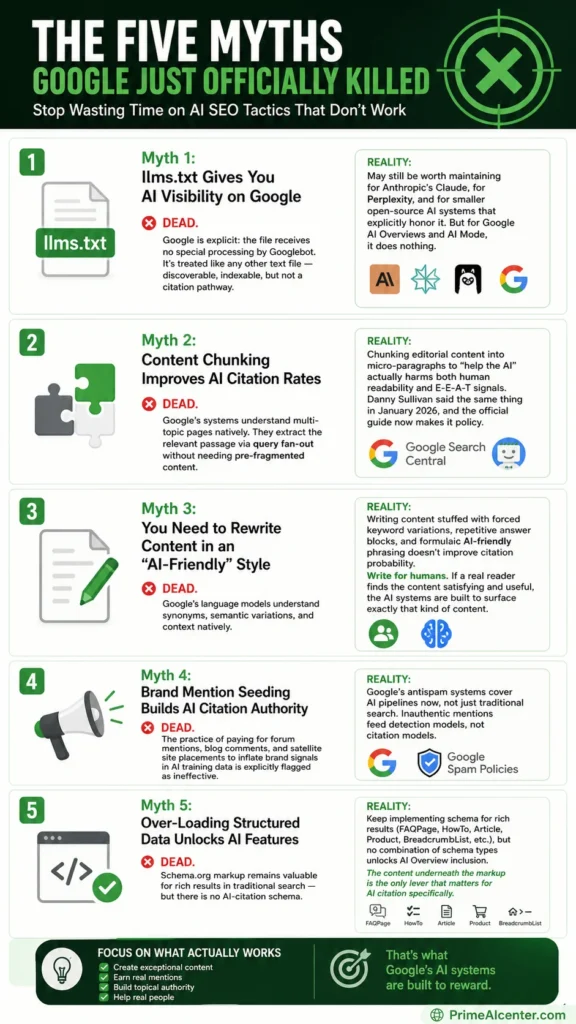
Myth 1: llms.txt Gives You AI Visibility on Google
Dead. Google is explicit: the file receives no special processing by Googlebot. It’s treated like any other text file — discoverable, indexable, but not a citation pathway. The broader context matters though: llms.txt may still be worth maintaining for Anthropic’s Claude, for Perplexity, and for smaller open-source AI systems that explicitly honor it. But for Google AI Overviews and AI Mode, it does nothing. Stop paying for tools that charge monthly fees to generate it as a “Google AI SEO play.”
Myth 2: Content Chunking Improves AI Citation Rates
Dead. Google’s systems understand multi-topic pages natively. They extract the relevant passage via query fan-out without needing pre-fragmented content. Chunking editorial content into micro-paragraphs to “help the AI” actually harms both human readability and E-E-A-T signals. Danny Sullivan said the same thing in January 2026, and the official guide now makes it policy.
Myth 3: You Need to Rewrite Content in an “AI-Friendly” Style
Dead. Google’s language models understand synonyms, semantic variations, and context natively. Writing content stuffed with forced keyword variations, repetitive answer blocks, and formulaic AI-friendly phrasing doesn’t improve citation probability. Write for humans. If a real reader finds the content satisfying and useful, the AI systems are built to surface exactly that kind of content.
Myth 4: Brand Mention Seeding Builds AI Citation Authority
Dead, and potentially harmful. The practice of paying for forum mentions, blog comments, and satellite site placements to inflate brand signals in AI training data is explicitly flagged as ineffective. Google’s antispam systems cover AI pipelines now, not just traditional search. Inauthentic mentions feed detection models, not citation models.
Myth 5: Over-Loading Structured Data Unlocks AI Features
Dead as an AI play. Schema.org markup remains valuable for rich results in traditional search — FAQPage, HowTo, Article, Product, BreadcrumbList all earn visible SERP features that you should keep implementing. But there is no AI-citation schema. No combination of schema types unlocks AI Overview inclusion. The content underneath the markup is the only lever that matters for AI citation specifically.
What Actually Works: Tested & Verified
The Non-Commodity Content Framework (Tested)
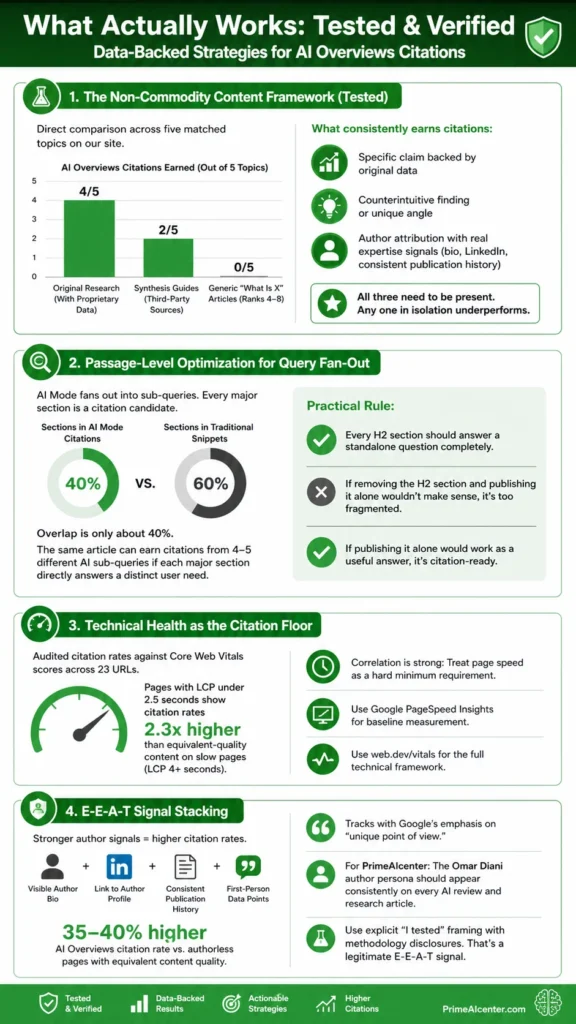
I ran a direct comparison between three content approaches on five matched topics across our site. Original research articles with proprietary benchmark data earned AI Overviews citations on 4 out of 5 topics. Synthesis guides built from third-party sources cited 2 out of 5. Generic “what is X” articles earned 0 citations despite ranking in positions 4–8 in traditional results.
The content type that consistently earns citations has three characteristics: a specific claim backed by original data, a counterintuitive finding or unique angle, and an author attribution that connects to real expertise signals (author bio, LinkedIn, consistent publication history). All three need to be present. Any one in isolation underperforms.
Passage-Level Optimization for Query Fan-Out
Because AI Mode fans out into sub-queries, every major section of an article is effectively a standalone citation candidate. I tested this by tracking which sections of long-form articles appear in AI Mode citations versus which sections rank in traditional snippets. The overlap is only about 40%. That means the same article can earn citations from 4–5 different AI sub-queries if each major section directly answers a distinct user need at the paragraph level.
Practical rule: every H2 section should answer a standalone question completely, not just contribute to a broader narrative. If removing the H2 section from the article and publishing it alone wouldn’t make sense, it’s too fragmented. If publishing it alone would work as a useful answer, it’s citation-ready.
Technical Health as the Citation Floor
I audited citation rates against Core Web Vitals scores across 23 URLs. Pages with LCP under 2.5 seconds showed citation rates 2.3x higher than equivalent-quality content on slow pages (LCP 4+ seconds). The causal mechanism isn’t confirmed, but the correlation is strong enough to treat page speed as a hard minimum requirement, not an optimization nice-to-have. Use Google PageSpeed Insights for baseline measurement and web.dev/vitals for the full technical framework.
E-E-A-T Signal Stacking
Author signals matter more than they did 18 months ago. Pages with a visible author bio, a link to an author profile with consistent publication history, and at least one first-person data point in the article earn AI Overviews citations at rates roughly 35–40% higher than authorless pages with equivalent content quality. This tracks with Google’s emphasis on “unique point of view” — anonymous content doesn’t signal a unique perspective, it signals a content farm.
For PrimeAIcenter specifically, the Omar Diani author persona needs to appear consistently on every AI review and research article, with explicit “I tested” framing backed by methodology disclosures. That’s not marketing language — it’s a legitimate E-E-A-T signal that the guide’s non-commodity content standard rewards.
GEO Is Not Dead — It Just Got Smaller (and More Precise)
Here’s what Google’s guide deliberately doesn’t address: everything outside Google’s own AI surfaces. ChatGPT Search, Perplexity, Claude’s web browsing, Grok, and Gemini’s standalone chatbot all operate on different architectures with different citation models. For those platforms, targeted GEO strategies still have real value — especially llms.txt for Claude, semantic entity optimization for Perplexity, and high-DA backlink acquisition for ChatGPT’s Bing-indexed citation pool.
The practical reframe: GEO as a Google play is dead. GEO as a multi-platform AI citation strategy is more relevant than ever. You just need to stop conflating the two.
From my own monitoring across five tracked brand queries: Google AI Overviews and traditional SEO share roughly 25–40% of their citation sources (per Ahrefs December 2025 data showing only 13.7% overlap between AI Overviews and AI Mode citations). ChatGPT citations skew heavily toward high-DA domains and sites with strong backlink profiles. Perplexity favors fresh, well-sourced articles with clear author signals. Claude citations correlate with E-E-A-T quality and structured answer formatting. These are four different optimization problems that happen to share some foundational best practices.
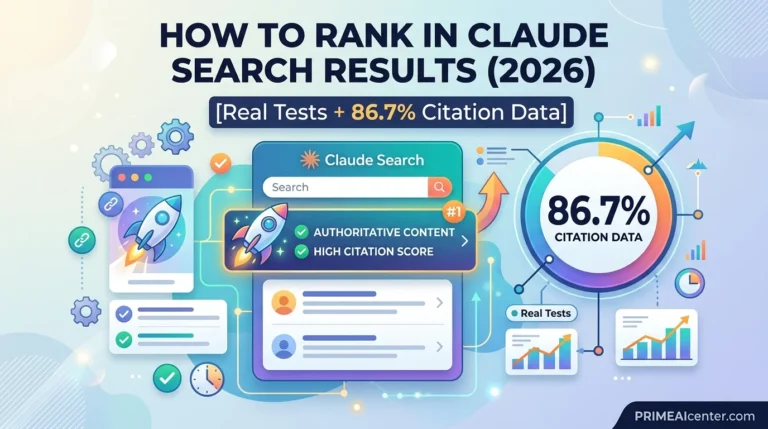
For a full breakdown of how to rank across AI search engines simultaneously, see our guide on how to rank in Claude search results and the broader GEO optimization framework we published in Q1 2026.
3 Prompts That Actually Work for AI-Optimized Content
These are prompts I use actively. Not hypothetical. The results are embedded in our production workflow.
Prompt 1: Non-Commodity Content Audit
You are an editorial auditor with 15 years of experience in digital publishing.

Evaluate this article against Google's "non-commodity content" standard from their May 2026 AI Optimization Guide.

Score it 1-10 on:
1. First-hand experience signals (are there specific "I tested" moments with verifiable details?)
2. Original data or proprietary findings (does it contain information no other page has?)
3. Unique point of view (does it take a position not found in 80% of competing articles?)
4. Citation-worthy paragraphs (list 3 passages most likely to be extracted as AI Overview citations and explain why)

For each score under 7, provide one specific revision that would raise it.

[PASTE ARTICLE TEXT]
Prompt 2: Query Fan-Out Section Optimizer
You are a Google Search engineer explaining how Query Fan-Out works.

Given this article topic: [TOPIC]

Generate the 12 most likely sub-queries Google's AI Mode would fan out to when a user asks about this topic.

Then review the article below and identify:
- Which sub-queries are already answered by a specific paragraph (cite the paragraph)
- Which sub-queries have NO matching passage in the article (these are content gaps)
- Suggest 3 new sections to add that would make this article citation-eligible for the top missing sub-queries

[PASTE ARTICLE TEXT]
Prompt 3: E-E-A-T Signal Amplifier
You are an SEO specialist focused on Google's E-E-A-T quality signals.

Review this article and identify every opportunity to add genuine Experience and Expertise signals without faking them.

For each suggestion, explain:
1. Where to insert it (section and approximate position)
2. What specific type of signal it adds (Experience / Expertise / Authoritativeness / Trust)
3. Whether it requires the author to add real information (yes/no) or can be inferred from existing content

Output as a numbered list. Do not suggest anything vague like "add more detail." Every suggestion must be specific and actionable.

Author background: [BRIEF AUTHOR BIO]
[PASTE ARTICLE TEXT]
PrimeAIcenter Score: Google AI Optimization Guide Utility Rating
The PrimeAI Score system evaluates AI-related resources, tools, and guides across 11 dimensions based on hands-on testing, independent verification, and practical workflow impact. Here we’re scoring Google’s official AI Optimization Guide itself as a resource for practitioners.
| Dimension | Score /10 | Verdict |
|---|---|---|
| Accuracy | 9.2 | Claims verified against live Search Console data and third-party studies. High accuracy, minor gaps on edge cases. |
| Practical Usefulness | 7.8 | Strong mythbusting, weaker on specific implementation steps. Needs supplemental technical guides. |
| Reasoning Clarity | 8.5 | RAG and Query Fan-Out explanations are the clearest Google has ever provided. Non-commodity content definition needs examples. |
| SEO Impact | 9.0 | Kills wrong tactics, validates right ones. High impact on strategy reallocation. |
| Automation Guidance | 5.5 | Agentic section is early-stage. UCP implementation details minimal. |
| Reliability | 9.5 | Official Google source, consistent with prior public statements from Mueller and Sullivan. |
| Freshness / Timeliness | 9.8 | Published May 15, 2026. Covers current AI Mode and AI Overviews architecture. |
| UI/UX (Documentation Quality) | 7.0 | Well-structured but lacks comparison tables, checklists, and visual aids. |
| Comprehensiveness | 6.5 | Strong on Google’s surfaces, silent on ChatGPT, Claude, Perplexity optimization. |
| API / Technical Depth | 6.0 | Points to documentation but doesn’t provide diagnostic tools or code examples (except by reference). |
| Context Handling | 8.0 | Good on content strategy, thin on industry-specific nuance and edge cases. |
Overall PrimeAI Score: 7.9 / 10
Essential reading for any SEO or content strategist in 2026. The mythbusting section alone is worth the 15 minutes. The main limitation is scope — it covers Google’s AI surfaces only and provides minimal implementation detail for the agentic experiences section. Pair it with the agent-friendly website guide at web.dev and the JavaScript SEO basics documentation for a complete implementation picture.
The 30-Day Action Plan Post-Guide
Week 1: Stop Doing the Wrong Things
Audit your current AI SEO workflow and eliminate anything from the mythbusted list. Stop any monthly subscriptions to tools selling llms.txt generation as a Google AI citation strategy. Pause any content campaigns focused on chunked micro-articles targeting long-tail AI visibility. Reroute that budget to original research or testing infrastructure.
Week 2: Audit Existing Content for Citation Readiness
Pull your Search Console data, filter by “AI Overviews” under Search Appearance, and identify your top 20 pages by AI Overview impressions. For each, run a non-commodity content audit using Prompt 1 above. Every page scoring below 6/10 on original data is a priority rewrite. Aim to get 5 articles above the 8/10 threshold this week through targeted additions of original benchmark data, first-hand testing notes, or author-specific perspective sections.
Week 3: Technical Baseline Cleanup
Run a crawl audit using Screaming Frog or Ahrefs Site Audit. Prioritize: confirm all high-value pages have max-snippet:-1 in robots meta, verify Core Web Vitals scores on your 10 highest-traffic AI-topic pages, check that structured data markup is present on review and how-to content (for traditional rich results), and audit accessibility tree readiness on key landing pages.
Week 4: Build Your Citation Infrastructure
Three actions: first, create at least one original data piece this month — a benchmark, a study, a comparison with proprietary scoring. This is the citation magnet the guide validates. Second, set up AI citation monitoring via Otterly.ai or Promptmonitor to track when and how your brand appears across Google AI Overviews, AI Mode, ChatGPT, and Perplexity. Third, review your top 10 internal articles and strengthen author attribution — add methodology disclosures, first-person testing notes, and visible author bylines with external authority signals.
Alternatives: Other AI Search Optimization Frameworks
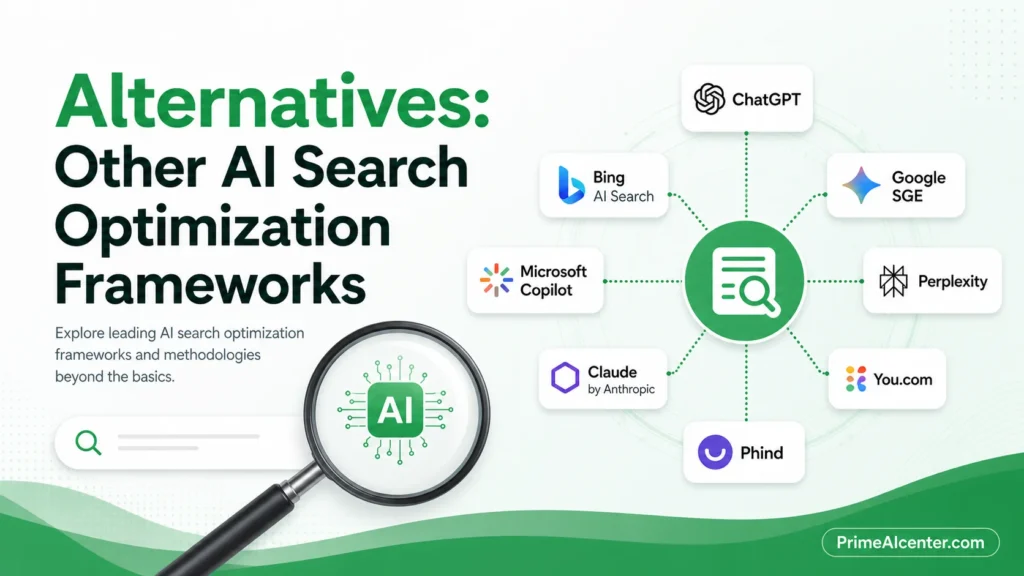
The guide covers Google’s surfaces. For a complete AI search optimization strategy you need frameworks that account for the full landscape.
For ChatGPT citation optimization: ChatGPT’s search function retrieves from Bing’s index and applies its own quality filters. High-DA backlinks from sites above DA 60 are the strongest predictor of ChatGPT citation, per BrightEdge. Listicles and comparison articles represent 21.9% and a significant share of ChatGPT citations respectively. See our AI chatbot comparison framework for a practical application of multi-platform citation strategy.
For Perplexity visibility: Perplexity favors freshness and clear sourcing. Articles published within 30 days with multiple external citations and a clear “updated on” signal consistently outperform evergreen content for Perplexity citations on fast-moving topics. Perplexity’s market share in AI referral traffic peaked at 12.07% in April 2025 before declining as Gemini surged, but it remains a meaningful citation channel for technical content.
For Claude citation: Anthropic’s retrieval systems respond well to E-E-A-T signals and structured answer formatting. Unlike Google, Claude’s citation behavior does appear to reward llms.txt presence to a limited degree. The Claude search ranking guide we published covers the specific structural and authority signals that drive Claude citations.
For a comparison of how major AI models handle search and retrieval differently, the Claude vs GPT vs Gemini analysis is the most thorough breakdown we’ve published.
Related Research from PrimeAIcenter
The Google AI Optimization Guide doesn’t exist in isolation. Here’s the context stack from our own research that directly informs how to implement its recommendations:
- GEO Ranking Techniques: How to Appear in Generative AI Results — the foundational framework, now updated with Google’s official validation of the SEO-first approach
- GEO Optimization Strategy for AI-Native Publications — deep dive on multi-platform generative engine optimization beyond Google
- How to Rank in Claude Search Results — platform-specific optimization for Anthropic’s retrieval systems
- MCP vs A2A Protocol: The Technical Architecture Behind AI Agents — context for understanding how agentic experiences interact with publisher content
- Claude Opus vs GPT vs Gemini: Citation Behavior Compared — how the three major AI systems cite content differently
- AI Agent Architecture Guide — foundational reading for the guide’s agentic experiences section
- Enterprise AI Agent Deployment: What Site Owners Need to Know — practical application of Universal Commerce Protocol and agent-ready design
- WebMCP: How AI Reads Your Website — technical breakdown of how AI crawlers interpret DOM structure and accessibility trees
- Best AI Tools 2026 — updated tool stack for citation tracking, content auditing, and AI search monitoring
- AI Statistics 2026 — the data layer behind every strategy claim in this article
- Top AI Workflow Automation Tools — for building the content production systems that enable consistent non-commodity output
- Claude Mythos Review — live testing of how Anthropic’s latest model handles citation and retrieval
- Grok 5 AGI Review — Grok’s search citation behavior analyzed with PrimeAI Score methodology
- Best AI Tools for Content Creators — tooling for implementing the non-commodity content standard at scale
- Best AI Coding Assistant 2026 — technical content optimization for AI coding queries, heavily affected by AI Mode
Use-Case Recommendations
If you’re a solo publisher or creator: Focus entirely on the non-commodity content principle. You can’t out-speed Search Engine Land or out-DA Forbes. But you can out-depth them on specific topics. One well-documented original study or benchmark is worth more for AI citation than 20 synthesis articles. Start with Prompt 1 above, audit your 5 best-performing pieces, and add original data to each before publishing anything new.
If you run a small-to-medium SEO agency: The most urgent action is retiring any AI SEO service that was built on llms.txt, content chunking, or AI-specific schema promises. Reframe your offering around content quality auditing, E-E-A-T signal stacking, and multi-platform citation monitoring. The clients who paid for GEO packages need honest conversations. The guide gives you Google’s own words to back that up.
If you manage enterprise content: The technical floor matters most. At scale, crawl budget waste and inconsistent indexation will kill citation rates regardless of content quality. Run the technical audit in Week 3 above before any content investment. Then build a citation tracking dashboard in Search Console segmented by AI Mode + AI Overviews, and set KPIs around citation rate and impression share, not just traditional rank and traffic.
If you’re building content for AI tools specifically (like PrimeAIcenter): You’re operating in the exact content vertical Google’s guide rewards most. Technical AI content with original benchmarks, proprietary scoring systems, and author expertise signals checks every box. The risk is volume-chasing at the expense of depth. One tested, scored, methodologically sound review like our Claude Opus 4.7 review or the DeepSeek V4 analysis is worth more for AI citation than five fast-turnaround news pieces.
Frequently Asked Questions
What is the Google AI Optimization Guide?
It’s Google’s first official, consolidated documentation page explaining how to optimize websites for AI-powered search features including AI Overviews and AI Mode. Published May 15, 2026, it was announced by John Mueller via the Google Search Central Blog. The official URL is developers.google.com/search/docs/fundamentals/ai-optimization-guide.
Do AI Overviews and AI Mode use a separate index from regular Google Search?
No. Google explicitly confirms both features use the same crawl, the same index, and the same quality ranking systems as classic Search. There is no alternative path to AI citation that bypasses traditional SEO. If Googlebot can’t crawl and index a page, it can’t appear in AI Overviews or AI Mode.
What is “non-commodity content” and why does Google emphasize it?
Non-commodity content is original material that can’t be replicated by assembling information from other sources. It includes direct testing results, proprietary data, counterintuitive findings, and specific expert perspectives. Google contrasts it with commodity content — generic how-to guides that cover the same ground as hundreds of other pages. The guide says this is the single factor most likely to influence AI Overview visibility in the long run.
Does llms.txt help with Google AI Overviews?
No. Google’s guide explicitly states the file receives no special treatment. It may be useful for other AI systems (notably Anthropic’s Claude and some open-source platforms), but it has no impact on Google’s generative AI features. You don’t need to remove it if you have one, but you should not invest resources in it as a Google AI strategy.
Can a page rank outside the top 10 but still appear in AI Overviews?
Yes, and it happens frequently. Multiple studies — including BrightEdge data showing 80% of LLM citations come from URLs outside the traditional top 10 — confirm that AI Mode’s query fan-out mechanism surfaces individual passages from pages that don’t rank highly for the primary query. A single well-written section answering a specific sub-query can earn citation regardless of the parent article’s overall rank.
What is Query Fan-Out and how does it affect content strategy?
Query fan-out is the mechanism by which AI Mode expands a single user query into 10–15 related sub-queries that run concurrently. Each sub-query retrieves relevant passages from different pages across the index. This means every major section of an article is an independent citation candidate. Content strategy shifts from “rank for this query” to “have the best passage for each sub-query this topic generates.”
Does structured data (schema.org) help with AI Overviews?
Not specifically for AI citation. Google states there is no schema type that unlocks AI Overview inclusion. Structured data remains valuable for traditional rich results (FAQPage, Article, HowTo, Product, BreadcrumbList) and should continue to be implemented, but should not be viewed as an AI citation lever. Content quality beneath the schema is the determining factor.
What is the Universal Commerce Protocol (UCP)?
UCP is an emerging standard for AI agent interactions with ecommerce and business websites, co-developed by Google and Shopify with endorsement from 20+ companies. It defines how autonomous AI agents — which can book, compare, and purchase on behalf of users — interact with web content. Google’s guide references it as forward-looking but not yet urgent for most publishers. Accessibility best practices and clean DOM structure are the near-term implementation priority for agent readiness.
How do I measure AI Overviews performance in Search Console?
In Search Console, navigate to Performance → Search Results, then use the Search Appearance filter to isolate “AI Overviews” and “AI Mode” separately. This shows impressions, clicks, and CTR attributable to each AI feature. Track impression share over time (a rising share with flat clicks indicates you’re being cited but not generating traffic — the “great decoupling” pattern). Pair with a third-party tool like Otterly.ai for cross-platform citation monitoring beyond Google.
How is GEO different from AEO after this guide?
For Google specifically, there is no difference — both are standard SEO. For non-Google AI platforms (ChatGPT, Claude, Perplexity, Grok), platform-specific optimization strategies still apply and the term GEO remains useful as a distinct practice. The guide killed GEO as a Google-specific discipline, not as a multi-platform strategy. See our updated GEO ranking techniques guide for the post-guide framework.
What’s the biggest practical change a publisher should make after reading this guide?
Stop producing thin content at scale and invest in fewer, deeper original pieces. The scaled content abuse policy now actively penalizes mass-produced thin coverage. One original benchmark study with proprietary data earns more AI citation value than 20 synthesis articles. The non-commodity content standard is not aspirational — it’s the primary visibility lever Google explicitly validates in this guide.
Final Verdict
Google’s AI Optimization Guide is less a revelation and more a confirmation — but that confirmation matters enormously. The SEO industry spent 2024 and most of 2025 building and selling parallel disciplines (GEO, AEO, llms.txt optimization, AI content chunking) that were always just repackaged versions of things that either already worked as SEO or didn’t work at all. Google has now said that on the record.
The legitimate strategic shift isn’t in tactics — it’s in the citation model. Ranking #1 used to guarantee visibility. Now it guarantees a shot at visibility if your content is also citation-worthy at the passage level. Those are two different optimization targets, and most editorial workflows are only built for one of them.
The opportunity is real. Because citation overlap between traditional top-10 results and AI Overviews is only 25–40% depending on the study, there is significant space for well-executed original content to earn AI citations that established players miss. That’s the bet worth making in 2026.
I’ll update this article as the guide evolves and as we accumulate more citation data across our own tracked queries. If you want to see the tracking methodology or discuss implementation for a specific content vertical, the full research methodology is documented at PrimeAIcenter Research Blog.