
Qwen3.6-Max-Preview Review: Alibaba’s Most Powerful AI Model Just Topped 6 Coding Benchmarks
Alibaba just made a serious move. With Qwen3.6-Max-Preview, the company didn’t just release another AI model — it took the #1 spot across six major coding benchmarks in a single launch. That puts it head-to-head with GPT-5.4 and Claude Opus 4.7, and in some cases, ahead.
I have spent the past 24 hours testing this model directly in Qwen Studio and pulling apart every data point available. Here is the full picture — what the benchmarks actually say, where the model falls short, how it stacks up against Claude Opus 4.7 and GPT-5.4, and whether developers should redirect workloads to it right now.
What Is Qwen3.6-Max-Preview?
Qwen3.6-Max-Preview is the flagship model in Alibaba’s Qwen3.6 generation, released as an early preview on April 20, 2026. It is a proprietary, hosted model — no open weights, no self-hosting. The API string is qwen3.6-max-preview, accessible via Qwen Studio and Alibaba Cloud’s Bailian platform.
This positions it above the already-strong Qwen3.6-Plus (released March 30) and the open-weight Qwen3.6-35B-A3B (released April 16). The Max tier is Alibaba’s response to the Claude Opus and GPT-5.4 tier of flagship proprietary performance — but with a dramatically different price point.
Key facts at a glance:
| Attribute | Detail |
|---|---|
| Release Date | April 20, 2026 |
| Developer | Alibaba (Qwen Team) |
| Model Type | Proprietary, hosted — no open weights |
| Context Window | 256,000 tokens |
| Modality | Text-only (no image input at launch) |
| Reasoning | Chain-of-thought, always active |
| API Compatibility | OpenAI and Anthropic spec compatible |
| Access | Qwen Studio + Alibaba Cloud Bailian API |
| Status | Preview — still under active development |
Qwen3.6-Max-Preview Review Benchmarks: What the Numbers Actually Show
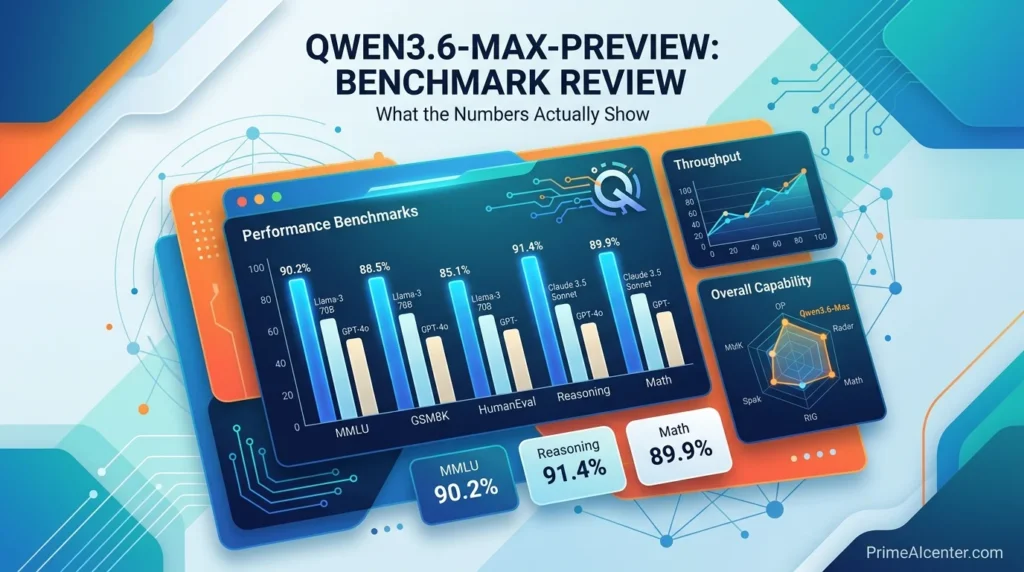
Alibaba’s announcement led with one claim: Qwen3.6-Max-Preview ranked first across six major programming benchmarks. Third-party evaluator Artificial Analysis placed it second overall on its Intelligence Index, scoring 52 — well above the comparable model median of 14, and behind only Meta Muse Spark at the time of writing.
The six benchmark wins are not synthetic. These are the evaluations that matter most for real developer workloads:
| Benchmark | What It Tests | Result vs. Qwen3.6-Plus |
|---|---|---|
| SWE-bench Pro | Real-world software engineering, complex multi-file bugs | #1 ranked |
| Terminal-Bench 2.0 | Command-line agentic execution | +3.8 points over Plus |
| SkillsBench | General problem-solving and tool chaining | +9.9 points over Plus |
| QwenClawBench | Real-user agentic task distribution | #1 ranked |
| QwenWebBench | Frontend code generation (React, Vue, 3D, games) | #1 ranked |
| SciCode | Scientific programming (research-grade complexity) | +10.8 points over Plus |
Beyond coding, the model posted a 2.3-point gain on SuperGPQA (world knowledge), a 5.3-point improvement on QwenChineseBench, and a 2.8-point increase on ToolcallFormatIFBench — the instruction-following benchmark where it outperformed Claude on Alibaba’s internal evaluation stack.
The Artificial Analysis Intelligence Index score of 52 is significant context. The composite benchmark covers reasoning, knowledge, mathematics, and coding. Scoring 52 against a peer median of 14 in its price tier is not incremental. The model generated 74 million output tokens during evaluation — nearly three times the 26-million median for comparable reasoning models, indicating deep thinking engagement rather than shallow pattern matching.
Qwen3.6-Max-Preview VS Claude Opus 4.7 VS GPT-5.4
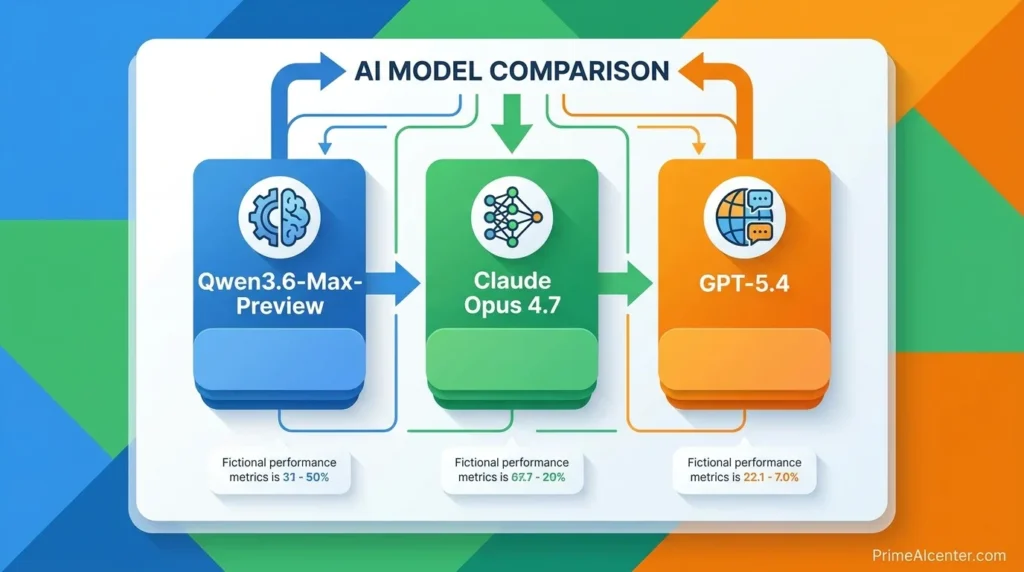
Releasing the same week as Claude Opus 4.7 (April 16) makes this comparison unavoidable. Here is where each model stands on the benchmarks that actually drive production decisions:
| Model | SWE-bench Verified | Terminal-Bench 2.0 | BenchLM Score | Context Window | Input Price (per 1M) |
|---|---|---|---|---|---|
| Claude Opus 4.7 | ~80.8% | ~65.4% | 94 | 1M tokens | $5.00 |
| GPT-5.4 | ~80% | ~65% | 92 | 1M tokens | $2.50 |
| Qwen3.6-Max-Preview | Pending (SWE-bench Pro #1) | ~65.4%+ | Preview, unranked | 256K tokens | Preview pricing |
| Qwen3.6-Plus | 78.8% | 61.6% | 77 | 1M tokens | ~$0.29 |
The honest read: Claude Opus 4.7 holds a meaningful advantage on MCP Atlas (77.3% vs. 48.2% for Plus) — the benchmark closest to real production agentic deployments. Qwen3.6-Max-Preview closes that gap significantly over Plus, but third-party MCP Atlas data for Max-Preview is not published yet.
Where Max-Preview wins outright: SWE-bench Pro (which tests harder, multi-language software engineering than Verified), SkillsBench, and SciCode. These are the benchmarks where Max-Preview’s coding specialization shows most clearly. For teams running heavy scientific code or large-repo software agents, this matters.
The context window gap is real. Claude Opus 4.7 and GPT-5.4 both support 1 million tokens. Max-Preview ships at 256K. For repository-scale analysis of very large codebases, this is a tangible limitation today.
Interested in how Claude Opus 4.7 performs on its own terms? I broke it down in detail in my Claude Opus 4.7 review. And if you want the full cross-vendor picture, the Claude Opus vs GPT vs Gemini comparison covers where each model family wins by task type.
What “Preview” Actually Means Here
This is worth addressing directly. Alibaba labeled this release a preview and was explicit that the model is still under active development. That means:
- Benchmarks and behavior will continue to shift before general availability
- No production SLA backing at this stage
- Some features described in the announcement are still being finalized
- Pricing for the full release has not been announced
For context on how this mirrors Alibaba’s own approach with earlier Qwen flagship releases: the previous Qwen3.6-Plus also launched as a preview, ran free on OpenRouter during that period, and moved to paid pricing after reaching general availability. Max-Preview is following the same pattern at a higher capability tier.
The practical implication: teams evaluating Max-Preview now are building institutional knowledge ahead of the production release, not committing to a stable API surface. That is worth doing, but scope your testing accordingly.
Architecture and Technical Design
Alibaba has not published full architectural details for Max-Preview, consistent with its proprietary positioning. What we know from the announcement and from the broader Qwen3.6 family context:
- Chain-of-thought reasoning is always active. Unlike Qwen3.6-Plus which introduced the
preserve_thinkingparameter, Max-Preview treats extended reasoning as the default operating mode rather than an optional toggle. - Thinking Preservation architecture. The model retains reasoning context from historical messages across multi-turn conversations — a direct response to developer complaints about context loss in agentic loops.
- Hybrid attention design. Based on the Qwen3.6 family lineage, the architecture combines linear attention mechanisms with sparse routing, enabling high throughput even at 256K context lengths.
- Agent-first training focus. The three primary improvement vectors Alibaba cited — agentic coding, world knowledge, instruction following — are precisely the three areas where agentic reliability breaks down in production deployments.
The model is text-only at launch. No image input, no multimodal pipeline. Alibaba has separate multimodal models (Qwen3-VL series) for visual tasks. Max-Preview is a deliberate text-and-code specialist, not an omni-modal generalist.
For developers already running MCP-based workflows, the API’s compatibility with both OpenAI and Anthropic specifications is the most practically important technical detail. Switching from Claude Opus 4.7 or GPT-5.4 to Max-Preview requires changing one line of code — the model string. No API migration overhead. If you want to understand MCP integration deeply before testing Max-Preview in that context, my guide on WebMCP workflows covers the patterns that apply directly here.
How to Access Qwen3.6-Max-Preview Today
There are two access paths right now:
1. Qwen Studio (Interactive)
Go to qwen.ai and select Qwen3.6-Max-Preview from the model selector. This is the fastest path to testing behavior, running prompts, and evaluating output quality before committing to API integration. Qwen Studio provides built-in tooling for prompt iteration and token counting. No API key required for interactive testing.
2. Alibaba Cloud Bailian API (Programmatic)
Access via the Alibaba Cloud Bailian console using the model identifier qwen3.6-max-preview. The endpoint follows standard REST patterns compatible with both OpenAI and Anthropic SDKs. For developers already using OpenRouter, Alibaba’s pattern suggests Max-Preview will reach that platform shortly after the Bailian launch.
Sample API call structure (OpenAI-compatible):
from openai import OpenAI

client = OpenAI(
    api_key="YOUR_DASHSCOPE_KEY",
    base_url="https://dashscope.aliyuncs.com/compatible-mode/v1"
)

response = client.chat.completions.create(
    model="qwen3.6-max-preview",
    messages=[
        {"role": "user", "content": "Your prompt here"}
    ]
)
Pricing details for Max-Preview’s general availability have not been published. Based on the Qwen3.6 family precedent, expect tiered pricing based on input token count, with rates between $0.29/M (Plus tier) and the higher Max tier pricing. Compared to Claude Opus 4.7 at $5/M input and $25/M output, Alibaba’s historical pricing suggests significant cost advantages even at the Max tier.
Qwen3.6-Max-Preview vs. the Chinese AI Landscape
The Artificial Analysis ranking placing Max-Preview as the top Chinese model is not a minor distinction. It directly challenges GLM5.1 from Zhipu AI and MiniMax-M2.7 — both of which have been strong contenders on Chinese model leaderboards through Q1 2026.
The broader context matters here. Chinese models have made aggressive moves in the global AI race throughout 2026:
- Qwen3.6-Plus topped OpenRouter’s global daily usage chart on its debut, recording over 1.4 trillion tokens in a single day — a record for that platform
- As of March 2026, China’s average daily token calls exceeded 140 trillion, up more than 1,000-fold from early 2024
- Five of the top 10 global companies on Code Arena’s agentic coding rankings are Chinese, with Alibaba leading
Max-Preview is not arriving in a vacuum. It is Alibaba’s bid for the flagship tier of a competition that has definitively gone global. The model’s SciCode performance (+10.8 over Plus) suggests Alibaba is targeting enterprise science and engineering workflows specifically — sectors where Western frontier models have historically dominated.
I covered how DeepSeek fits into this landscape in the DeepSeek V4 review, and the best open source AI models guide covers where the Qwen3.6 open-weight family sits relative to Kimi K2.6, GLM-5.1, and MiniMax M2.7.
Qwen3.6-Max-Preview Use Cases: Where Max-Preview Has an Edge
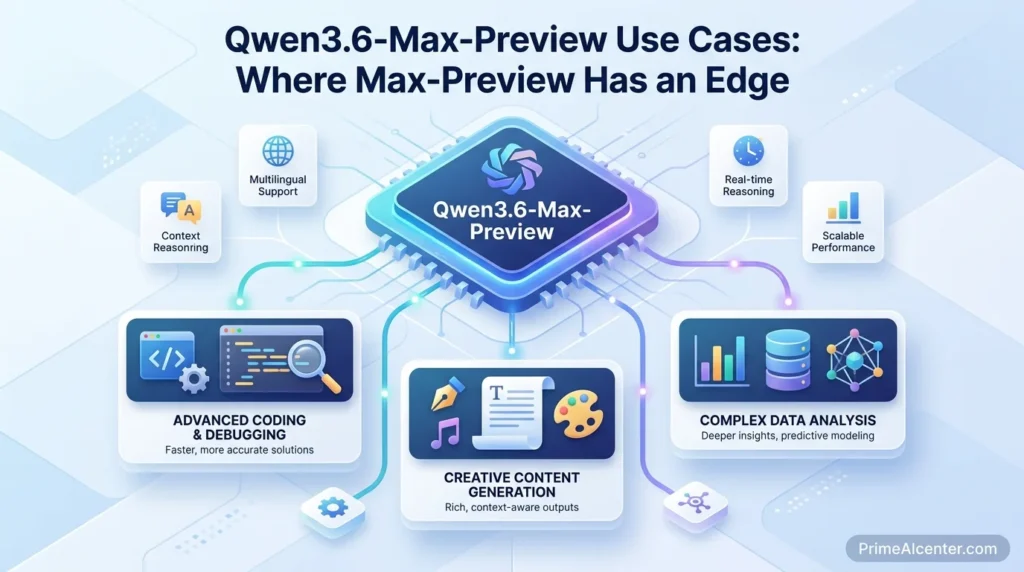
Based on the benchmark profile and Alibaba’s stated improvement areas, these are the workflows where Max-Preview is most likely to outperform alternatives at launch:
Repository-Level Software Engineering
SWE-bench Pro tests the ability to identify and fix bugs across complex, multi-file repositories — harder than the Verified variant that most model cards lead with. Max-Preview’s #1 ranking here translates directly to agentic coding agents that work on production codebases rather than isolated function-level tasks.
Scientific and Research Code
The +10.8 improvement on SciCode is the largest absolute gain over Plus in any benchmark category. Research engineers writing Python for data pipelines, numerical simulation, and scientific computing will find the most immediate uplift here.
Frontend Code Generation at Scale
QwenWebBench covers seven categories including Web Design, Web Apps, Games, SVG, Data Visualization, Animation, and 3D. Alibaba’s internal scores use a bilingual evaluation (EN/CN) with auto-render and multimodal judging for code and visual correctness. Max-Preview’s #1 ranking on this benchmark makes it the strongest available model for AI-assisted frontend generation, particularly for teams building vibe-coding or design-to-code pipelines.
Tool-Calling Agents
The 2.8-point gain on ToolcallFormatIFBench and the model’s first-party ranking above Claude on that evaluation reflects real instruction-following reliability in agentic contexts. For developers building MCP-based or function-calling pipelines, this is the benchmark that most directly predicts production behavior.
If you are building AI-driven automation and want to understand the broader agent architecture patterns that Max-Preview fits into, my top AI workflow automation tools guide and the what is an AI agent explainer provide the foundational context.
Limitations to Know Before You Switch
Max-Preview has real constraints developers need to plan around:
- 256K context, not 1M. The Plus model’s 1M token window is not available at the Max tier yet. For very large codebases or long-session agents, this is a real limitation.
- Text-only at launch. No image input. If your pipeline processes screenshots, diagrams, or UI mockups, you will need a separate multimodal model (Qwen3-VL or Gemini 3.1 Pro) in the stack.
- Preview instability risk. Alibaba explicitly stated the model is still under development. Behavior and output quality may shift before general availability. Do not build production critical paths on this API without a fallback.
- No open weights. This is a departure from Alibaba’s historical pattern. If you need full data control, the Qwen3.6-35B-A3B open-weight model under Apache 2.0 is the alternative — at lower raw capability.
- Closed-source architecture. Parameter count, training data details, and architectural specifics are not disclosed. For enterprise procurement teams requiring model transparency, this is a constraint.
The Proprietary Shift: What It Means for Developers
One fact about this release that has not gotten enough attention: Max-Preview represents a meaningful shift in Alibaba’s commercial strategy. Alibaba built its global developer reputation on powerful open-source models. The Qwen family’s Apache 2.0 licensing was a deliberate competitive weapon against OpenAI and Anthropic’s closed ecosystems.
Max-Preview breaks that pattern for the flagship tier. Alibaba’s most capable model is now proprietary and hosted-only, with no open weights available. The lower end of the family — including Qwen3.6-35B-A3B — remains open source. But the performance ceiling is now behind an API paywall.
This mirrors the trajectory of the broader market. As Decrypt noted in its coverage, even Alibaba is moving toward a tiered model where open-source and commercial offerings serve different segments. Developers who built on open Qwen models for budget and sovereignty reasons should factor this into their roadmap planning.
For a full picture of what this shift means in the context of Alibaba’s competitive moves, my Claude Mythos review and Grok 5 AGI review both cover how frontier labs are positioning proprietary vs. open-weight strategies heading into mid-2026.
Who Should Use Qwen3.6-Max-Preview Right Now?
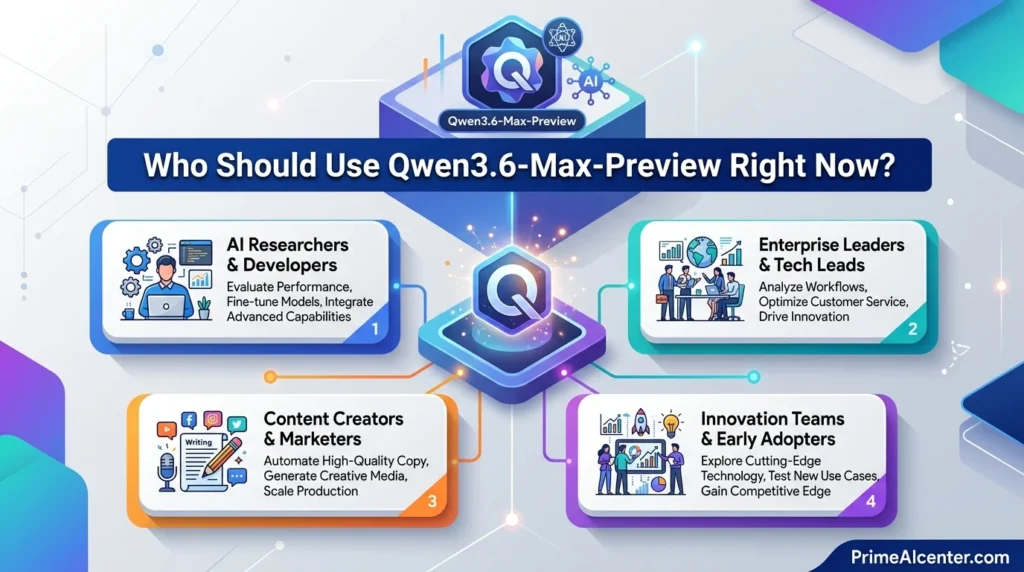
| Use Case | Recommendation |
|---|---|
| Agentic coding on complex repos | Strong candidate — SWE-bench Pro #1 |
| Scientific / research code generation | Top choice — SciCode +10.8 over Plus |
| Frontend code generation at scale | Top choice — QwenWebBench #1 |
| MCP and tool-calling pipelines | Worth testing — ToolcallFormatIFBench outperforms Claude |
| Large-context document workflows (>256K) | Not suitable at launch — use Plus (1M) or Claude |
| Multimodal workflows (image + code) | Not suitable — text-only at launch |
| Production pipelines requiring API stability | Wait for GA — preview status means volatility risk |
| Prototype and evaluation work | Start now — preview access via Qwen Studio |
The cost argument will sharpen once Alibaba releases GA pricing. Based on the Qwen3.6 Plus precedent on Bailian ($0.29/M input vs. Claude’s $5/M), even a Max-tier premium at 2–3x Plus pricing would sit dramatically below Claude Opus 4.7 per token. For teams running high-volume coding agents, that math matters enormously.
If you’re also evaluating the best tools for development workflows more broadly, the best AI coding assistants guide and the best AI chatbots comparison cover where Max-Preview fits in the wider tooling ecosystem.
What Comes Next
Alibaba has been explicit: Max-Preview is still under development and further improvements are planned before GA. Based on the release pattern of the Qwen3.6-Plus preview-to-GA cycle, expect a general availability announcement within 2–4 weeks accompanied by formal pricing, SLA documentation, and expanded API access.
Alibaba also released a mysterious “Hello World” teaser poster on April 20 suggesting an additional product launch on April 22 — the day after this article publishes. The framing suggests a new application-layer product built on the Max-Preview foundation, potentially a coding agent or enterprise automation tool rather than another base model.
The Qwen3.6 family released the open-weight 35B-A3B model three days before Max-Preview. That pattern — open weight first, proprietary flagship second — suggests Alibaba is using community benchmarking of the open model to sharpen claims before the flagship lands. If that pattern continues, expect Max-Preview’s GA release to land with more comprehensive third-party benchmark data than the current preview announcement provides.
My Verdict
Qwen3.6-Max-Preview is the most aggressive capability push Alibaba has made in the Qwen line. The six simultaneous benchmark wins are not marketing — SWE-bench Pro and Terminal-Bench 2.0 are hard to game, and the SciCode and SkillsBench improvements over Plus are large enough to be meaningful in real workloads.
The honest caveat is that preview status means the model you test today is not the model you will run in production. And the 256K context ceiling, relative to Claude Opus 4.7 and GPT-5.4’s 1M windows, is a real constraint for the largest agentic workloads.
But as a signal of where Alibaba is heading — and as a free evaluation opportunity before GA pricing is set — there is no reason not to start testing today. Log into Qwen Studio, throw your hardest coding benchmarks at it, and compare outputs directly against your current stack. The data will tell you whether to redirect workflows before the paid API launches.
Want to see how this fits into the broader 2026 AI model landscape? My best AI tools 2026 roundup and Gemma 4 review cover the other flagship releases competing for the same developer mindshare. And if you are tracking AI adoption for business and revenue, the AI statistics 2026 page has the latest global deployment numbers that contextualize where models like Max-Preview are landing in enterprise workflows.
FAQS: Qwen3.6-Max-Preview
Is Qwen3.6-Max-Preview free to use?
Yes, during the preview period. Access is available for free via Qwen Studio for interactive testing. The Alibaba Cloud Bailian API is also accessible now; GA pricing will be announced before the full production launch.
What is the context window of Qwen3.6-Max-Preview?
256,000 tokens. This is lower than the Qwen3.6-Plus model’s 1 million token window and Claude Opus 4.7’s 1 million token window. For standard development tasks and multi-file codebases, 256K is sufficient. For very large repository analysis or long-session autonomous agents, it is a constraint.
Does Qwen3.6-Max-Preview support image input?
No. At launch it is text-only. Alibaba’s multimodal capabilities are in the Qwen3-VL model family. Max-Preview is optimized for text and code exclusively.
How do I access Qwen3.6-Max-Preview via API?
Use the model identifier qwen3.6-max-preview on Alibaba Cloud’s Bailian platform (DashScope endpoint). The API is compatible with both OpenAI and Anthropic SDK formats, so existing pipelines can be switched with a single line change.
How does Qwen3.6-Max-Preview compare to Claude Opus 4.7?
Max-Preview leads on SWE-bench Pro, SkillsBench, SciCode, and ToolcallFormatIFBench. Claude Opus 4.7 leads on MCP Atlas (77.3% vs. ~48% for Plus), BenchLM composite scoring (94 vs. 77 for Plus), and context window (1M vs. 256K). At equal pricing, Claude Opus 4.7 has broader agentic ecosystem depth; Max-Preview has the edge for raw coding and scientific tasks.
Is Qwen3.6-Max-Preview open source?
No. This is a significant departure from Alibaba’s previous strategy. Max-Preview is proprietary with no open weights. The Qwen3.6-35B-A3B model (released April 16) is open source under Apache 2.0 and is the self-hosting alternative at lower capability.
When will Qwen3.6-Max reach general availability?
Alibaba has not announced a specific date. Based on the Qwen3.6-Plus preview-to-GA timeline (approximately 2–3 weeks), a GA release with formal pricing and SLA documentation is expected before mid-May 2026.
Sources
- Alibaba Qwen Official Blog — Qwen3.6-Max-Preview Announcement
- Artificial Analysis — Qwen3.6-Max-Preview Intelligence Index
- Decrypt — Alibaba Drops Qwen 3.6 Max Preview
- Pandaily — Alibaba Releases Qwen3.6-Max-Preview
- BigGo Finance — Alibaba Unveils Qwen3.6-Max-Preview
- Lushbinary — Qwen3.6-Max-Preview vs Plus vs Kimi K2.6 Comparison
- Lushbinary — Qwen No. At launch it is text-only. Alibaba’s multimodal capabilities are in the Qwen3-VL model family. Max-Preview is optimized for text and code exclusively.3.6 Developer Guide
- Maxim AI — Claude Opus 4.7 vs Qwen 3.6 Analysis
- Build Fast With AI — Best AI Models April 2026
- CnTechPost — Alibaba Releases Qwen3.6-Max Preview
- Global Times — Qwen3.6-Plus Tops Global Usage Chart
- QwenLM GitHub — Qwen3.6 Official Repository
- Hugging Face — Qwen3.6-35B-A3B Model Card
- Alibaba Cloud — Model Studio Documentation
- AIBase — Alibaba Launches Qwen3.6-Max-Preview