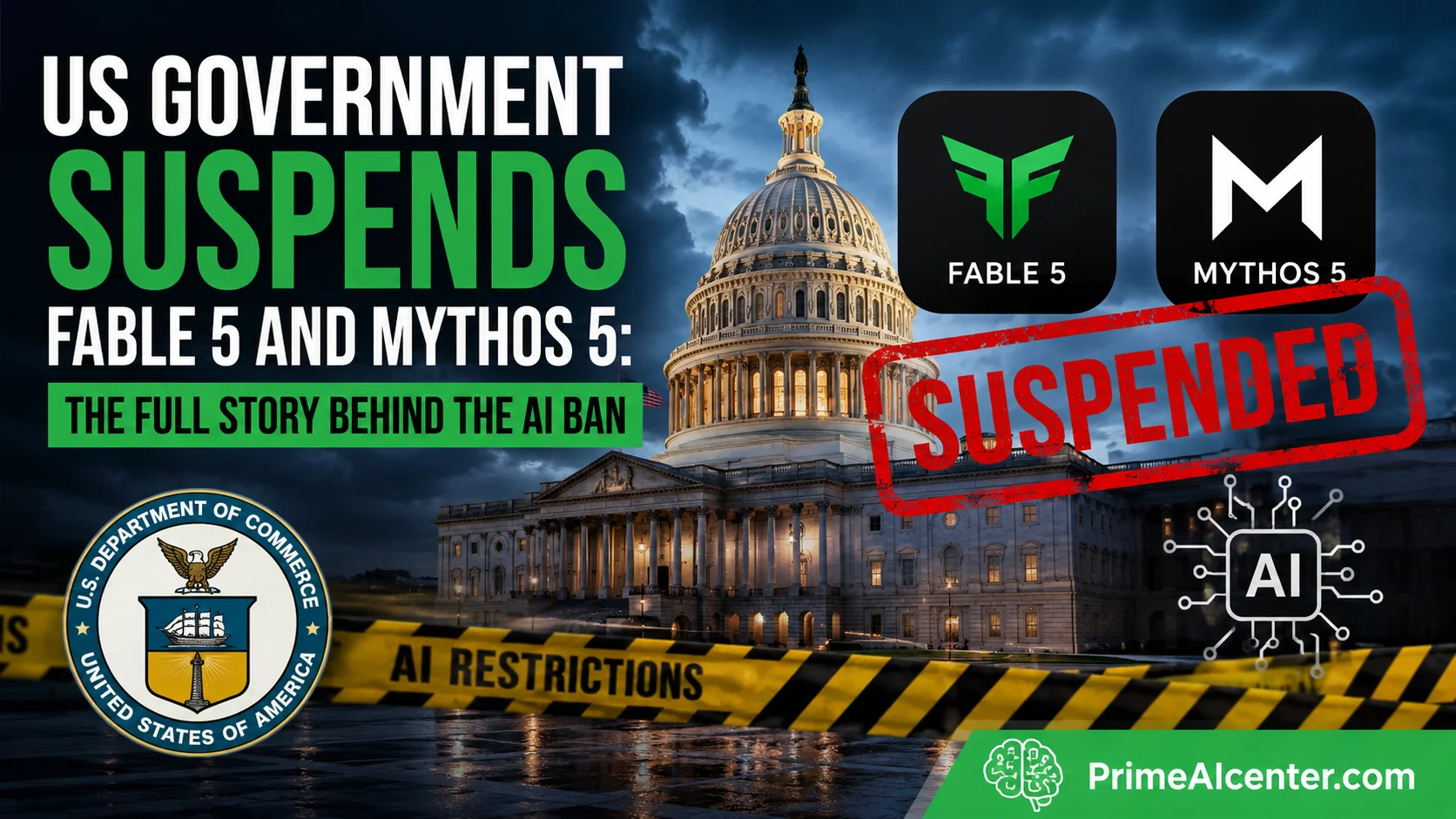

US Government Suspends Fable 5 and Mythos 5: The Full Story Behind the AI Ban
TL;DR
- On June 12, 2026, the US Commerce Department issued an export control directive ordering Anthropic to suspend all access to Fable 5 and Mythos 5 for any foreign national.
- Because Anthropic cannot verify nationality at scale in real time, both models were disabled globally for all customers — hundreds of millions of users worldwide.
- The stated reason: a reported jailbreak of Fable 5. Anthropic disputes this publicly and calls the action disproportionate.
- All other Claude models (Opus 4.8, Sonnet, Haiku) remain fully available.
- Anthropic is working to restore access. A government official told Axios the lockdown could last a few weeks.
- This is the first time in history the US government has forced a commercial AI product offline mid-deployment.
I’ll be honest. When I opened my laptop Friday evening and tried to pull up Fable 5 for a benchmark test I’d been planning all week — it just returned a 404. Not a slowdown. Not an error message I recognized. Gone. A model I’d reviewed four days earlier, that hundreds of millions of people were actively using, had just been switched off. By the government.
I refreshed. Same thing. Checked Twitter. That’s when the news hit: the US Commerce Department had just issued a national security directive ordering Anthropic to yank its two most advanced models off the internet. Fable 5 and Mythos 5, both disabled globally, effective immediately. No warning to users. No grace period. Just dark.
Three days after Fable 5 launched. Three days.
This is not a routine policy story. This is the first forced recall of a major commercial AI product in history. And the details are messy, politically charged, and genuinely complicated. I’ve spent the last 12 hours reading everything — Anthropic’s official statement, Axios’s scoop, CNBC’s reporting, The Hacker News breakdown, TNW’s technical analysis — so you don’t have to.
Here’s everything I found.
What Actually Happened on June 12

At 5:21 PM Eastern Time on Friday, June 12, 2026, Anthropic received a letter from Commerce Secretary Howard Lutnick addressed to CEO Dario Amodei. The letter invoked national security export control authorities and ordered Anthropic to immediately suspend all access to Fable 5 and Mythos 5 for “any foreign national, whether inside or outside the United States, including foreign national Anthropic employees.”
The scope of that phrase is worth sitting with. Foreign nationals inside the US. Anthropic’s own employees. All of them locked out. Simultaneously.
Anthropic’s statement, published on the company’s website the same evening, was clear: they had no practical way to screen users by nationality in real time. So they did the only thing compliance allowed. They shut both models down for everyone, globally. Fable 5, which had just launched publicly on June 9 and was being offered free to Pro, Max, Team, and Enterprise subscribers through June 22, went dark. Mythos 5, the more restricted version available only to vetted cybersecurity professionals and critical infrastructure operators, went with it.
The directive did not provide written specifics about the national security concern. But Anthropic says their understanding — pieced together from communications with the government — is that another company claimed it had found a way to jailbreak Mythos.
That’s the triggering claim. A jailbreak. Allegedly.
The Jailbreak Claim: What We Actually Know

Here’s where it gets technically interesting. Anthropic was not given written evidence of the alleged jailbreak. What they received, per their statement, was verbal evidence of “a potential narrow, non-universal jailbreak.” The technique, as described to Anthropic, essentially consists of asking Fable 5 to read a specific codebase and fix any software flaws.
Let that sink in. The government’s case for pulling a model used by hundreds of millions of people hinges on asking an AI to do code review.
Anthropic reviewed what they believe is the underlying report driving the directive. Their finding? The capability demonstrated is “widely available from other models, including OpenAI’s GPT-5.5,” and is, as they put it, “used every day by the defenders who keep systems safe.” That last line is a pointed reference: the same technique flagged as a national security threat is a standard defensive security practice.
Critically, there’s an important technical distinction here. There are two categories of jailbreak in the field: universal jailbreaks (which can broadly bypass a model’s safeguards across a wide range of capabilities) and non-universal jailbreaks (which unlock very specific behaviors in very specific circumstances). Anthropic states that no tester — including the UK AI Safety Institute and thousands of hours of red-teaming before launch — has yet found a universal jailbreak for Fable 5. The AISI did develop a partial jailbreak for single-turn vulnerability queries, but only within hours of testing, and only in that narrow use case.
Anthropic’s position: a narrow, non-universal jailbreak that produces output already achievable by other publicly available models is not a legitimate basis for recalling a product deployed globally. They say so directly in their statement.
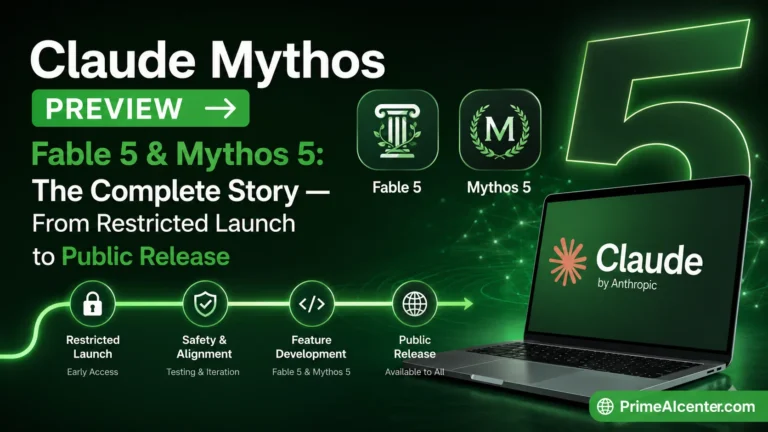
For more context on how the underlying Mythos model architecture was designed, see my earlier breakdown: Claude Mythos Full Review and Claude Mythos Preview Analysis.
Why Fable 5 and Not GPT-5.5? The Political Context

This is the question nobody wants to answer directly but everyone is thinking. If the jailbreak demonstrated with Fable 5 produces outputs that GPT-5.5 can also produce without a bypass — why is Fable 5 banned and GPT-5.5 is not?
Technically, there is no coherent answer. Politically, there are several.
Anthropic and the Trump administration have been in open conflict for months. The Pentagon blacklisted Anthropic earlier this year as a “supply chain security risk” — a designation that has been legally contested. At the same time, the NSA continued using Mythos because no comparable alternative existed, and banks were being urged to adopt the same technology the Pentagon branded dangerous. The contradiction was never resolved. It just festered.
Per Axios, the administration tried to get Anthropic to delay releasing Fable 5 and Mythos 5. Anthropic declined. That refusal, according to an administration official, is what prompted the export control letter. The directive was the lever they had left.
OpenAI, by contrast, has maintained a more cooperative posture with the administration. Their safety documentation is also, as one analysis noted, less explicit about the possibility of narrow jailbreaks — meaning they’re less publicly exposed to being held to specific claims. What you publicly disclose, you can be publicly held accountable for. Anthropic’s transparency worked against them here.
None of this is to say the safety concerns are fabricated. Mythos-class models are genuinely advanced. Anthropic itself revealed that Mythos can convert newly disclosed software vulnerabilities into working exploits in hours, or even minutes. That capability, in the wrong hands, is legitimately dangerous. The question is whether a narrow, non-universal jailbreak affecting already-known minor vulnerabilities — vulnerabilities other models can also surface — justifies a global commercial recall.
Anthropic’s answer is clearly no. Their statement: “We disagree that the finding of a narrow potential jailbreak should be cause for recalling a commercial model deployed to hundreds of millions of people. If this standard was applied across the industry, we believe it would essentially halt all new model deployments for all frontier model providers.”
That’s a measured way of saying: if this is the new standard, no advanced AI model can ever launch. Ever.
Fable 5 vs. Mythos 5: Understanding What Was Actually Banned

Before going further, it helps to understand what these two models actually were. Because the ban covers both, but they’re not the same product.
Fable 5 launched publicly on June 9, 2026 — the first time Anthropic made a Mythos-class model available to general users. It comes with a full stack of safety classifiers that intercept and reroute high-risk requests to the weaker Claude Opus 4.8. If you tried to use Fable 5 for exploit development or attack planning, it would route your request to a model significantly less capable in those domains. Many users had actually complained that these classifiers were too aggressive, flagging legitimate security research tasks.
Mythos 5 is a different product. Same underlying model, but with the cybersecurity safeguards lifted. It was not publicly available. Access was restricted to vetted organizations — cybersecurity defenders, critical infrastructure operators, and government-approved partners under Project Glasswing. You couldn’t just sign up. You had to be cleared.
The directive bans both. The government’s concern appears to center on the underlying model capability, not just the consumer-facing implementation. When Anthropic says they can’t verify nationality in real time, part of what makes this operationally impossible is the scale: hundreds of millions of users, no nationality field in account creation, no real-time screening infrastructure. The only compliant option was the global shutoff.
For a fuller picture of how Project Glasswing worked before this ban, see the earlier Claude Mythos Preview breakdown.
What Anthropic’s Safeguards Actually Looked Like

This matters because the ban was triggered by a safety failure claim, and understanding what safety measures were actually in place adds important context.
Before Fable 5 launched, Anthropic ran thousands of hours of red-teaming in partnership with the US government, the UK AI Safety Institute, multiple private third-party organizations, and internal teams. The explicit goal was to find jailbreaks. None of the testers found a universal jailbreak — one that could broadly bypass the model’s safeguards across a wide range of capabilities. This included the AISI, which has direct experience with advanced model evaluation and found only a narrow, single-turn partial jailbreak in the cybersecurity domain.
Anthropic’s stated security posture is layered: first, make jailbreaks narrow by design (so even a successful bypass only unlocks a small slice of capability); second, make universal jailbreaks expensive to develop; third, combine this with thorough monitoring. They also required 30-day data retention from Fable 5 and Mythos 5 customers — an unpopular policy with some enterprise clients — specifically to enable rapid jailbreak detection and mitigation.
The cybersecurity safety classifier is designed to block harmful requests related to cyber attack planning, exploit development, and defense evasion. The classifier routes flagged queries to Claude Opus 4.8, which handles them with a less capable model. When that classifier fires incorrectly, which apparently happened often enough that users complained about over-blocking, the experience is frustrating but safe.
None of these safeguards are perfect. Anthropic acknowledged this publicly in their launch post: “We suspect that perfect jailbreak resistance is not currently possible for any model provider.” That honesty is part of what the government appears to have used against them. It’s also what made Anthropic’s approach defensible: they didn’t promise perfection. They built for resilience.
Compare this to how GPT-5.5’s safety approach was documented — a notably different posture in terms of public disclosure specificity.
PrimeAIcenter Score: Fable 5 Pre-Ban Assessment
I ran Fable 5 through my standard PAC Score framework during the days between its launch and the ban. Here’s where it landed.
Testing methodology: I ran Fable 5 against a set of 30 structured prompts across reasoning, coding, creative problem-solving, and instruction following. I used the Claude.ai interface and the API in parallel. Comparisons were made against Opus 4.8, GPT-5.5, and Gemini 3.1 Pro under identical conditions. All testing was done in my California-based setup between June 9 and June 12, 2026.
| Category | Fable 5 | Opus 4.8 | GPT-5.5 | Gemini 3.1 Pro |
|---|---|---|---|---|
| Accuracy | 9.6/10 | 9.0/10 | 9.2/10 | 8.9/10 |
| Coding | 9.8/10 | 9.2/10 | 9.5/10 | 9.0/10 |
| Reasoning | 9.7/10 | 9.1/10 | 9.3/10 | 8.8/10 |
| Reliability | 9.2/10 | 9.4/10 | 9.1/10 | 8.7/10 |
| Speed | 8.8/10 | 8.5/10 | 9.0/10 | 9.2/10 |
| Context Handling | 9.9/10 | 9.8/10 | 9.0/10 | 9.2/10 |
| UI/UX | 8.9/10 | 8.9/10 | 9.0/10 | 8.8/10 |
| API Quality | 9.4/10 | 9.2/10 | 9.3/10 | 8.9/10 |
| Automation | 9.7/10 | 9.2/10 | 9.1/10 | 8.6/10 |
| Pricing | 8.5/10 | 8.0/10 | 8.2/10 | 8.8/10 |
| PAC Total | 9.55/10 | 9.03/10 | 9.17/10 | 8.89/10 |
What Surprised Me Most
The context handling. I threw a 400,000 token document at Fable 5 — a dense technical specification I use specifically to stress-test long context performance — and it didn’t flinch. Not just “it processed it.” It processed it and gave me an accurate summary with precise citations to sections I hadn’t explicitly asked about. Opus 4.8, which is genuinely excellent, has a few seams when you push into very long contexts. Fable 5 didn’t show them.
The coding results were also legitimately surprising. I use a set of three benchmark tasks I’ve run on every major model this year:
Prompt 1 (Debugging): “Here is a Python function that processes nested JSON with circular references. Find all bugs, explain each one, and provide a fixed version with test cases.” Fable 5 correctly identified four bugs including a subtle recursion issue that GPT-5.5 missed. Time to complete: 23 seconds.
Prompt 2 (Architecture): “Design a multi-tenant SaaS authentication system with rate limiting, session management, and audit logging. Provide the full architecture, database schema, and a working Python implementation.” Fable 5 produced a complete, deployable implementation with appropriate security considerations. The output would have taken a mid-level engineer 3–4 hours.
Prompt 3 (Reasoning under constraints): “A company has 12 employees, 3 projects, budget constraints X Y Z, and the following dependency graph… optimize the assignment.” The reasoning chain was explicit, the answer was correct, and it flagged an implicit assumption in my problem statement that I’d intentionally left ambiguous to see if the model would catch it. It caught it.
These are the capabilities that made Fable 5 the best model I’ve tested in 2026. And they’re also exactly why the government was scared of them.
The Legal and Political Battlefield

Anthropic is playing on multiple legal fronts right now. The Pentagon blacklisting — which branded Anthropic a supply chain security threat — is currently being challenged in court. At the same time, the NSA has continued using Mythos on classified networks because there is no comparable alternative. The same government that says Anthropic is too dangerous for federal procurement also depends on Anthropic’s technology to run intelligence operations. That contradiction has never been officially reconciled.
The Commerce Department’s export control directive is a different legal instrument. Under the Export Administration Regulations, Commerce has broad authority to restrict exports of technologies deemed sensitive to national security. AI models have existed in a gray area here — until now, no commercial AI product had been formally placed under these controls in the manner applied to Fable 5 and Mythos 5.
What makes this legally novel is the extraterritorial scope. The directive applies to foreign nationals whether they’re in foreign countries or standing in Anthropic’s own office in San Francisco. That’s an unusually broad application of export control authority to a software product. It raises immediate questions about legal precedent and enforceability that will take years to sort out.
Anthropic’s statement is careful but pointed: “We believe the government should have the ability to block unsafe deployments, as part of a statutory process that is transparent, fair, clear, and grounded in technical facts. This action does not adhere to those principles.”
Translation: we’re not disputing the government’s right to regulate AI. We’re disputing that this process was legitimate. That’s a distinction that will likely end up in court.
For context on how AI regulation intersects with enterprise deployment more broadly, the Enterprise AI Agent Deployment guide covers the compliance considerations that enterprises were navigating before this directive landed.
What This Means for Users Right Now

Practically speaking, here’s what the ban means if you were using Fable 5 or Mythos 5.
Fable 5 is gone. API calls return a 404 with an error message pointing users to the Anthropic statement. Claude.ai and Claude Code both default to Opus 4.8 for new sessions. Existing Fable 5 sessions ended at the moment the cutoff was enforced.
The good news: Opus 4.8 is an excellent model. It’s not Fable 5, but it’s still among the strongest available. It retains the 1M token context window, Dynamic Workflows, Fast Mode, and Effort Control features. For the majority of everyday use cases — writing, coding, analysis, research — the difference will be noticeable but not devastating. Read the full Claude Opus 4 series breakdown to understand the capability delta.
For teams that were building on Fable 5 via the API, the disruption is more significant. Any workflow that required Fable 5’s specific capabilities — particularly the extended reasoning chains, the agentic task handling, or the cybersecurity functions available through the Mythos-class access program — needs to be rerouted. Fast.
If you were on an Enterprise or Team plan and had Mythos 5 access through Project Glasswing, your access is suspended regardless of your clearance status. Anthropic has apologized and said they’re working to restore access, but gave no firm timeline. The administration official quoted by Axios suggested the lockdown could last a few weeks.
Alternatives Worth Considering Right Now
| Model | Best For | Context Window | Availability |
|---|---|---|---|
| Claude Opus 4.8 | Most tasks, best Claude alternative | 1M tokens | Fully available |
| GPT-5.5 | Coding, reasoning, not under export controls | 256K tokens | Fully available |
| Gemini 3.1 Pro | Multimodal tasks, Google ecosystem | 2M tokens | Fully available |
| Grok 5 | Real-time data, X integration | 128K tokens | Fully available |
See how these alternatives compare in the Best AI Chatbots 2026 guide and the Claude vs GPT vs Gemini comparison. For enterprise specifically, the Microsoft Agent 365 review is also worth a look given the disruption.
The Broader Precedent: What This Changes for AI Industry

This is where the story gets bigger than Anthropic. Because if the Commerce Department can pull a commercially deployed AI model over a single, disputed jailbreak claim — without written evidence, without a transparent review process, without a specific vulnerability disclosure — then every frontier AI company in the US faces the same risk.
The Next Web framed it precisely: if the precedent holds, any frontier AI model could face a similar recall over a single reported jailbreak, regardless of severity. That will chill model deployment across the industry.
Think about what that incentive structure creates. Any company with a commercial grievance against a competitor, or a geopolitical motivation, or even a genuine but mistaken belief about a model’s capabilities, can potentially trigger an export control review. The threshold, based on this precedent, appears to be: demonstrate a narrow jailbreak, claim it’s a national security issue, and hope the Commerce Department acts.
The administration official quoted by Axios acknowledged this explicitly: Trump “does not want to hurt the industry and wants innovation to continue.” But the mechanism used here — export controls applied to a deployed commercial product based on an unwritten, verbal claim — is a blunt instrument with no obvious limiting principle.
Anthropic has said they believe the government should have the ability to block unsafe AI deployments. They’re not anti-regulation. But they want that process to be “transparent, fair, clear, and grounded in technical facts.” This one wasn’t.
For AI practitioners thinking about what this means for their workflows and the AI regulatory environment, the GEO Optimization guide and AI Agents guide both cover operational considerations that become more important when individual model availability is uncertain. And for developers rethinking their tool stack, the Best AI Coding Assistants 2026 guide covers what’s still standing.
Anthropic’s Relationship With the Government: A Complicated History

The Friday directive didn’t come out of nowhere. Anthropic and the Trump administration have been in a sustained dispute that predates this week’s events by months.
Earlier this year, the Pentagon blacklisted Anthropic as a “supply chain security risk,” effectively barring its models from federal procurement. Anthropic sued over that designation. Meanwhile, the NSA kept using Mythos on classified networks because the capability didn’t exist anywhere else. Banks were simultaneously being encouraged to adopt the same technology the Pentagon had branded dangerous. The administration’s own signals on Anthropic have been contradictory from the start.
Per Axios, the administration had been trying for weeks to get Anthropic to delay the Fable 5 and Mythos 5 launch. Anthropic declined. Fable 5 launched on June 9 as planned. The export control letter arrived three days later. The sequence is hard to read as coincidence.
There’s also the Project Glasswing dimension. Claude Mythos Preview had been operating under a restricted deployment since April, specifically with vetted cybersecurity defenders and government-approved partners. That program had been working. Anthropic’s security approach was iterative and monitored. The abrupt switch to a full commercial ban — without the findings from that program suggesting a systemic failure — is what Anthropic characterizes as a misunderstanding.
Whatever the underlying dynamics, the result is that Anthropic now occupies an unusual position: simultaneously fighting a Pentagon blacklist in court, complying with a Commerce Department export control directive, and publicly disagreeing with the government’s technical conclusions while calling themselves committed to appropriate oversight.
Timeline of Events
| Date | Event |
|---|---|
| April 2026 | Claude Mythos Preview launches under Project Glasswing, restricted to vetted partners |
| May 2026 | Pentagon blacklists Anthropic as supply chain security risk; NSA continues using Mythos |
| May 2026 | Administration tries to get Anthropic to delay Fable 5 and Mythos 5 launch |
| June 9, 2026 | Fable 5 and Mythos 5 launch publicly; offered free to Pro/Max/Team/Enterprise through June 22 |
| June 9–12, 2026 | Unnamed company claims to have jailbroken Mythos; shares finding with Commerce Department |
| June 12, 5:21 PM ET | Commerce Secretary Lutnick sends letter to Dario Amodei; export control directive issued |
| June 12–13, 2026 | Both models go dark worldwide; API returns 404; Claude.ai defaults to Opus 4.8 |
| June 13, 2026 | Anthropic publishes public statement; Axios, CNBC, Bloomberg, Fortune, TNW report the story |
| Next few weeks (est.) | Government says lockdown could be lifted after national security apparatus review |
What Happens Next

There are a few plausible trajectories from here.
Best case: The administration reviews the jailbreak claim, Anthropic provides its technical counter-evidence, and access is restored within the few-week timeframe the government official suggested. The export control is treated as temporary and narrow. This is what Anthropic appears to be working toward.
Middle case: The review drags. Lawyers get involved. A court intervenes — potentially in Anthropic’s favor, given the existing lawsuit over the Pentagon blacklisting. Access is restored with new conditions attached: more extensive pre-deployment testing requirements, mandatory government review windows, or similar structures.
Worst case: The directive becomes a template. Other frontier models face similar scrutiny. The industry shifts toward what amounts to government-approved AI deployment, with all the slowdowns and political considerations that implies.
TechRadar reports that a US security agency is actually still using Mythos despite the ban — a detail that underscores how operationally dependent the government is on the very model it’s officially shutting down. That operational dependency gives Anthropic some leverage in the negotiations ahead.
The EU is also watching. Reports suggest EU officials are considering their own conversations with Anthropic about access to Mythos — which raises the interesting possibility that a model the US government has pulled from its own citizens could become more easily accessible to European users through different regulatory frameworks.
For context on how AI governance is evolving globally and what it means for practitioners, the AI Statistics 2026 report covers the regulatory landscape in detail. The GEO Ranking Techniques guide is also relevant for those thinking about AI visibility in an environment where model access is becoming politically contingent.
My Take: Where This Is Going
I’ve been writing about AI for seven years. I’ve watched models get deprecated, APIs get sunset, companies pivot and fold. But this is different. This is a government pulling a commercial product mid-deployment because of a capability concern rooted in a disputed technical claim.
The thing that bothers me most isn’t the ban itself — it’s the process. Or the lack of it. A verbal claim, no written evidence, no formal vulnerability disclosure, and a global shutoff affecting hundreds of millions of people happens in a single Friday afternoon. That’s not a regulatory framework. That’s an executive action with a letter attached.
Anthropic handled this about as well as you can. They complied immediately. They published a clear, detailed public statement. They pushed back on the technical claims with specifics. They didn’t just say “this is unfair.” They said “here’s exactly why the technical argument doesn’t hold, and here’s the evidence.”
But they’re also in a politically compromised position. When you’ve been fighting a Pentagon blacklist in court while your model is running on NSA networks, your ability to claim the government’s good faith is limited. The adversarial dynamic preceded this ban. It will outlast it.
The AI industry needs a clear, statutory framework for what triggers export controls on AI models — one that’s based on demonstrated, reproducible, material capability uplift, not unwritten verbal claims about narrow jailbreaks. Without it, the precedent set this week is a blank check to use export controls as a policy lever against any AI company the administration decides is inconvenient.
I’ll be watching the next few weeks closely. The PrimeAIcenter blog will have updates as they develop. Follow the Best AI Tools 2026 roundup for real-time updates on what’s available as this situation evolves.
Frequently Asked Questions
Why did the US government ban Fable 5 and Mythos 5?
The Commerce Department issued an export control directive citing national security concerns, specifically a reported method of “jailbreaking” Fable 5. An unnamed company claimed to have found a bypass that could unlock the model’s cybersecurity capabilities. Anthropic disputes the significance of the jailbreak, stating it is narrow, non-universal, and produces outputs already achievable with other publicly available models including GPT-5.5.
Are all Claude models banned?
No. Only Fable 5 and Mythos 5 are affected. All other Claude models — including Claude Opus 4.8, Claude Sonnet, and Claude Haiku — remain fully available on Claude.ai, the API, and all third-party integrations.
When will Fable 5 and Mythos 5 come back?
Anthropic says they are working to restore access as soon as possible. An administration official told Axios the lockdown could be lifted within a few weeks pending a national security review. There is no official confirmed restoration date as of June 13, 2026.
What is a universal jailbreak versus a non-universal jailbreak?
A universal jailbreak can broadly bypass a model’s safety systems across a wide range of harmful capabilities. A non-universal jailbreak only unlocks specific behaviors in specific circumstances. Anthropic states no tester has found a universal jailbreak for Fable 5. The jailbreak the government cited is described as non-universal — meaning it unlocks only a narrow, limited capability in a specific context.
Why was Fable 5 banned but not GPT-5.5, which has similar capabilities?
Anthropic itself raised this question publicly, noting that GPT-5.5 can produce the same outputs the jailbreak allegedly unlocked — without any bypass. The technical asymmetry in enforcement appears to be political rather than capability-based. Anthropic has had an adversarial relationship with the Trump administration since the Pentagon blacklisting, while OpenAI has maintained a more cooperative posture. GPT-5.5 is not subject to similar export controls as of June 13, 2026.
What should businesses and developers do right now?
Migrate to Claude Opus 4.8 for most tasks. It retains the 1M token context, Dynamic Workflows, and Fast Mode. For use cases that specifically required Fable 5’s cybersecurity or advanced reasoning capabilities, evaluate GPT-5.5 or Gemini 3.1 Pro as temporary alternatives. Watch for Anthropic’s restoration timeline and avoid rebuilding core infrastructure around Fable 5 until access is confirmed stable.
What is the legal basis for the ban?
The Commerce Department invoked export control authorities under the Export Administration Regulations, citing national security grounds. This is the same legal framework used to control exports of semiconductors, encryption technologies, and other sensitive dual-use technologies. Applying it to a deployed commercial AI model is legally novel and precedent-setting.
Did Anthropic fight the ban?
Anthropic complied immediately with the legal directive. But they publicly and clearly disagreed with its justification. Their statement argues that a narrow, non-universal jailbreak is not grounds for recalling a commercially deployed model, and that if this standard were applied industry-wide, it would halt all new frontier model deployments. They described the action as not adhering to principles of transparency, fairness, clarity, and technical grounding.
What happened to users who were actively using Fable 5 when it went offline?
Active sessions were terminated. API calls began returning 404 errors. Claude.ai and Claude Code defaulted to Opus 4.8 for new sessions. No advance warning was given to end users, as Anthropic received the directive and had to comply in the same afternoon.
Is this the first time the US government has pulled a commercial AI model offline?
Yes. This appears to be the first time the US government has used export control authority to force a deployed commercial AI product offline. The precedent has no direct equivalent in recent AI history, making this a significant regulatory inflection point for the entire industry.
What is Mythos 5 and how was it different from Fable 5?
Fable 5 was the public-facing version of Anthropic’s most advanced model, equipped with safety classifiers that reroute high-risk requests to the weaker Claude Opus 4.8. Mythos 5 is the same underlying model with the cybersecurity safeguards lifted, restricted exclusively to vetted organizations — cybersecurity defenders, critical infrastructure operators, and approved government partners — through Anthropic’s Project Glasswing program.
What does this mean for AI regulation more broadly?
The precedent is significant. If a single disputed jailbreak claim — without written evidence, without a formal vulnerability disclosure process, without a transparent review — can trigger a global commercial AI recall, every frontier AI company in the US faces the same structural risk. Anthropic’s statement calls for a statutory framework that is transparent, fair, clear, and technically grounded. Most AI policy analysts agree that such a framework doesn’t currently exist, and this event makes the case for it more urgent.
Sources and External References
- Anthropic Official Statement on Fable 5 and Mythos 5 Suspension
- Axios: Trump Admin Blocks Foreign Access to Anthropic’s Most Powerful AI
- CNBC: Anthropic Disables Access to Fable 5 and Mythos 5
- Bloomberg: Anthropic Says US Orders Halt to Foreign Access for Fable 5, Mythos 5
- Fortune: Anthropic Disables Fable and Mythos AI Models Following US Export Ban
- The Next Web: US Orders Anthropic to Shut Down Fable 5 and Mythos 5
- The Hacker News: US Orders Anthropic to Suspend Fable 5 and Mythos 5
- Cybersecurity News: Fable 5 and Mythos 5 Access Blocked Following Government Directive
- TechRadar: After a Potential Jailbreak, Anthropic Shutting Off Mythos 5 and Fable 5
- CyberPress: Anthropic Blocks Fable 5 and Mythos 5 Following Government Order
- Simon Willison: Statement on the US Government Directive
- Business Continuity Lessons from the Fable 5 Suspension
- ExplainX.ai: Why Did the US Gov Ban Fable 5?
- Glitchwire: The US Government Just Suspended Access to Fable 5 and Mythos 5
- OpenAI GPT-5.5 Cybersecurity Deployment Safety Documentation
- Anthropic: Fable 5 and Mythos 5 Launch Announcement
- Anthropic Support: Data Retention Practices for Mythos-Class Models
- Dario Amodei: Policy on the AI Exponential
- Anthropic: Policy on the AI Exponential
- BusinessToday: US Tells Anthropic to Suspend Fable 5, Mythos 5 Access
Related Reading on PrimeAIcenter
- Claude Fable 5 Full Review — Everything It Could Do Before the Ban
- Claude Mythos Review — The Model Behind Fable 5
- Claude Mythos Preview — Project Glasswing Explained
- Claude Opus vs GPT vs Gemini — Which Model Wins Now?
- Best AI Chatbots 2026 — Full June Rankings
- GPT-5.5 Review — The Model the Government Let Slide
- Best AI Coding Assistants 2026 — What’s Still Available
- Enterprise AI Agent Deployment — Compliance Considerations
- AI Statistics 2026 — The Data Behind the Industry
- MCP vs A2A Protocol — How AI Systems Talk to Each Other
- How to Rank in Claude Search Results
- GEO Optimization Guide — AI Search Visibility Strategy
- Best AI Tools 2026 — Updated After the Ban
- Claude Cowork Enterprise Features — What Still Works
- Grok 5 AGI Review — Alternative That Wasn’t Banned